
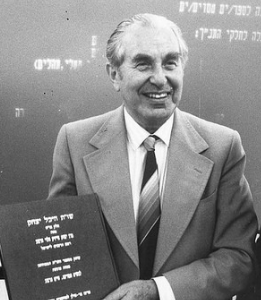
Browsing in a secondhand bookshop I took up the memoirs of Chaim Herzog (1918-1997) , the Irish-born Sixth President of Israel. I’d known that his father had been Ireland’s Chief Rabbi, but not that he often hosted Eamon de Valera in his Dublin home.
His father, Yitzhag HaLevi Herzog, was born in Poland in 1888 and moved with his family to Leeds ten years later.He studied at the Sorbonne in Paris, and later at the University of London. He became a Rabbi, serving in Belfast from 1916 to 1919 whence he transferred to Dublin, where he was appointed Ireland’s first Chief Rabbi in 1921, remaining there till 1936 until appointed the first Chief Rabbi of the mandated Palestine territory.
A world class scholar, he was fluent in Irish and supported Ireland’s first democratically established Parliament, Dail Eireann, from its inception in 1919. Apparently he was nicknamed “the Sinn Fein Rabbi” and he remained a valued friend of De Valera until he died in 1959.
In 1950 De Valera, during his break from Government visited Israel where Herzog was Chief Rabbi of that new State, meeting his old (though younger) friend, together with that state’s leaders. De Valera had met some of them when he presided over the Council of Ministers at the League of Nations, and also when he was President of its General Assembly and was on good term with them. But he never endorsed Zionism, nor it seems, did he discuss it on his 1950 visit.
The Wikipedia entry on Rabbi Herzog says that he crossed the Atlantic during the Second World War (before or after Pearl Harbour) to plead with US President Franklin Roosevelt for help for Europe’s Jews, that he met with FDR, who was unable or unwilling to give any help, and that, between the beginning and the end of the interview, Yitzhag Herzog’s hair turned white.
I cannot vouch for that story but I can tell you that when Britain’s Prime Minister Tony Blair and US President George W Bush, in seeking to justify their attack on Iraq, claimed that when Neville Chamberlain and Franklin Roosevelt committed their countries to war with Germany (in 1939 and 1941) they were motivated by concern for Europe’s Jews, they were either sadly mistaken or lying through their teeth.
Should read ‘Jewish History, Jewish Religion: The Weight of Three Thousand Years’ by Israel Shahak, if you haven’t already Jude. A certain trip to the states in 1948 is mentioned whereby a sum of money is offered to the serving president (Harry Truman) to recognise the state of Israel, which he then does.
I doubt that this was a moniker he gave himself given Sinn Fein’s history of anti-Semitism.
I’ve never been “given” a history of “Sinn Fein’s anti-Semitism” Joe.
Is there a book on it? If so, who wrote it? I have it on good authority that Ireland’s tiny Jewish
community was involved in the national movement in 1920 and 1921 and has served Ireland well in the years since.
I don’t think that there is a book on anti-semitism specifically within Sinn Fein, but a lot of literature that points to anti-semtisim being rife within it.
See for example, Dermot Keogh’s “Jews in Twentieth-century Ireland: Refugees, Anti-semitism and the Holocaust”. Therein lies a description of Arthur Griffith’s role in leading anti-Jewish pogroms in Limerick.
Or maybe you can look to Griffith himself? In an article for the United Irishmen he wrote: “I have in former years often declared that the Three Evil Influences of the century were the Pirate, the Freemason, and the Jew”.
Another good source may be Carter’s, The Shamrock and the Swastika 1977. You will get a long list of Sinn Fein members who subscribed to Hitler’s doctrine. You could start with some basic research regarding Sean Russell and Frank Ryan who collaborated with the SS to land the Nazis in Ireland. Sean Russell is commemorated at his statue in Dublin by the Sinn Fein leadership every year, who seem comfortable with his Nazi sympathies (although they are less comfortable with the state of Israel and regularly hold fora with Hamas an organisation that threatens to drive all Jews into the sea).
I hope that is enough to get you started Donal! While anti-semitism remains a strong undercurrent in contemporary Sinn Fein, we can look to Griffith (the founding father of this proto-fascist organisation) as an open, and chronicled anti-semite and wonder whether the “Sinn Fein Rabbi” chose this title for himself or whether it was foisted upon him by people as ignorant of Sinn Fein’s hatred of the Jews as you are.
I’m on holiday at the moment. When I’m homI’ll devote a BLOG to support my statements and to demolish the allegations of “Joe Bloggs.”
The shameful boycott of Jews in Limerick was not a pogrom. Jews supported Sinn Fein, were selected as Sinn Fein candidates in local elections, served in the IRA, defended IRA men in the courts, and played an honourable part in the National movement.
Frank Ryan never supported Fascism nor did he seek an alliance with Fascists.
Sean Russell sought help from the Nazis but never subscribed to their ideology.
.
I’m at work, so similarly strapped for time, but I’ll come back to refute any of your revisionist points.
In the meantime, see this exert from “History Ireland” magazine. It sounds a bit violent to me, but probably just your average night out in Limerick. Supported all the while by the Sinn Fein founder and open anti-Semite.
“Large numbers from the Arch Confraternity launched an attack on the Jewish sector of the city, pelting the Jews with mud, breaking windows and throwing stones. The police moved in and eleven were arrested and later prosecuted, but it was estimated that at least 200 had behaved violently. At the trial of the eleven, Michael Davitt’s protest was read out, only to be dismissed by the defending solicitor, John Nash, as an unwarranted intervention by an outsider. Nash claimed that the events were exaggerated. But in fact they had only set the ball rolling.
Fr Creagh again rocked the pulpit. He deprecated violence, he said, but if the citizens of Limerick wanted to end Jewish extortion they should boycott Jewish commerce. This cry was echoed in the Limerick Leader and taken up by the Irish Independent. Arthur Griffith, who was shortly to found Sinn Féin, added his voice in favour of a boycott. To the Jews a boycott was almost as pernicious as the violence, as it hit their means of livelihood. Besides, some people were wilfully reneging on their debts and the Jews were unable to collect because of threats and intimidation. The boycott was solidly supported, though some said that they found the Jews’ trading terms reasonable and were only driven into complicity by their neighbours and the authority of Fr Creagh.
After a lull, the violence flared again in March; in April there were 40 attacks on the Jews and the anti-Semitic stridency of the Arch Confraternity continued. The pogrom received wide coverage and on 4 April The Times in London published a letter supporting the anti-Jewish drive”