
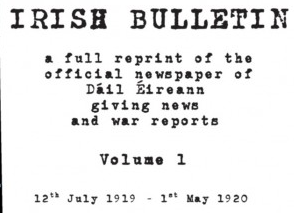
“The Irish Bulletin is a detailed account, issued daily between1919 and 1921, of the means by which the British Government attempted to rule Ireland during the three years after it had comprehensively lost the General Election in Ireland…………
It was published by the elected Irish Government of 1919-21 to inform British public opinion about how the unelected British Government of Ireland………. was trying to govern ..against the will of the Irish democracy.. It ceased to be published…..in December 1921 and has never been reprinted until now. …..there was no need for it during the two generations following the War of Independence.
People knew what had happened. They knew in detail what had happened in their own locality, and they knew much the same thing had happened in other paces. ……..
The situation began to change drastically a little over a generation ago….partly due to the fact that common knowledge grows weaker with the passing of generations. It is chiefly due to a systematic effort on the part of the Universities to throw doubt on the generally-accepted story of the War of independence, and the increasing influence on public opinion of what was taught in the Universities, due to the great expansion of second and third-level education..”
From the Introductions, by Brendan Clifford to Volumes I and III of collected Reprints of The Irish Bulletin covering July 1919- January 1921.
(Volume 1 of the Reprints covering July 1919 to June 1920 was issued in 2012 and Volume III, covering September 1920 to January 1st 1921 in 2015. Volume IV covering January 1921 to March 31st 1921 will follow shortly.)
The Irish Bulletin was spectacularly successful and British Cabinet Ministers were challenged in the House of Commons on the conduct of their agents in Ireland by Members who read the Bulletin. Notable among them Captain William Wedgwood Benn and Lieutenant-Commander Kenworthy, both War heroes. Benn was to become an Air Commodore and Secretary of State for Air. Both he and Kenworthy entered Parliament as Liberals and later switched to Labour. Benn was made Viscount Stansgate and Kenworthy was made Baron Strabolgi. Benn served with Erskine Childers in the Great War.
Ignorance about the Irish Bulletin is almost total in Ireland today, The biography of Hanna Sheehy-Skeffington by Margaret Ward describes it as a broadsheet paper. One Michael Foley in a review of “Periodical and Journalism in Twentieth Ireland” (Irish Times 14 February 2015) gave it short shrift as it “was not available from corner newsagents.”
In fact the paper was mimeographed using a typewriter cutting a stencil which transferred Its message on foolscap sized paper 13 and a half by 8 and a half inch paper. They were posted, a few at a time, from scattered postboxes to avoid detection to trusted politicians and journalists, in Britain and further afield. Those producing the paper risked death at the hands of the Crown Forces and the idea of it being available in newsagents is ridiculous.
Edward Mac Lysaght (1887-1986) recalled in his memoir “Changing Times -Ireland since 1898” published in 1978, how he had kept every copy since its inception, and his mother had borrowed a couple of copies to read on a train from Killaloe to Limerick in February 1921. The train was boarded by Crown Forces, she was searched and the papers found, court-martialled and sentenced to a fine of £20 or a month’s imprisonment. She chose imprisonment, but her husband, who arrived home that day from a business trip to Australia paid the fine for her. I suppose today’s lobotomised academics and journalistic hacks should be told that there were no air services between Australia and Limerick in 1921 and that Australia is a long way away.
Notable in the production of The Irish Bulletin were Lawrence Ginnell, Erskine Childers, Robert Brennan, Frank Gallagher, and Desmond Fitzgerald, and Kathleen McKenna, all of them extremely able people. Brennan who became Irish Minister in Washington was associated in the launch of the Irish Press in 1931 of which Gallagher became long-time Editor. Childers won fame as author of The Riiddle of the Sands.Desmond FitzGerald, who held a number of Ministerial Posts between 1919 and 1932 was a published poet who wrote a short memoir in the 1940s. His son Garrett became Taoiseach.
Brennan’s memoir “Allegiance” is a delight to read. Gallagher wrote “The Four Glorious Years” under the pen-name David Hogan, a classic.
The British captured the presses of The Irish Bulletin once and immediately ran off a fake copy which they sent to its mailing list. But the Bulletin had duplicate equipment and a duplicate list and sent out the genuine paper without a pause. The genius who prepared the fake paper had previously produced a film on Killiney’s Vico Road by Dublin seaside purporting to show the scene of the Kilmichael Ambush inland in County Cork. He was part of the British Propaganda Gang in Dublin Castle.His name was Captain Hugh Bertie Campbell Pollard.
He was a small arms fanatic and a pathologically racist anti-Irish bigot. He was, incidentally a Catholic. In the 1930s he flew General Franco from the Canary Islands, where he had been stationed by the Spanish Government to keep him out of mischief, in a private plane to Morocco, whence the mutinous traitor launched his attack on democracy. Pollard was a member of Britain’s MI6 and was their man in Britain’s Madrid Embassy when the city was abandoned to the Tyrant in 1940.
I expect any day now to read in THE TIMES and its imitators that Pollard, like the NAZIS’ collaborator Frank Foley of MI6, is to have a statue erected in his memory as a humanitarian who saved Jews from fascists.
The reprints are unpaid labours of love by the Aubane Historical Society including Jack Lane,
Philip O’Connor, Geraldine Conway,Jenny O’Connor and Angela Clifford.
The Reprints, like the Originals, never get a mention from paid historians or other paid commentators
but they are essential for an understanding of Ireland these past 100 years.
So, come to think of it, is the Silence of the Hacks.
Comments are closed.