
.
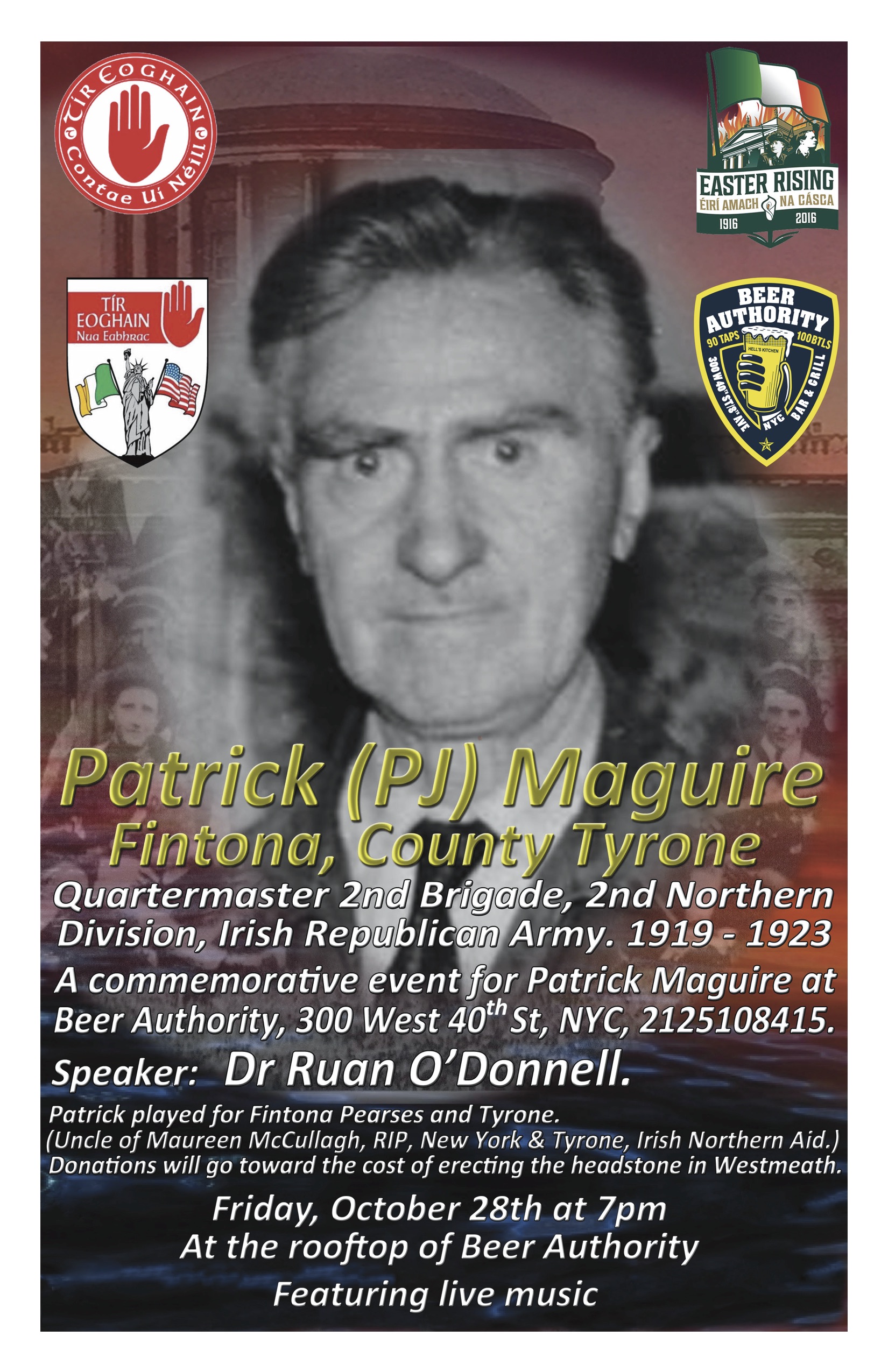
Tyrone Republicans recently rediscovered the final resting place of Patrick Maguire, Quartermaster 2nd Brigade, 2nd Northern Division 1919 -1923 and have chosen to remember the Fintona native with a September Commemoration in Westmeath.
Tyrone people in the US are raising money for Patrick Maguire’s headstone and remembering his niece Maureen McCullagh, originally from Fintona, who was a nurse in New York and a highly regarded Republican. A commemorative event will include a live link with his daughter Ann Bradley and Declan McAleer in Tyrone. Leading historian Dr. Ruan O‘Donnell will give a presentation on Maguire’s involvement in 1916 and an overall account of what happened in Tyrone during that period.
Patrick Maguire was from Sionee House Fintona and was educated in Omagh CBS and then St McCartan’s College Monaghan. He played football with the Fintona Pearses and with Tyrone, he was interned went on hunger strike aboard the Argenta during the troubles of 1921 and ‘24. He also served time as a political prisoner in the Crumlin Road. Patrick’s statement to the Bureau of Military History details raids, blowing up a bridge, road breaking, enforcing the Belfast boycotts, planned risings, IRA counter attacks, pitched battles between his unit and the B Specials, training and how he was driven from Tyrone by the North of Ireland Police to live the remainder of his life in the Free State and be buried in a graveyard in Ballymore, County Westmeath.
Patrick’s statement tells us about a planned rising for County Tyrone devised by IRA Commander and leader of the Monaghan Brigade Owen O’Duffy for the 5th April, 1921.
As a result of orders issued by General Owen O’Duffy a simultaneous series attacks were made in Co. Tyrone in about ten villages, those attacks should have been general but in many places nothing happened. At Dromore Mick Gallagher and four others attacked a B Special Patrol going into Dromore R.I.C. Barracks after being on duty on the roads.
“This attack took place at 2 a.m. I can’t tell exactly how many were in the Patrol as the night was dark. We threw a hand grenade into the party and then opened fire with revolvers.”
The statement also details the swift and vicious reprisal for their actions the following night:
“On the 6th April 1921 the Orangemen in all their lodges in Co. Tyrone mobilised and, concentrated in large numbers on the town of Dromore as a reprisal for the general rising of the previous night.
“The town was completely cut off from the surrounding districts and no person was allowed by the Orangemen to leave their houses. The invaders indulged in terrorising tactics, shooting up the town the whole night”.
“They broke into three houses and took out three men John Devine, Dan Dogherty and Charles Slavin, These three men were taken a half mile outside the town and murdered”.
Patrick’s statement also talks about the skills of the British army being employed to train the IRA in Tyrone and give them proper “Training in Arms”.
“We were fortunate in having an ex-Lieutenant of the British Army, Jack O’Brien, Letteree, Dromore, a member of the Volunteers. This man was invaluable for training purposes. He took classes in farmers lofts and gave the Volunteers a grounding on Drill Musketry training, tactics etc. O’Brien was helped by another man Hugh McGoldrick who was Naval Marine. McGoldrick was very useful for training purposes and was also a good soldier in many of our operations”.
While Patrick’s witness statement opens with an interesting report on a raid on a poteen maker in the hills of Tyrone, it also details a raw and devastating time in Tyrone, filled with families being burned out, police brutality, internment for Patrick and others, and the vicious reprisals carried out by Orangemen targeting the local population. It also details the campaign for the release of prisoners from the floating hell that was the prison ship Argenta anchored in Belfast Lough.
Patrick’s volunteer activity was to lead to his being a marked man for police intimidation, with raid after raid on his home and unionists monitoring his daily life.
The Red Hand and Patrick Maguire
It’s a challenge to get a full picture of anyone, when you can only rely on records. What made them laugh? What made them proud? When did they invest every single fibre of their being into something? What did friendship mean to them or were they sporting and fair?
A glimpse of a record reveals for us, nearly a hundred years later, a place of happiness for Patrick Maguire, a place where he was part of a team, where he would have experienced the exhilaration of wins and the shared despair of loss in a place where it only mattered until the next game.
Patrick Maguire excelled among his peers at football and represented his county on the GAA field. He is listed on the panel that faced neighbours Donegal in the first round of the championship in May 1919. His number was 14, so while we don’t know, we will make the leap that he was their full forward, swift and decisive maybe known for his strategic mind and ability to shake the close man marking of the time. They would have looked very different from our footballers today, photos from the time show men, fit, from the rigours of a physical working life rather than gym, hair neat and tight to the head, maybe he wore a flat cap onto the pitch to shield his eyes against the sun ready for a high ball coming into him from his midfielder. The clothes too did not have the science that dictates the cut and the cloth of the modern game so it would have been wide stripes and long thick socks. Many of the photographs at the time even show the footballers leaning against the goal and sharing a cigarette while the play was at the far end of the field. The records for Tyrone at the time do not describe the elite county squad that now wear the red hand, so there was probably ample time for Patrick to enjoy a cigarette and a catch up with the Donegal full back marking him.
Tyrone may not have been All-Ireland contenders back then but it’s not a stretch, knowing all we know about Patrick, that he must have been a proud man to wear Tyrone colours in 1919 and we know that, then as now, the people of Tyrone would have been out to cheer for the county team.
Patrick married Rose Moran and they had two daughters Anne and Brenda. Patrick and his family suffered further tragedy with the loss of his wife when Anne was only 3 months old. He was a Gaelic Scholar, highly intelligent and could speak several different languages. He was also a successful business man and owned and ran a Soap Factory in Dublin called Greenfield Soap. He also had a grocery shop.
Patrick is remembered by his two daughters Anne in Tyrone and Brenda who lives in Australia. He is also remembered by his four grand-children – Patrick, Teresa, Margaret and Deirdre and 5 great-grandchildren; Rachel, Oisín, Áine, PJ and Holly.
Tyrone Republicans have chosen to recognize Patrick and his work by supporting his daughter’s wish to have a gravestone erected at her father’s unmarked grave in Ballymore, Westmeath.
Comments are closed.