
(Letter first published December 4 2010 in The News Line (London), a small left-wing paper.)
Sir,
Behind screens of Poppies and barrages of Poppycock the reality of wars and their fruits have been forgotten.
Consider a few short weeks in London in 1920. In December 1920 the Government of Ireland Act, partitioning Ireland, got the Royal Assent.But it had not the assent of a single Irish MP when the Bill had its Third Reading in the Commons on the 11 November 1920. Three quarters of the MPs for Irish constituencies elected in December 1920 did not attend Westminster. The six Nationalists and the twenty-six Unionists who did attend did not support the Bill.
Two ceremonies of great pomp were held in Westminster that same 11th November 1920. An Unknown Warrior was interred at Westminster Abbey, and the Cenotaph, or Empty Grave, was unveiled in Whitehall. The Unknown Warrior may well have been Irish, and turning in his grave at what was being done to his country by those he’d served and trusted.
Is it too fanciful to suggest that the Cenotaph was not in fact empty, but was the place of burial for promises of freedom of small nations, democracy and national self-determination, which had led gullible young men to early graves?
Yours faithfully
Donal Kennedy
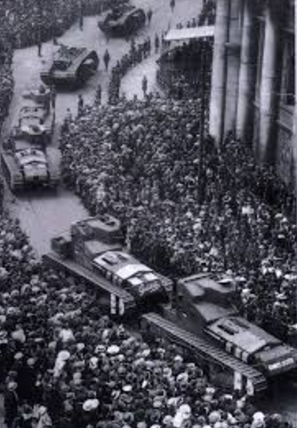
P.S. A year earlier, the British Army paraded massed tanks through central Dublin on the 11th November, two months after the British Government had deemed Dail Eireann an illegal assembly. I believe this was the first occasion tanks were deployed in a capital city to crush democracy and shock and awe the citizens.
D.K.
Comments are closed.