
The PULSE has been in the news of late on Liffeyside.
For those who live north of the Black Sow’s Dyke the PULSE is an acronym for:
-Police Using Leading System ,erm, Effectively.
Which is the computer system used by An Garda SÍochána. (AGS). The use of the verb ‘Effectively’ is enough to take the breath away, even unto the point of testing the most long-holding of lungs. Seems like a Million blow-into-the-face- bag tests were recorded which , in effect, never took place.
Many voices (concerned) of rebellion are yelling with decibels on high for a civilian Commissioner.
Curious too how the PULSE has been a recurring motif whenever the red, red robin of raic, rí-rá agus rúille-búille / trouble comes bob-bob-bobbing along to the Bobbies of Baile Átha Cliath.
On November 4, 1961 f’ristance, the Macushla Revolt from within the lower ranks of An Garda Síochána (AGS ) occurred. It claimed its name from the protest meetings held in the Macushla Ballroom, hard by Amiens Street Railway Station in Dublin. Oddly enough, the then Commissioner of AGS was one Daniel Costigan, a (gulp) civilian.
Pat ‘Headlights’ Rabbite has put his off-shore oar into the current dispute from his lofty positon in the Sunday Business Warren, oops Post . Would not surprise one, one bit, to read he is calling for a change of Commissioner too, the replacement one to be ‘from outside the Jurisdiction’.
This is an Irish (sic) Labour Party thingy, dating back to the time of Headlights’ favourite Fuhrer, Conor Cruise O Brain-sturm-und-drang.
Macushla, of course, is a transliteraton of ‘Mo chuisle’ which is Leprechaun for ‘My pulse’ which is a synonym for ‘heartbeat’, ‘honey’, ‘sweetheart’, ‘significant other’, ‘luvvydovey’, ‘gentleman caller’ and even, erm, ‘inamorata’ itself.
The Machushla Ballroom was named for/ after the plaintiff, oops, plaintive ballad popularisised by John McCormack the Count from County Westmeath who counted for a lot in Luciano Pavarotti’s pantheon of favourite tenors.
It was perhaps only natural that a ballroom in Baile Átha Cliath should be named thus in a romantic city which already houseS the (gulp) heart of St. Valentine himself.
Two Hollywood actresses with strangely similar strange surnames were not entirely unaquainted with the M-word:
In the 1945 movie ‘Christmas in Connecticut’, starring Barbara Stanwyck, the cow was called (gulp) Machusla.
In the 2004 fillum ‘Million Dollar Baby’ trainer Frankie (Clint Eastwood) has ‘Mo Chuisle’ embroidered on the silks of boxer Maggie Fitzgerald (Hilary Swank) for her first overseas fight and it is subsequently chanted by the various crowds in the film numerous times.
Given the Gardai’ overestimation of the drink driving test by more (somewhat) than a hair’s breath, the m-number, a Million seems to be a recurring numeral here where the m-word is concerned, Macushla.
We have indeed much to thank the Mizzes Swank and Stanwyk for their promotion of the Cúpla Focal, not to mention Clint Eastwood. Can the same be said of (gasp) another C. Eastwood?
This is all by way of a commodius vicus of recirculation / a Bobby on the beat way to the topic of classical music in general and Lyric fm, in particular, the wireless channel through which RTE opts to disseminate classical music to the licence paying masses.
‘The Pulse of an Irishman’ is perhaps the most famous of Irish melodies which the noted German composer, Ludwig Von Beethoven arranged. In the early 1800s he was commissioned by George Thomson, the Scottish folk song collector to arrange around a dozen Irish folk tunes.
(This Thomsonian attraction to artistic giants seems to have been inhertied by his grandaughter who married Charles Dickens).
‘The Pulse of an Irishman ever beats quicker
When war is the story and love is the theme
And place him where bullets fly thicker and thicker
You’ll find him all cowardice scorning
…and how they will jig it and tug at the spigot
On Patrick’s Day in the morning !’.
Beethoven’s arrangment for piano and flute is delightfully impish in the way it finger-pounds heavily on the keyboards where war is the topic but, after the briefest of melodramatic pauses, alternates to a lightfingerd ripple on the ivories once the mood alters to love, the absence of worry and never having to say sorry.
The first point being, that Ludwig Von B. quickly twigged the sophistication in the oringal melodies and reacted accordingly, even if with no accordeon. (Natrually, Lud though undeoubedly good, still needed to eat and so would have insisted there be more than a few token notes of the folding variety in the arrangement to arrange the folk notes)
The second point being, that the exact place where the folk muic morphed to become a classical melody is so insignificant it is a futile waste of chronological space to seek it out, music being music being music).
There is a recognised tradition of great classical composers being commissioned to arrange folk airs (see below).
The third point being, the first language of some of Ireland’s greatest contributors to classical music – bookended indeed from Toirdealbhach O Cearallain (aka Turlough O Carolan) to Sean O Riada was Leprechaun ; so who then was the cloth-eared committee of cawbogues in RTE who put the Prom into Promulgate that classical music should be transmitted only through the medium of mandatory English over the Irish airwaves?
Ó Cearalláin was born in Nobber, County Mea th in 1670. As it happens nobber is a contemporary Corkonian term of disparagement for a drisheen-addicted bowsie. It is not without the bounds of possibility therefore that there might even be a Corkonian or more on said committee.
Bleing Sir Arthur Blissfully unaware that Nobber, County Meath is a corruption of Obair (Work) and that Ó Cearalláin’s life was a job of musical journeywork , not to harp too long upon it.
Nowhere on the current schedule can one find a solitary programme on Lyric fm that is presented in the Leprechaun. Which is not to say we don’t have a delightful Leprechaun from Laganside who loves to ham things up behind the microphone:
For the star player on the Lyric fm schedule is indubiatblly the DJ who saddles the programme known as:
-The Hamilton Scores.
The hint is the title: for the DJ made is name as a soccer,oops, footie commentator whose most memorable quote will surely be incribed on his tombstone (gur fada uainn an droch-lá dobhrónach sin!):
-The nation holds its breakfast.
That this DJ should be chosen to penalise the populace was as predictive as text:
-El Classico and Clissical Music goe togehter like D and J, like G and H..
This old boy of Methodist College on the Malone Road (it rhymes with Pogmahone) is not only multilingual (German Queen’s English, German and French) is not only a footie fan but is deeply musical, having being a swell player of the cello in the school orchestra as well as becoming a virtual virtuoso in the art of blowing the trumpet (quite possibly his own).
-George ‘Hearty’ Hamilton.
His middle sobriquet is right: there is a real Bobby Vee vibe about George: a reall bouncy, bouncy feel to his on-air peronsality once the studio red light begins to glow.
Little wonder his programmes go out on the weekend mornings over RTE; it is as if it is a statement along the lines of:
-I A.M., who am.
This disc jockey saddles up twice a weekend , in the prime time slot of 10 to 1, Saturday and Sunday.
Six hours of Hammo Ammo: Four full games of Hamilton Scores !
Some begrudring clousawnees (who are always with us) claim that this appointment was facilitated by its combining his criss-crossing of the Continet as a footie commentator: thus adding cruciate injury to insult. But, sans doute, The Perkin is not to be found among them. For he finds ‘Hearty’ Hamilton a treasure trove of cross bred info betwen El Classico and Classical music.
Truly was their, erm, Methody in the (alleged) Madness of the Mandarins of Lyric fm.
-Last night I was the wonderful stadium of San Siro in Milano where I had the absolute (GHH tends to shoot in absolutes) privelege of witnessing a real star in the making, one, Gaetano Donizetti, a fluent inside forward with a mazy dribble and an absolutely potent kick off either foot.
His game breaker of a score on the coda of full time brought lusty cheers to the throats of the Atalanta Bergamo supporters while leaving the downhearted fans of Inter Milan to shed a shed load of:
-Una Furtiva Lagrima.
One week finds the pathetic, oops, peripathetic Georgie HH in Italia whie the very next might well see him broadcasting his programme from further north.
-Last night I was in the wonderul Uliveval Stado in Oslo. Now, Norway are normally known as the Oslo, oops, my mistake, meant to say, of course, Also Rans of European Footie but I had the absolute privilege of witnessing what I can only descirbe as the absoute Overlook of the footie century.
I am talking here of the hero of heroes of Norwegian footie, their creative genius at midfield:
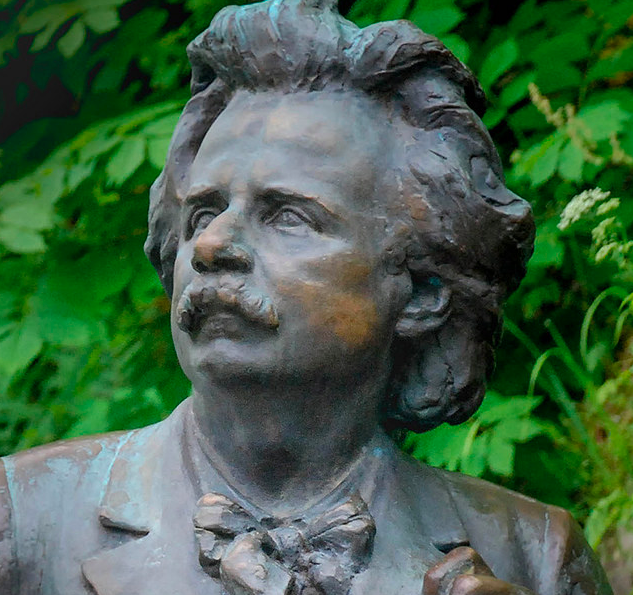
-Edvard Grieg. Make a note of it, folks: Edvard Grieg, you’re gonna be hearing a heap lot more of that name in the knock-out stages of the World Cup. I’m absolutely sure of that.
It was his superb generalship of the vital area between the 2 D’s which so demoralised the visitng Scots that the Norwegians won in a canter, to the tune of 5-1 in the end. The Scots only managing a consolation goal on protest in the opening minute.
And here’s the kicker, folks, the ABSOLUTE kicker. If the Scots had been wearing their wide-awake hats the way we, erm, Irish do Edvard Grieg could just as easily have been togging out for the Jocks. Under the old Great-Great-Grandfather Rule.
The family name, originally spelled Greig, has Scottish origins. No joking, folks, this is the absolute truth. After the Ballte of Culloden 1746, Grieg’s great-granfather, Alexander Greig (e before i) travelled widely, settling in Norway about 1770, and establishing business instests in Bergen (where he put the i before the e to cover his multi-tracks).
I know, I know, folks there will be trolls out there somewhere in Radioland disputing these facts with their own version of alternative facts. But these trolls, needless to say, are not in any way to be found among my absolute favourite folks in the whole wide wireless wordl : my faitful listenes to Lyric fm.
With effortless ease Edvard Grieg had the entire team of Norwegian would-be semi professionals humming off the same hymn sheet. With the ease and calm of a, e.g., born footie player, EG can create acres of space and fjiords of time by the merest schrerzo of a swirl. Thus, enabling him to put his boot of the leather orb and take a leisurely look around.
-On the ball of the Moutain King.
From the north to the south the next week for George ‘Hearty’ Hamilton:
-And even though I am coming to you this morning from the absolutely wonderful Ferenc Puskas Stadium here in Buda Pest (note the gap in my pronunciation, folks out there in Radio Land) where a game of enormous importance is being played tonight – to see which of the two bottom club teams of the local Fourth Division will avoid the drop –and certain extinction.
This is the annual derby which is known colloquially in Hungary as the Clash of the Cash-Starved Clubs.
Bela Bartok, the celebrated Hunagairan composer, as it happens, was a fan of footie and also, of the folk music of his native land. Indded, as a natural born ethnomusicalogist he spent many years collecting and arranging the f.m. of his n.land (see above).
Not only was he a fan of footie but he was also no mean practitioner on the pitch of play as he was pitch perfect off the field of play. A legendary penalty taker he did not earn the sobriquet Bela ‘Under the Bar’ Bartok for nothing.
Indeed, it is generally accepted he would have made the Magic Magyars who defeated England 6-3 at Wembley in 1953, if the exquisite timing of ‘Old Four Beats to the Bartok’ had not been off for once in his life: as instanced by his untimley death in 1945.
Contrary to a common misconception this was not the first time England were defeated at home. For in 1949 the ROI beat ‘The Oul Enemy’ at Goodison Park on a scoreline of 2-0. (Note GHH’s effortlenss fluency in the lingo of Loyal Liffeyside – ‘The Oul Enemy’).
There was, of course, an association beteen music and that game of association football in that Peter Corr, an uncle of the Corrs, was on the Irish team. A man, it is said who put the pass into El Paso. It is an absolute joy for me to receal that this is a tradition which is continued to this very day: witness Calum O Dowda the grandson of the great Brenan O Dowda, the noted tenor, and native of Dundalk, as well.
I can tell you through the absolute miracle of modern broadcasting that, although I am speaking to you this morning from the banks of the Blue Danube, I can also tell you that the skies today are delightfully grey over the the morning over green waters of the Shannon.
The HQ of Lyric fm is located in (of course) Limerick:
PLANCSTAÍ ANGLO ANGST
Níl spás ar L fm do Nat King Ceol
Ní spéis le Lfm an Leiprechán a ól
Tá an stáisiún Luimníoch
Go millteanach imníoch
Roimh Ella agus eile, mar is eol.
LYRIC’S LINGUISTIC VIC
The acid test of music all the way from Maced-
Onia to Ol’ Malonia is ordered by borders vapid
Thus the victory of Lyirc
Is in every way, Pyrrhic
Music rapidly 2-fingers frontiers, hard or flaccid.
Comments are closed.