
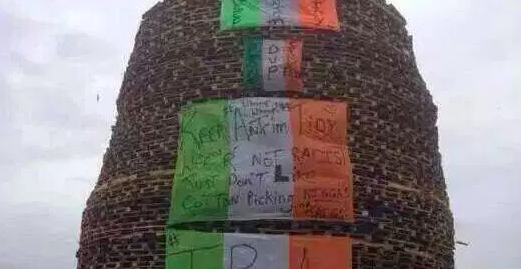
The recent deal between the Tories and the DUP is a stark reminder of the actions of right-wing Tories and Unionists in the early years of the 20thcentury which greatly heightened tensions within Ireland and led to the partitioning of the country with its dreadful consequences. The Conservative and Unionist leaders, including some rabble rousing evangelical preachers, conned a great number into believing that Home rule, promised to the Irish, was a real threat to their power and culture. They were led to believe that their enemies were their Catholic neighbours. They were not to be trusted. The truth was and still is that their Catholic neighbours are their best friends.
One lesson we learn from our history is that those in the British-Unionist establishment who founded this statelet were determined to keep their hold on this part of north-east Ireland, at all costs. The determination by the British increased animosity and bigotry in the Orange-Unionist community. Those who objected to the new political arrangement were severely punished by the state police and when necessary by the British army and their local auxiliary forces. Unionist rule under the British parliament had to be maintained at all costs. Gerrymandering of elections, job discrimination, forced emigration were some ways used by the unionists to maintain control. That one party, the Unionist party, with the support of the British political parties, governed in a most unjust way for more than 50 years. That period of repression and undemocratic rule ended in great sorrow and suffering, mainly for the poor and working class. After that experience of repression, one party unionist rule will never again be tolerated in the northeast of Ireland. That was what the Belfast Agreement in 1998 determined. There will never ever be a return to one party Unionist rule in this contrived statelet that was cut off from the rest of Ireland by a decision of the British ruling class. That decision in 1920 left the Catholic community in the northeast entirely vulnerable at the mercy of the state where they were treated as second class citizens.
With the violent reaction of the right wing Unionists in 1968-69, to the Civil Rights campaign, the British-Unionist alliance introduced ‘Kitson’s military Solution’. The idea was to destroy the civil rights movement, destroy the homes of many Catholics and force large sections of the Catholic population to move to the south. The Catholic population had grown and this was seen as a threat to the Unionist/Orange ascendancy. The ‘Kitson solution’ in the six counties was to eliminate ‘the enemy’ or, at least, reduce their political power and weaken their resolve. The British government and their unionist allies encouraged loyalist mobs as well as their police (RUC) and their heavily armed British regiments to implement this policy of destroying ‘the enemy’. We saw an example of the ‘Military Solution’ with the burning of Bombay Street on 15 August 1969, with the killing by British soldiers of eleven innocent people in Ballymurphy in August 1971 and in the Bogside, Derry on Bloody Sunday in January 1972 with the killing of 13 innocent people by the British Paratroop regiment. We saw it in county Fermanagh with ‘the Pitchfork killings’ of Naan and Murray, by the Argyll regiment of the British army in 1972. There were many other dastardly attacks on Catholics and Catholic premises carried out by the forces of the state and their local allies.
It was after these terrible events, which were intended to instil fear in the Catholic community throughout the six counties, that the IRA was reorganised to defend Catholic communities. There was broad support within vulnerable nationalist communities for the IRA at that time as it was felt in many of the more vulnerable areas that they provided a buffer between the British army, the RUC/B-men and loyalist death gangs. There was broad agreement in those areas about the need for the IRA’s defensive role. They had broad community support within working class Catholic areas. Of course, the British cleverly manipulated the Catholic middle class and the Catholic bishops, by making small concessions in an effort to maintain control. As the war intensified and as it became clearer there was going to be no outright victors, it took shrewd and courageous leaders like the late Martin McGuinness and Gerry Adams to negotiate a settlement that would make it possible for Irish republicans who organised in the Sinn Fein party to pursue a peaceful, political way forward. The Good Friday peace settlement in 1998 was intended to grant parity of esteem and equality to all citizens, provide for a local power sharing Assembly, promote better north -south relations and provided for a border poll.
Many in the Unionist-Tory alliance continue to do everything possible to frustrate the development of a peaceful future on this island and obstruct the full implementation of previous Agreements. Some of them still work out of the Supremacist mindset. They still do not accept the principles of equality and parity of esteem. They still regard Nationalists/Republicans as second class citizens. They mock the Irish language and burn effigies of republicans and religious symbols.
All that will have to change. The majority in the north who want the peace process to continue voted to Remain in the EU. The majority see that as the only way to make political, economic and social progress on this island.
After what we have witnessed this year Protestant Church leaders and Unionist politicians have a special responsibility to oppose and condemn sectarianism in all its ugly forms. Teachers and preachers must oppose the sectarian mind-set and the politics of supremacy which lie behind it. Over many years of brain-washing many in the Protestant/Unionist community have been led to believe that their real enemies are their Catholic neighbours. The Unionist/Protestant people need to realise that their real friends are living here in Ireland not across the Irish Sea in England,Scotland or Wales.
A well written piece Joe. I expect history books in the future will reflect a similar analysis.
I note you picture which accompanies the article is from a bonfire in Antrim and has a tricolour with the words “Just don’t like cotton picking ni**ers”. It is a travesty that in a modern society that this type of naked sectarian racism is tolerated!
Grma a Phontis. I share your disgust with naked sectarianism on display this year.
Joe what did you do to support many of your Fermanagh neighbours who were killed because of their perceived political views by so called Irish freedom fighters gangs between 1970 and 1994-You were preaching a lot of anti British/Unionist views during your time in Irvinestown-What was your view of such violence-Arlene Foster’s school bus being attacked-Eniiskillen 1987 etc-Look into your own soul Joe-Look hard and deep- what do you see?
Did you offer support to the victims-if not why not?
For the record I do not support burning images of people or religious symbols on bonfires and believe if we have to have them they should be subject to regulation-strictly enforced