
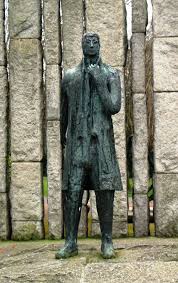
Yesterday 20 June marked the day two-hundred and fifty-seven years ago on which Wolf Tone was born. His father was Robert Tone, a coach-maker and a member of the Church of Ireland; his mother was from a Catholic merchant family. When Theobald Wolfe was born, she became a Protestant. The infant’s godfather was one Theobald Wolfe, and there was a wide-spread belief that the godfather was also the infant’s natural father, hence his full name of Theobald Wolfe Tone.
Tone attended Trinity College in Dublin and became a barrister. At the age of twenty, he eloped with and later married Martha Witherington who was sixteen. At Tone’s suggestion, she changed her name to Matilda. (No, Virginia, I have no idea why). Later, when Tone was in France and Martha/Matilda was in Hamburg, Tone wrote in his journal “She is the delight of my eyes, the joy of my heart, the only object for which I live . I dote upon her to distraction.”
Tone had links with many professions. He was a qualified barrister who at one point thought of becoming an actor. He was a tutor to two young half-brothers of Richard Martin MP of Galway. He fell in love with Martin’s wife but the relationship withered at an early stage – or so Tone said.
He had plans to create a military colony in Hawaii which came to nothing, as did his plans to become a soldier with the East India Company. He lived in Philadelphia at one point, and disliked the Americans intensely, especially George Washington who he considered to be nothing but a “high-flying aristocrat”.
He was, of course, a founding member of the United Irishmen, and his speech from the dock was clear, defiant and heroic:
“To contend against British Tyranny, I have braved the fatigues and terrors of the field of battle; I have sacrificed my comfort, have courted poverty, have left my wife unprotected and my children without a father.”
The day before he was to be hanged, he was found in his cell with an unusual neck-wound. Some believe it was suicide, others that he was tortured and shot in the neck by British soldiers.
He was thirty-five when he died. A short and colourful life that continues to reverberate through Irish history.
Comments are closed.