
This brings me back to Cobh and the story of one particular East Cork towns fight against British rule and how it sent them packing during the southern leg of the independence struggle. The town shortly before had the unionist title of Queenstown, but had that name abolished on July 2nd 1920 by the republican dominated Urban District Council. The royal title came about 71 years before when Queen Vic paid a visit to the port along with her husband Albert and their children. It was then that some local unionists and military types took it upon themselves to request permission from the monarch to rename the town in her honour. Up to that point, the town had been called Cove, pronounced the same way as it is today.
It goes without saying, that the ordinary lower-class citizens, many of whom didn’t speak English, had no say in the decision to invite the British monarch, or to change their towns name. It was also a time when an Gorta Mor – the famine, was ongoing and from through Cobh, hundreds of thousands were departing to the new world on coffin ships. These were the daily scenes which the people of this harbour town had to endure and witness, as they also had no choice but to look on each day as many of their retched fellow country men and women were dragged off to the dungeons on Spike Island, one mile out from the town, convicted for the crime of hunger and trying to feed themselves, before being shipped off to Van Demons land. Hundreds of years earlier, the same Spike Island was used by Cromwell to imprison Irish indentured servant/slaves before their journeys to the West indies.
On the upside, while Spike was used as an internment camp during the first leg of the war of independence, republicans launched two successful spectacular escapes from the Island in 1920 and 1921, with the Cobh A-Company 4th Battalion volunteers spearheading the first, and assisting in the second. After the Truce from July 11th 1921 onwards, Tom Barry was appointed by the republican movement to negotiate with the military authorities on Spike on behalf of the internees there, who were suffering severe mistreatment, hunger and physical abuse. One prisoner from Limerick was shot dead by a sentry after going to retrieve a sliotar during a game of hurling in the compound and when he got too close to the boundary fence was shot. Tom Barry was refused permission to visit the island and prisoners in person. The British, obviously working to a strategy whereby they wanted to use the prisoners as a negotiating chip during the pending Treaty talks. A hunger strike on the island soon followed, as did a second breakout.
Cobh was one of the most unique towns in all of Ireland to have a resistance movement operating under the noses of the British. Between the various military forts and barracks which dotted the whole sprawling landscape around Cork harbour, including Cobh itself, the British navy’s main battlefleet covering the ‘western approaches’ was also stationed in the harbour at Haulbowline, with its headquarters based in Cobh at Admiralty buildings. The main employer in Cobh was itself the British navy and that also extended to the sons of sailors who were employed as apprentices at the naval dockyard on Haulbowline Island. What was of interest here was that many of those apprentices were active Irish Volunteers, including its local leadership. Some of the older sailors who were Gaelic Leaguers agreed to secretly assist the young volunteers in instruction and training.
At Easter 1916, the Cobh Volunteers marched out to meet up with their Cork City comrades 15 miles away for what they believed would be a national rebellion, but as we know that never happened. Little did those Cobh volunteers know it, but the German ship ‘Aud’ with its cargo of weapons planned to feed the Rising had been scuttled the day before and was lying at the bottom 8 miles outside the harbour from Cobh. Within a week, the two leaders of the Cobh company would be arrested at their work place at Haulbowline and shipped off to internment at Frangoch in Wales. At the same time, frantic efforts were underway at the same Haulbowline dockyard on the construction of a special armored plated train/tank engine which was hoped would be used to smash through all the republican barricades and strongholds in Dublin, but this mobile super weapon was not completed by the time Pearce later surrendered his forces to the British. Simultaneously, a ship full of guarded republican prisoners from Galway was tying up at the pier on Haulbowline as the two local company leaders were being escorted away.
On the 2nd January 1920, the Cobh company led a large unit of East Cork volunteers on what would become the capture of the first RIC barracks in Ireland during the first leg of the war of Independence. It was as some said, their making up for missing out on the 1916 rising. Ironically, it would take British relieving forces nearly 24 hours before reaching the Carrigtwohill Barracks, after all the phonelines and modes of communication had been removed, and it would be none other than a force of the Cameron Highlanders who would arrive from the nearest military post, which happened to be Belmont Camp in Cobh, and by then all the arms and ammunition captured in the raid were well out of sight and gone. In the days which followed, a number of republican suspects in Cobh were paraded in front of an identity unit of police officers from Carrigtwohill, at the Cobh Barrack at Westview, but not a single RIC man was prepared to identify anyone.
The local republican volunteers availed of this time by purchasing weapons from the Americans and stealing them from British officers, who were careless leaving captured German souvenir weapons lying about in their quarters on Haulbowline.
Two years earlier as WW1 raged on, there were two battle fleets in situ in Cork Harbour, belonging to the British and American navies, both playing their parts in trying to defeat the busy German U-Boat war a few miles outside the harbour. The Americans had a favourable relationship with the local population and were responsible for adding some welcome infrastructure to the town in terms of roads, piers, jetties and buildings. One such building was a military hospital built on the west side of the town at an area called White Point. This building, known locally as the White House, is infamous for having the first two known casualties of the Spanish Flu epidemic in Europe (the flu having nothing to do with Spain) when two American sailors, having brought it with them succumbed to the deadly virus. One of the more famous casualties of the German torpedo war was the Lusitania Liner which sank off the Cork coast in May 1915. Most of the 1,198 victims were later buried in mass graves in Cobh. The famous Titanic Liner also had an association with Cobh as its last port of call, where it dropped off and took on passengers before meeting its cold fate in the icy waters of Atlantic in 1912.
Cork harbour, the second largest natural harbour in the world after Sydney in Australia, was well chosen by the crown and had offered centuries of service to the British Navy and Military, including acting as a major staging post for feeding both cannon fodder and supplies for all of its colonial wars and campaign adventures, including its fight back against the American revolution, the colonization of Africa, Asia, the Napoleonic wars, Crimea war, Boer wars, the list went on. While all of this is part of Cobh’s rich and diverse history, it is not the whole story for visitors to looking to learn about its past.
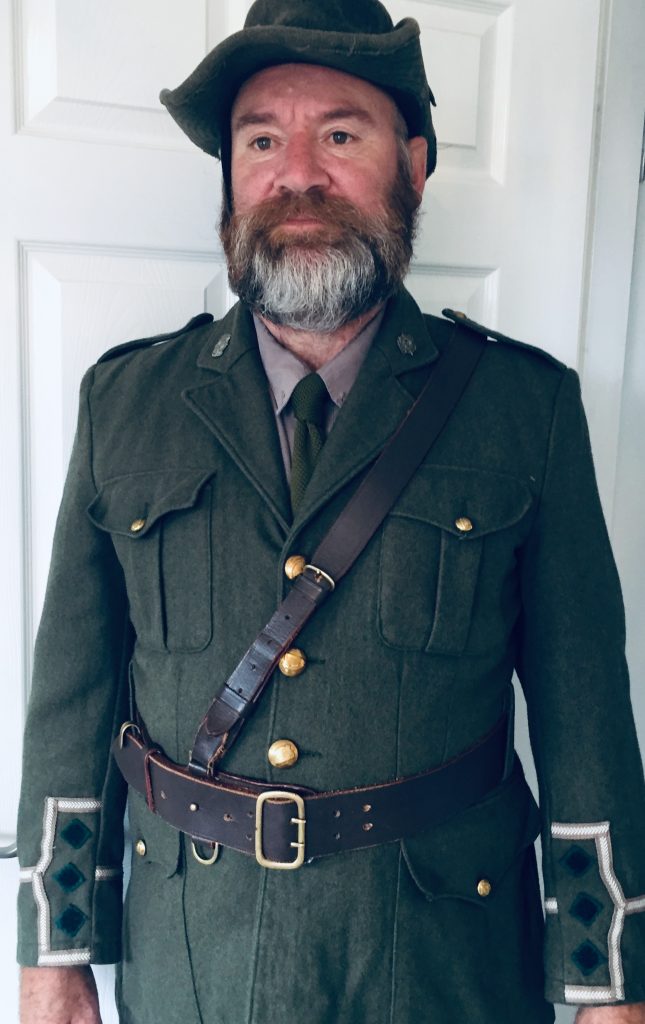
In 2017, I began to offer visitors, from the many hundreds of thousands who visit the town on cruise ships each summer, another side to the story of Cobh, through a new walking tour called ‘Cobh Rebel Walking Tours’. The tour involves a two hour walk around the town perimeter, where it visits 16 sites directly related to the war of independence and civil war. Some of what visitors will see and learn on the tour includes as follows:
- The anchor of the ‘Aud’ 1916 arms ship and its failed story
- The attempted assassination of the Viceroy Lord French outside of Admiralty Buildings
- The shooting of RIC District Inspector Mordaunt
- The building where James Connolly took refuge, after he was attacked by a mob and ran out of town in 1911
- The guesthouse where a teenage Padraig Pearce used to stay, when visiting his English father while he worked on the construction of Saint Colman’s Cathedral in the town
- The house with the secret tunnel used by republican fugitives leaving and entering Ireland from the US, including de Valera on his return in January 1920
- The snatch of twelve rifles from a party of Cameron Highlanders at the quarry area of the town in august 1920
- The house owned by a surgeon of Napoleon’
- The 1916 Garden of Remembrance – where once stood Westview RIC Barracks before republicans destroyed it at the outset of the civil war
- The old Admiralty House and grounds – today a priory and home to an order of nuns
- The sites of local republican safe houses, training halls and places of business
- The home of the Town Chairman which the Black and Tans tried to destroy during an attempted assignation in August 1920
And much more.
So, if any of the above interests you and you would like to learn more about the story of one the souths leading rebel companies, which largely operated from within the Lion’s Den during the southern leg of the war of independence, then Cobh is where you should definitely visit this year.
Last summer, I had many visitors from the northern counties, by people wishing to staycation in Ireland, and I can assure you they weren’t disappointed after visiting Cobh. If you would like to first learn more about my tour, you should log onto www.cobhrebelwalkingtours.ie to book a tour.
Alternatively, book or enquire by phone on 0894832126, or by email cobhrebelwalkingtours@gmail.com
I look forward to hearing from you. Your Tour Guide, Kieran McCarthy
Comments are closed.