
Viriliter Age
Memories of my Confirmation inevitably brought on memories of my First Holy Communion. That took place in 1956, as Philip Larkin might say, between the belly Flop of the Queen Mother’s horse, Devon Loch, in the Grand National and Ronnie Delaney’s winning of the Gold Medal in Melbourne. We knew about Devon Loch because when it inexplicably jumped in the air and then crashed to the ground while leading the field by several lengths in the final straight, it was overtaken by ESB and that was a name we knew well. Every day we would listen to the list of declared runners that was read out on Radio Eireann at the end of the lunchtime broadcast. It provided huge entertainment, and horses like ESB and Mr. What became as familiar to us as family friends. Some of the horses had very rude or very silly names and it was always great fun to hear them being read out in the posh accents of radio announcers. I was in the St. Louis School in Rathmines, in High Babies. We had High Babies and Low Babies. In the tough boys’ school in Richmond Hill nearby they had Junior and Senior Infants. That was much better for five-to-seven-year-old boys. They were the infantry. We were babies. How could anyone have imagined that a seven year old boy would not have suffered irreparable damage to his self-esteem by being classed as a High Baby? Already I had suffered the indignity of being spotted in my mother’s company by a woman who had asked “and is this the baby?” to which my mother had answered “Yes, this is the baby”. I was astounded and furious and rounded on my mother. “Why did you say I was a baby?” “Ah, it’s just a phrase”, she said, “It means you’re the youngest in the family”. “I’m not a baby”, I insisted. But I was. I was a High Baby, and like all the High Babies, held in contempt by the Senior Infants of Richmond Hill who would have surpassed Herod in relation to babies had they been given the chance.
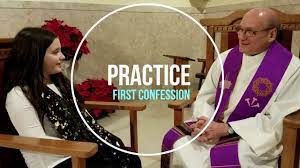
We made our Communion in the Church of Our Lady of Refuge in Rathmines, a vast basilica with a green copper dome that could be seen from all over Dublin. We had been well-rehearsed for months. Communion was the easy part, although you had to learn to fast overnight before it. Confession was a different matter. We had to confess our sins. We were taught the difference between venial and mortal sins. The nun asked me if I would commit a mortal sin (she didn’t actually invite me to commit one, she merely posed a hypothetical question). I answered in all honesty “No, Sister, I won’t commit mortal sins until I am a big man”. The nun thought this was hilarious and I was made to repeat this as many times as there were nuns in the school, all of whom thought it was hilarious. Meanwhile my frankness had forewarned a merciful God who, in His Wisdom, saw to it that I never became a particularly big man. While bigger men partied, I confined myself to venial sins. Back in High Babies it was difficult to come up with a convincing list of sins to confess. The Senior Infants over on the Hill were probably way ahead of us on this. The nuns provided us with sample lists of sins that might fit the bill. They were all venial and served me in Confession for many years to come. Life might have been very different had they thought to supply us with sample lists of mortal sins. The celebrated artist priest, Fr. Jack Hanlon, a very cantankerous man who was once our curate in Churchtown, and later served in Wicklow, once startled his assembled penitents in Wicklow by roaring out in the confessional “You did WHAT?” It cleared the pews outside his confession box of all but the few who were hung around to see who would emerge, and ensured that he could devote the rest of his Saturday to painting. Our list of approved venial sins to which anyone could safely confess spared us all from that. When we held our practice confessions in the classroom, however, with the nun as our confessor, one boy confessed very audibly to having bitten his sister. We had been warned by the nun not to listen in on other children’s confessions and now we worried that we had committed a worse sin than he had. His was a sin that, had I committed it, would have had serious repercussions. My sister was five years older than me and would have laid me out flat had I attempted to bite her. This boy’s sister was obviously a more equal match for a High Baby, but nevertheless, his confession echoed around the classroom to the amazement of all. Henceforth the female High Babies accorded him a degree of respect not accorded to the rest of us. Had the echo carried that far, he would probably have been invited to join the Senior Infants of Richmond Hill.
We were all kitted out for our Communion. The girls acquired white dresses and veils (my brother-in-law, who was raised as a Protestant in South County Dublin, once saw a girl in her Communion dress and asked “Why is that lady dressed in a curtain?” We all had new clothes bought for us. I was brought to the Blackrock Tailoring Company in Chatham Street where I was measured for a white suit. This went on for weeks. Being measured by obsequious assistants left me feeling like Al Capone, or perhaps like Baby-faced Nelson. Instead of a fedora, the white suit was complemented by white sandals and a dickie bow. Anyone who saw me would have known that they were looking at a High Baby incapable of mortal sinning or indeed much else.
Other boys were dressed more conventionally, all except one other who was also dressed in white, but he was wearing a white short-sleeved jumper and white slacks and looked like he had just stepped off the cricket pitch. He looked like Fred Trueman. The girls were dressed in curtains and looked like they had stepped out of a performance of Swan Lake. Being dressed in white should have been the perfect camouflage to allow me pass unnoticed through enemy lines, the kind of tactic employed so successfully by the Finns against the Russians in the Winter of 1939. In this instance however, it had the opposite effect. The group photograph was posed in a way that differed from the normal seating arrangements for our class. These insured that boys were seated on one side and girls seated on the other. Now, the photographer decided that this arrangement did not reflect the perfect harmony that should reign on an occasion like this. Instead, what had been outlawed by the Papal Encyclical Divini Illius Magistri, The Christian Education of Youth, was made horridly visible – i.e. the promiscuous herding together of the sexes. Even so, convention should have dictated that the photograph would convey an image of order – boy girl, boy, girl, boy girl, dark attire, light attire, dark attire, light attire etc. Instead, our Communion photo shows the photographer’s best intentions to have been frustrated. As your eye travels along the lines you see boy, girl, boy, girl, Angel Gabriel, or boy, girl, boy, girl, Fred Trueman. And there we all are, frozen in time, fifty-six of us, one hundred and twelve little hands pressed together in supplication, and fifty-six little toothless mouths grinning into the camera. Who was it who decided that children should make their First Holy Communion precisely at the moment when their teeth were falling out? Perhaps it was meant to convey the message that the Lord giveth and the Lord taketh away. Had they waited just a few months, we would all have had full Colgate smiles. In those days of the Communion host being placed directly on young tongues unused to receiving, it probably had the fortunate outcome of fewer priest losing their fingers or catching rabies, and perhaps this was what lay behind it. We had been told by the nuns how fortunate we were to be making our First Holy Communion at the age of seven. It seems that a previous Pope (Pius X?) had made the decision to reduce the age for First Communion to seven. No-one had mentioned that this was in response to the entreaties of the digitally-diminished members of his flock. Of course we soon grew a second set of teeth and learned to use them in a non-provocative manner, all except for one of us. For most, the second set would last no longer than the first. Orthodontics were unknown to us. Your second set of teeth mostly came as fangs which grew out at odd angles, usually well-spaced. Most couldn’t wait to get rid of them and have them replaced with perfect sets of dentures, the kind that could be seen on the front pages of newspapers in ads for patent compounds that would hold them in place. A step in this direction might be realised by taking a wrong turn onto Richmond Hill, otherwise you waited for nature to take its course aided by a large quantities of sugary substances. The was helped along by the practices of the Dental Hospital in Cornmarket. They should probably have emblazoned their entrance with the motto “Abandon teeth all ye who enter here”. No one bothered with such effete practices as drilling and filling. That was just a futile attempt to postpone the inevitable. It was best to yank the teeth out and have done with it. But all that was in the future.
Toothless though we now were, once the photographs were taken we were all treated to breakfast. As a change to the bread and sugar and hot milk that most of us had for breakfast in those days, we were treated to a breakfast comprising scrambled egg and segments of orange. We had been fasting since the previous night and the less robust of us were probably beginning to pass out. The breakfast must have been designed to bring about a rapid rise in blood-sugar levels. It must also have presented challenges to the pristine appearance of the curtain-clad ladies, Fred Trueman and myself, but as far as I remember there was no sullying of the white suit. Perhaps I had been warned to prolong my fast until I had been paraded in front of the relatives. After that there would no longer be any use for a white suit.
In the remaining years of childhood that were to follow there would be no occasion to warrant the wearing of a white suit. We were realists. We knew that this would be the case. In a little over a year, I transferred from the St. Louis Nuns in Rathmines to the Christian Brothers in Synge Street. White suits were not an option, but otherwise we could, within limits, dress as circumstances allowed. There was a school blazer, but its wearing was not compulsory. The blazer was purple, with a crest that read “Viriliter Age” or “Act Manfully”. We didn’t have an idea what this meant. For all we knew it might have stood for “Kiss me, I’m Irish” or “Stop me and buy one”. You could buy the crest separately from the blazer, and so this was what was done in my case. The white suit jacket was pressed into service as a blazer and was dyed purple, as indeed I was whenever it rained.
Comments are closed.