
Inbox
Dear Jude,
My take on the glory days of Fianna Fail and Archbishop McQuaid is different to Donal’s. Dev, the Chief, and Mischief McEntee, and Lemass. My dad had to end all his Civil Service letters with “Mise, le meas” as instructed (“I am instructed by the Minister”). I though it was “Mise Lemass” and that it was a formal salutation like “Heil Hitler” that had to be used because Lemass had been my dad’s Minister in Industry and Commerce”. Best of all was Mr. Haughey because as children we heard the name as Haw Hee and it sounded like Hee Haw, and that reminded us of Mario Lanza singing “The Donkey Serenade”
There’s a song in the air
But the fair senorita doesn’t seem to care
For the song in the air.
Oh, I’ll sing to the mule
If you’re sure she won’t think that I am just a fool
Serenading a mule…
She’d love to sing it too if only she knew the way.
But try as she may, in her voice there’s a flaw
And all that the lady can say
Is hee-haw
Or Haw Hee, perhaps, if she were that way inclined?
My memories of McQuaid are also slightly different to Donal’s. We lived in terror of McQuaid when we were preparing for our Confirmation. We prayed that we would have his auxiliary, Bishop Dunne, Bishop of Nara – it sounds a little like the Vicar of Wakefield or the Sheriff of Fractured Jaw, and I suppose that a fractured jaw was what we were hoping to avoid. McQuaid had a reputation for refusing to confirm children who could not answer their catechism correctly. This was probably just a rumour, but it was real enough to scare us shitless, helped by the fact that the Christian Brother who was teaching us our catechism was already beating the shit out of us because he was scared shitless that one of his pupils would disgrace him in front of the Archbishop. A knowing of the catechism was meant to equip you should you encounter one of those pesky Russian communists armed with a gun who would put your faith to the test. We could steel ourselves to say “Eye hath nor seen, nor ear heard, nor hath it entered into the heart of man, what God hath prepared for them that love Him” or “Depart from me, ye curs-ed, into everlasting flame which was prepared for the Devil and his angels”. God always said “hath”. He must have had a lisp. It may have been an affectation. Actually, we longed to meet a Russian communist with a gun. If you were shot by a communist for proclaiming your faith you would go straight to heaven. Your soul would be washed clean in a flash. “Flash aha, cleans up the impossible”. (God, those ads get into your brain. I mean how many times an hour do we need to hear “Mr. Blue Sky” on all broadcast media, and did anyone ever buy a lotto ticket because they thought that the cost of the ticket was helping a community project? No, they buy lotto tickets because they are in a crummy job and there is a big jackpot this Saturday and if they win it they won’t have to go into work on Monday).
On this occasion God, in His wisdom, declined to answer our prayers, and McQuaid it was who confirmed us and asked us our catechism, and brushed our downy faces with his hand. I don’t remember this. I must have been too overcome with terror to remember it. Still, it can’t have been too bad, Not as bad as the possibility of being Confirmed by McQuaid’s predecessor, Archbishop Byrne who, poor man, was afflicted with tremors in his later years, resulting in sudden spasms which threatened the possibility of his inadvertently delivering a huge clatter to some child at Confirmation.
How well I remember the Archbishop Byrne Hall in Harrington Street, just across the road from where Fr. McNamee would lie in wait for schoolboys, with nude swimming in mind. Over in the Archbishop Byrne Hall I remember hearing my sister and her friends singing “Ging Gang Goolie Goolie Goolie Watcha, Ging Gang Goo, Ging Gang Goo” and “Beidh Aonach Amarach I Gcontae an Chlair” and “Bheir mí ó, óró, bhean ó”. I heard “Bheir mí ó” as “Vermio”, and imagined it as some kind of ointment that came in a tube and that you might have rubbed on a cut while being force-fed a spoonful of cod liver oil or syrup of figs. Given how deprived we were in the fifties, it is amazing that we had access to products like cod liver oil and syrup of figs that must have come from all kinds of exotic places. Although the word “syrup” was not in our everyday vocabulary, we were well-acquainted with syrup of figs, and it must have been a more familiar word than “stirrups” because when we had to memorise the poem about the Bridge at Athlone and came to the line
St. Ruth in his stirrups
Stood up and cried
“I have seen no deeds like this
In France”
I heard “stirrups” as “syrup” and had an image of the French general immersed in syrup of figs trying to save his dignity whilst attempting to raise himself into a standing position. French generals were like this. We knew them from the comics. They were always doing comic turns and coming out with phrases like “Sacre blue”, “Mon Dieu”, “Oo La La “and “Je t’adore”. “Je t’adore” we also knew from Eartha Kitt singing it in “C’est Magnifique”, but I always heard it as “Shut the door” and failed to understand why that was “fantastique”. Whenever someone said “shut the door” to me it was never delivered in the seductive tones of Eartha Kitt, probably because in my case there was usually an epithet inserted between the words “the” and “door”. I always misheard the words of songs. When we marched up the South Circular Road from Harrington Street to Harold’s Cross in our whites and colourful boleros to participate in our annual drill display, we marched behind the Garda Band and they would play “Step Together, Boldly Tread”, which we all sang as “Step Together Baldy Heads”.
Of course Luke Kelly famously sang about the Garda Band:
And when the Czar of Rooshia
And the King of Prooshia
Landed in the Phoenix
In the big balloon
They asked the Garda Band
To play the Wearin’ of the Green
But the buggers in the depot
Didn’t know the tune.
I suppose it couldn’t have been the Garda Band in the time when there was a Czar of Russia and a King of Prussia. It must have been the DMP band. Did you know that there is a theme park near Lake Garda in Italy called “Gardaland”? I always imagine that it must be like Copper Face Jacks beside the Garda HQ in Harcourt Street, one of the most lawless places on Earth at three in the morning.
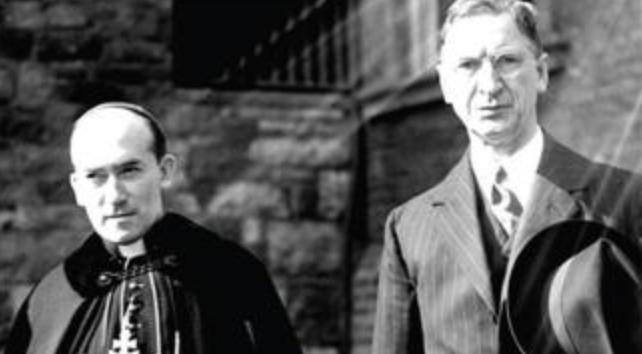
John Charles McQuaid was a familiar sight in those days. He travelled between his palace in Drumcondra and his palatial residence in Killiney in a chauffer-driven limousine, looking like a Renaissance prince. My strongest memory of him was during the Patrician Year, 1961. I was in the Catholic Boy Scouts. We lined the streets as a guard of honour during the visit of the Papal legate, Cardinal Agagianian, who was that rarest of things at the time, a bearded cardinal. He was a vision of wonder, like the bearded lady in the circus, or Dana International in the Eurovision who, unlike the real Dana from Derry, didn’t become an MEP or run for the Presidency, or indeed sing about her boyfriend of whom she was reminded, as Kevin McAleer tells us, by snowdrops, daffodils, butterflies, bees, sailboats, fishermen, wishing-wells, wedding bells, early morning dew, seagulls, aeroplanes, winds that go howling, breezes that sigh, city sights, neon lights, grey skies or blue, dances, romances, sunshine, holidays, postcards, budding trees, autumn leaves, a snowflake or two and whatever you’re having yourself. That guy must have been some tulip.
Cardinal Agagianian wasn’t at all like that, but like Dana International he had a beard. Being a papal legate he may have been expecting to leg it, but he was driven all over Dublin in a big car, with an army motorcycle escort. This was very impressive, but McQuaid managed to upstage him at every turn, sweeping majestically out of his much flashier car and being met by politicians who kissed his ring and by flunkies who held up the end of his cape. As a guard of honour, we had a close-up view of all these proceedings while the crowds in the streets sang “Hail Glorious Saint Patrick, dear saint of our isle”. The cardinal must have wondered on what planet he had landed. My dad had told me how, as a member of the Local Defence Force at the time of the bombing of the North Strand in Dublin in 1941, he had linked arms with his comrades to hold back the crowds from a gas main that threatened to explode. It seemed like an act of great courage, and so as we lined the street outside the Pro-Cathedral as the Cardinal and the Archbishop arrived, I persuaded my boy scout comrades to link arms and hold back the crowds who were singing “Hail Glorious Saint Patrick”.
We were the Catholic Boy Scouts. We were the good guys. The bad guys were the Protestant Boy Scouts, the Baden Powell brigade. Curiously, we dressed in blue and they dressed in green, which was strange as they tended to be Empire loyalists and we were dedicated to driving foreign tyrants and Russian communists from the Land of Saints and Scholars. Although we would occasionally sit around the crepe paper camp fire in the Scouts Hall in Donnybrook and sing The Quartermaster’s Store, we mostly sang hymns. The Protestant Scouts also sang The Quartermaster’s Store (and Ging Gang Goolie) so had they shown up, we might have formed an ensemble. But they didn’t show up for the Patrician Year ceremonies. Perhaps they weren’t invited. Had they shown up, in fact, we would probably have taken the opportunity to tell them a few things about the One True Church. Of course it wouldn’t have been quite as good as being shot by a communist.
McQuaid was a man with some strange obsessions. As President of Blackrock College, he once asked Vivion De Valera, then a student, to review a pile of newspaper cuttings of full-page adverts for Clery’s department store, showing women’s underwear. He pointed out to the young De Valera that “Some of them, if one used a magnifying glass, indicated the outline of a mons veneris”.
Well, who among us can place our hand on our heart (or any other place) and deny peeping at newspaper ads for women’s underwear? But how many of us have used a magnifying glass to do this?
McQuaid also listened to the radio. He listened to “Hospitals’ Requests”, although he once let Radio Eireann know that he had been shocked to hear a song called “Always True to You” played on the programme and it had included the lines “I’m always true to you, darling in my fashion; Yes, I’m always true to you, darling, in my way”. Of course the qualification is truly shocking and ranks alongside that of Leonard Cohen which mercifully the good prelate never heard
Everybody knows that you’ve been faithful
Give or take a night or two
Everybody knows you’ve been discreet
But there were so many people you just had to meet
Without your clothes
Everybody knows
Oh dear, why does Father McNamee keep haunting my thoughts?
All the best,
Dave
Comments are closed.