
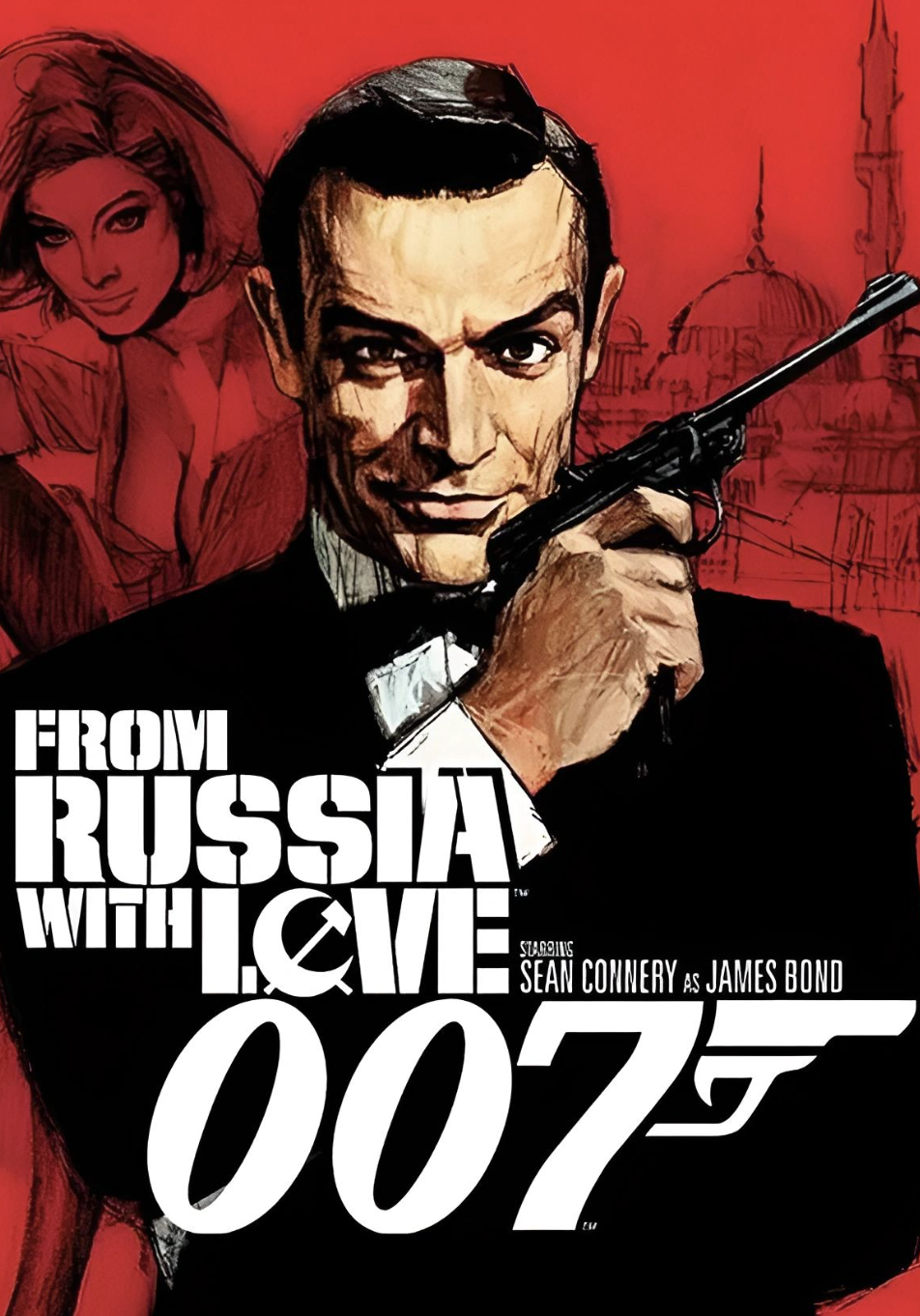
Stuck for something to read, I recently pulled Ian Fleming’s From Russia With Love down from my shelves. Although it had been on my shelves for a long time, it had remained unread, probably because I had seen the film too many times and reckoned I knew the plot too well. That was a mistake. The novel is a remarkable document and tells us much about the mindset of the “intelligence” establishment in 1950s Britain. Someone should write a Ph.D. on it. Perhaps someone has. It centres around a plot by an elite murder organisation within the Soviet secret service called SMERSH (contracted from “Smiert Spionam” = “Death to Spies”). The plot is designed to discredit the British Secret Service by arranging for its most celebrated agent to be murdered in shameful circumstances. SMERSH had given some consideration as to the choice of which state’s secret service might be best compromised. Sweden is dismissed: “Comrade, they are always having spy scandals in Sweden, one more scandal would not make the world look up”. Italy is likewise dismissed “They are clever and active, but they do us no harm. They are interested in their own backyard, the Mediterranean”. As for the French “France is looking after itself”. The Americans? “They get enthusiastic about some Balkan spy who says he has a secret army in the Ukraine. They load him with money to buy boots for his army. Of course he goes at once to Paris and spends the money on women… Americans try to do everything with money. Good spies will not work for money alone- only bad ones, of which the Americans have several divisions”.
Basically the only secret service in the world worth sabotaging is the British one. The other will all do it for themselves. Perhaps Fleming was aware of the irony of this, that it was actually the reverse of what was true, but somehow I don’t think it was meant to be ironic. There seems to be no irony, for instance. in the descriptions of the Russians, who are, without exception, thoroughly bad eggs. The worst of them is Colonel Rosa Klebb who is a senior intelligence officer, a predatory lesbian of course (at a time when lesbians were considered as dangerous as Communists) and a sadist who specialises in the use of poisoned knitting needles and who wears boots with toe caps that conceal poisoned daggers with which she kicks her enemies to death. To misquote Oscar Wilde, you would have to have a heart of stone not to warm to such a woman, and I have to admit to having become something of a Klebbtomaniac.
Along the way in the novel, there is much gratuitous insulting of other nations. Turkey, for instance, is described as a “country of furtive stunted little men”. In this world of incompetent, devious, sadistic and villainous foreigners some of whom are lesbians, where Bond struggles hard to keep the flag flying for honour and decency, one of the worst villains is Donovan Grant
Donovan Grant was born in Aughnacloy. For some reason Fleming names it as “Aughmacloy”, presumably because all Irish names must have an O or a Mac in them. And if your name is Timothy or Pat, as long as you come from Ireland there’s a welcome on the mat. And you are probably a psychopath. Donovan Grant certainly is. We are told he was the result of a midnight union between a German professional weight-lifter and a Southern Irish waitress. The union lasted for a quarter of an hour on the damp grass behind a circus tent outside Belfast. Afterwards the father (already!) gave the mother half a crown and the mother walked happily home to her bed in the kitchen of a café near the railway station. She dies six months after giving birth to the baby but not before she has given instructions that the boy was to be called Donovan (the weight-lifter had styled himself “The Mighty O’Donovan”) and Grant, which was her own name. He grows up a fighter and it is through his fighting that he comes to the notice of the Sinn-Feiners who use Aughnacloy for their comings and goings with the north, and also to the notice of the local smugglers who use the village for the same purpose. He becomes a strong-arm man for both these groups. However, about the same time his body begins to feel strange and violent compulsions around the time of the full moon. And in his sixteenth year he goes out and strangles a cat. This makes him feel better and he follows up with a sheepdog. After that it is a neighbour’s cow (I think I know where this is going; I remember Burl Ives singing about the little old lady who swallowed a fly. I wonder if she ever swallowed anything like this?). He realises that the village will soon start wondering about these deaths and so he buys a bicycle, and every month at the time of the full moon he heads off into the countryside, progressing from geese and sheep to an old tramp and then to women. Ghastly rumours are spreading around the whole of Fermanagh, Tyrone and Armagh. Although he is questioned a few times by vigilantes looking for the “Moon Killer”, he has powerful protection in Aughnacloy, as he is now the pride and joy of the village and a contender for the North of Ireland light-heavyweight championship which he wins in 1943. Then he is taken for his National Service and he becomes a driver in the Royal Corps of Signals. This must have surprised him, as no one else in Northern Ireland ever had to do National Service, thanks to the opposition of de Valera and the Catholic Hierarchy. I remember that cartoon of two Irish paratroopers huddled together in the back of a plane being strafed by the Luftwaffe, and one saying to the other “Janey Mack, aren’t we lucky that de Valera kept us out of this war?” Perhaps Ian Fleming and his friends in the intelligence community were also unaware of this. Anyway, Donovan Grant might just as well have joined the British Army of the Rhinoceros, for he is so thick-skinned as to continue his killing spree in Germany and is invited to skip over to the East where his talents are recognised and he is eventually granted Soviet citizenship and becomes the chief Soviet executioner. Bond would find it possible to forgive all of this. What he cannot forgive is that Grant ties his tie with a Windsor knot – the sure sign of a cad. (Yes, Sir Jeffrey, you will understand this). Presumably Bond associates this effete fashion with the biggest cad of the lot, the Duke who bears the title Windsor and who has let the side down.
My wife was surprised on Friday morning to discover me in my study with a book propped up in front of me and with a tray on which there was a glass of pure orange juice, a pot of coffee brewed from freshly-ground Nicaraguan coffee beans, full-fat cream, two boiled eggs, two slices of wholegrain toast, Kerrygold butter, and a jar of locally-produced honey. “But you never have anything for breakfast other than orange juice”, she said. I had to admit that the book in front of me was From Russia With Love and that just a little while earlier I had been reading about James Bond’s breakfast. This was served to him by his elderly Scottish housekeeper, May, who has iron grey hair and a handsome closed face. We never discover whether May is her first or second name or, if it is her second name, whether she is Mrs, Miss or Ms. May. Hardly the latter. Bond had indicated to her his preparednesss for breakfast by ringing twice on a bell before abruptly flinging the single bed sheet off his naked body and swinging his feet to the floor. Some time later, but only after he has put on a sleeveless dark blue Sea Island cotton shirt and navy blue valeted trousers, and having slipped his bare feet into black leather sandals, May brings him his breakfast, together with The Times, the only paper Bond ever reads.
Breakfast was Bond’s favourite meal of the day. It comprised very strong coffee, from De Bry in New Oxford Street, brewed in an American Chemex, of which he drank two large cups, black and without sugar. The single egg, in the dark blue egg cup with a gold ring around the top, was boiled for three and a third minutes. It was a very fresh, speckled brown egg from French Marans hens owned by some friend of May in the country. Then there were two slices of whole-wheat toast, a large pat of deep yellow Jersey butter and three squat glass jars containing Tiptree “Little Scarlet” strawberry jam, Cooper’s Vintage Oxford Marmalade and Norwegian Heather Honey from Fortnum’s. The coffee pot and silver on the tray were Queen Anne, and the china was Minton, of the same dark blue and white as the egg cup.
I thought “Gosh that sounds jolly good”, and so I had fixed something similar for myself using the materials that were to hand. And it was jolly good.
May tells Bond that a pesky man has been calling “about the Televeesion” . It seems that he has now called six times, trying to flog the household a Televeesion on the never-never. May, of course, regards Televeesion as sinful, and sends the man packing each time, but she has also very sensibly asked him to show ID, and he has flourished his union card. The Electricians’ Union it is too. “They’re the Communist one, aren’t they?”, she says very perceptively, and Bond says “Yes, that’s right”, and wonders if they could be keeping an eye on him. Those pesky Communist electricians! I remember them well, just as I remember that USSR football team that played the Republic of Ireland in the seventies. The commentator on RTE Radio mostly referred to them as “The Soviets”, but occasionally referred to them as “The Communists”, leaving me to wonder if he might have been so specific in his description had some of them been anarcho-syndicalists.
The Electicians’ Union may well have been Communist in the 1950s but was certainly not so from the mid-1960s. Presumably Bond’s and May’s suspicions did nothing to impede the path to power and influence of Frank Chappel who was General Secretary of the Electrical Trade Union from 1966 to 1984. I remember him as being one of the loudest voices on the right of the trade union movement at that time. When he retired in 1984 he was appointed to the House of Lords and became Baron Chappel of Hoxton. If you placed Frank Chappel on a graph representing the political spectrum from right to left, Frank would have been at the right end, with Sir Keir Starmer crowded into the space at the left end, alongside Jeremy Corbyn, Chairman Mao and Che Guevara. That’s how far to the right he was. The Televeesion man, however, managed to combine his Communism with a remarkable degree of Free enterprise, selling Televeesion sets on commission in his spare time. I wondered is this had also been how Frank Chappel began his journey from the left to the right and ultimately into the House of Lords. Apparently Chappel, who had been a Communist to begin with, had a rapid change of heart in 1956 when the USSR suppressed the Hungarian uprising. Of course this was much better than, say, waking up in bed with a boy and seeing a photographer smiling and saying “Watch the birdy”. But then, the British secret service never resorted to such ungentlemanly tactics, unlike SMERSH who were planning something of this nature for 007, and we have the word of no less a person than Colonel Rosa Klebb as proof of the more gentle methods of interrogation used by the British. Giving her chosen Bond bait, a striking (but not in the Communist Electricians’ Union sense) 26 -year-old former ballerina named Tatiana Romanova, who has grown too tall to fit into her swan costume, but who has retained her firm buttocks, a pep talk in which she is reminded of how her body belongs to the state (a state-sponsored body, by Jove, just like like CIE and Bord na Mona), she reassures Tatiana that should she be questioned by the British, the questioning will be easy –“The English do not use harsh methods” – something they themselves demonstrated in Castlereagh a few years later. Of course many public figures on a journey from the left to the right attributed their change of direction to the suppression of the Hungarian Uprising and there were many in Ireland who identified with the Hungarians and welcomed them as refugees at the time. It was easy to sympathise with a people who came from a place called Hungary. What is it about the names of states that tends to reflect their national characteristics? When the Hungarian refugees arrived in Ireland in 1956 it was assumed that they would be very Hungry indeed, and great efforts were made to ensure that they were given plenty of the appropriate food. The Government employed the services of a famous French restaurateur, Monsieur Jammet, I think , to advise them on food, and he advised the Government to provide great quantities of goulash. The Hungarians would probably have preferred Jammet dodgers, because there soon followed the second Hungarian Uprising when the refugees declared that they had had been given nothing but goulash to eat since they arrived in Ireland and that they hated the stuff and were refusing to eat any more of it. That went down almost as badly as the goulash. We are a generous people, after all, and become really narked when our hospitality is spurned. Or indeed our legendary wit. When the Chile National Football Team played the Republic of Ireland in Dalymount Park a few years later and were trailing in the match. I well remember the legendary radio commentator, Philip Greene, displaying his unrivalled wit to repeat several times that Chile was now feeling very chilly. We thought this was hilarious. It was so reflective of our ability to find cause for laughter at anyone’s expense. On one of my first visits to Dalymount to watch the Republic of Ireland play Turkey, I watched the great and majestic Charlie Hurley, who was playing centre forward, being tackled simultaneously from two sides by two of these furtive stunted little men, so well-known to Ian Fleming, and a wit in the crowd behind me said “Jaysus, a Turkey sandwich!”.
Well, From Russia With Love was a remarkable insight into the attitudes and assumptions that were prevalent in 1950s Britain, and I wondered if they and other Bond books might have shaped the attitudes and assumptions of others closer to home, including one or two Irish Times columnists who have shown themselves to be instinctively conservative. However, I didn’t remember the movie as being as polemical as the book.
So I watched the film. It is not as polemical as the book and there is less of the racial stereotyping. There is no mention of Aughnacloy, and although most of the foreigners are typically silly and incompetent, the relative degrees of silliness are not defined. Nor are the Russians the real baddies. That role is now performed by an international criminal organisation called SPECTRE which is playing off the secret services of Britain and Russia against each other. Rosa Klebb has even defected from SMERSH to SPECTRE and is played by Lotte Lenya, made famous by Bertold Brecht and Kurt Weill and Louis Armstrong and of course Bobby Darin in “Mack the Knife” which seems singularly appropriate given her preferred choice of footwear. There are also some wonderful views of Istanbul and Venice and a trip on the Orient Express, the only problem being that most of these places are populated by foreigners who of course are not to be trusted. Nevertheless, they all speak perfect English, albeit that they seem to have difficulty with the simple words like “yes” and “no” and can never quite avoid relapsing into their native tongue. I remember the Andrews Sisters singing about this
In Spain they say “Si, Si”
In France you’ll hear “Oui, Oui”
Every little Dutch girl says “Ya, Ya”
Every little Russian says “Da, Da”
As children we thought it hilarious that in France they said “wee wee” because we said that too, and of course we knew from Inspector Maigret that the French spoke perfect English, mastering complex concepts, all except for the few simple words that would reveal them as foreigners. Then this little piggy would go “oui oui oui oui” all the way home”, just like the Irish, really, who also spoke the best English in the world but were frequently pissed.
In fact, as ever, I found myself mesmerised by, and transported back by, the music. In this case it was Matt Monro singing the theme song. I once worked alongside someone who claimed to have discovered Matt. They both worked on the buses in London. My colleague had been the driver, Matt was his conductor. My colleague was also a drummer and played drums occasionally for the likes of Cliff Richard and Marty Wilde. He invited his mate to sing a few songs in his jazz club and the rest is musical history.
Matt’s song in the Movie was written by Lionel Bart and contained the moving admission:
But my tongue-tied, young pride would not let my love for you show
In case you said “No”.
I found myself wondering how it would sound if other characters in the movie had sung it– for instance if Rosa Klebb had warbled it to Tatiana in Russian –
But my tongue-tied young pride could not show my love for you yet
In case you said “Nyet”
Or in if our friend, the Moon Man from Aughnacloy had sung it in his dad’s German
But my tongue-tied young pride would not let my love for you shine
In case you said “Nein”
Or even in his mammy’s Irish
But my tongue-tied young pride would not let me whoop out “Yee hah”
In case you said “Ni hea”
These are the things that keep me awake at night.
Comments are closed.