

In the 1960s my first art instructor was a very good local painter called Hugh Largey, who gave me some idea as to what was possible.. The first thing he asked me to read was a book called from “Giotto to Cezanne” by Michael Levey, a distinguished supporter of the Humanist Association, who had also worked at the National Gallery in London.It was one of the first art books published by Thames and Hudson back then. My teacher and mentor pointed out that it would be a good place to start, bringing as it did, a sort of condensed continuity to the development of art. It had been recently published in 1962 , just a few years before and this was at a time when affordable art books in full colour were only then beginning to appear. There was nothing like it at the time.It was a colour revelation in an age of no internet and mostly black and white television. This was an overview of artwork in the Western world from the discovery of the use of perspective in Italy to the start of modern art at the beginning of the 20th century. It was how people saw their world until our age of mass- communication.
This was also where I began to realise that there was something of a “hidden language ” in art besides simply representing “real life”. For one thing , I began to acknowledge that colours in some paintings could have special meanings. The painters didn’t just use them in a random way. The colour of a painted robe might have a connotation beyond the simple fact of its hue in the same way that people believe that certain numbers might have magical or superstitious qualities such as the number “13” being unlucky.
What I’d never thought about before was how these paintings could also be used as tools of propaganda in their time-frames.Most of the painters , for better or for worse were in the pay and the orbit of rich and powerful men and in many cases, the church was the richest and most powerful benefactor.You can imagine that behind the scenes, given the artistic temperament that sometimes life may not have run smoothly.Patron and artist might clash but ultimately the artist did what he was told by the men who paid the bills.It’s just the way things are and always have been .
I was reminded of this all when I heard a piece on the radio over Easter about Judas and I’d read too that a new book has been just published which digs deeply into his story. Peter Stanford has written a new book about Judas .You’ll probably know that Judas was the one follower who betrayed Jesus ,the Christ with a kiss. It is a story most of us brought up in the Christian tradition know well. Even outsiders will probably know the connotation .Someone famously screamed” Judas!” at Bob Dylan in the Manchester Free Trade Hall back in the 1960’s when he had the temerity to set down his acoustic folk guitar and plug into the electrical rock and roll grid. He’d betrayed his folk following , it seemed.
Judas , long ago became the villain of the piece in contrast to Jesus’ s heroism. You might say that Jesus needed a villain like Judas to put shape to his own storyline. It is assumed , after all that Jesus already knew all about his coming betrayal and allowed it to happen anyway;thus condemning the poor unsuspecting Judas to two thousand years of antipathy for the small price of thirty silver pieces. Peter also fell foul to this visionary plan because Jesus had already heard that pre-destined cock crowing, three times.You might think that Jesus could otherwise have sat them both down and explained carefully the arc of the story he wanted to tell.They might not have felt so bad about themselves then.
In the end ,Judas was driven to taking his own life , so the story goes ,and was infected by such deviltry that in death his poisonous innards spilled out of him to the ground below his hanging body.It’s hard to consider that anyone would do something like this to anyone, knowing as they did , what the end result would be .Is it a better or worse fate than being, scourged , flayed and crucified ; to live on in igmony in the public imagination, for two thousand years as a villain, or to be lauded as a saviour of mankind.You might ask , who made those choices for the sake and the shape of a story?
A Shakespeare could make mythic hay with a storyline and a theatrical cast like that.
You can see how two young Jewish teenagers Siegel and Shuster ,could go on to base their comic book character ” Superman” on the story of Moses in his basket , right down to Kal-El in his rocket ship. It’s all in a story-telling tradition alright.
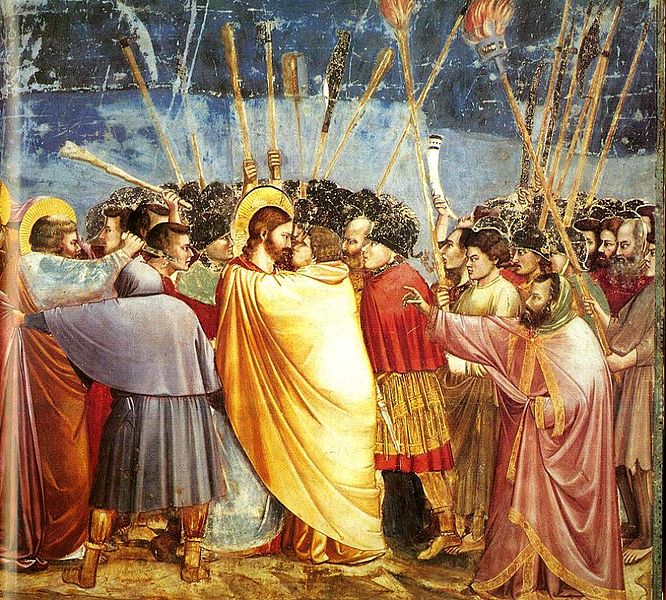
Back to “From Giotto to Cezanne”……Giotto’s story is as imbued with mystery as anything from the Bible. In art as in history, nothing should be taken for granted because the historical record is always open to interpretation and artistic licence. Most of it is lost in time .Giotto seems to have lived in Florence between 1266– 1337 , but even that mightn’t be right .He is acclaimed for bringing a realism to artistic expression that really only took hold then in the 13th century.He painted the “Kiss of Judas” or the “Betrayal of Christ” as it is also known. You might say that the “Jesus Story” became “real” at that very point in time.
The painted figures looked like real people for the first time and it was probably only then that ordinary people could visualise these Biblical stories in true-life rather than in symbolic forms .We need to always remember that most people were unable ot read so their information was either in the oral tradition or consumed visually in two-dimensions or stone sculptures. These paintings must have seemed like the CGI of their day, such was the illusion of depth and detail in them.
The colours were another thing. Judas is often depicted as having red hair which, I’m afraid all you gingers should note , was a sign of violence and wickedness. In the painting Judas is painted wearing a yellow robe because in those times just as green denotes envy , yellow signified jealousy to the people of the time . Apparently Judas was very jealous of the other apostles surrounding Jesus.The artist made sure everyone understood this.Jews became associated with the colour yellow and it is not surprising that the star of David that was displayed on the Jewish population during Hitler’s Holocaust was a yellow one.
Of course , you might say that Jesus made Judas the ultimate anti-hero which is a sobriquet that many would still crave. In that respect, he made him more remembered than anyone else.Some say there is no such thing as bad publicity .Some people crave that sort of infamy .Like the pilot who recently crashed his plane full of passengers into the mountain. He wanted to be remembered.He will be .
Like Judas he will still be remembered when many better or less- disturbed men, have been long-forgotten..It’s all in the way the story is told …
i was priveglyed to surve as School governor @ holy Cross Boys Schoolat my suggestion the Princlipalintoduce great art to the children teachers brought art that they believed The children should be aware of the first piece brought in was Picaso!s Geurnica, he also introduced Latin and Greek classes to help the vocabulary of children.