
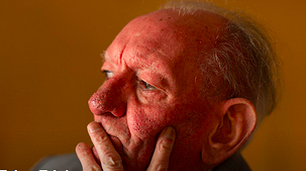
Picture by Burns Library, Boston College
Like thousands, maybe millions of people, I felt saddened by the death of Brian Friel. When I was in my early twenties, I used the fact that my sister was married to a cousin of his, and the fact that she knew Friel’s wife, to get an interview with him. For what newspaper or magazine? None. I was interested in being a writer; Friel was an up-and-coming-but-not-totally-famous writer, and I thought I could get some pointers from him. He was generous with his time and gave me some good advice and (for me) some bad advice. The good advice was that you have to be open to using your experience of the world and people as the raw material for fiction, and resist the temptation not to use Aunt Maggie because Aunt Maggie might get upset. In other words, you must have a sliver of ice in your heart.
The bad advice was that I should get myself a literary agent. He had an agent in London and it had made all the difference in terms of placing his work. I tried to get an agent – oh, how I tried. Pointless. None of them wanted to take me, probably because I simply wasn’t good enough.
Fast forward a few years and I’m back from teaching in Canada. I’ve begun a job teaching in the Creggan in Derry, and my wife and I are living across the border outside a small town called Muff. As it happened Brian Friel was living in the same area – he had moved out of Derry – and I would sometimes run into him in the local shop. He was friendly and enquiring, wanted to know how I’d found coming back to Ireland. This time he advised me to finish about a dozen of the short stories I was tinkering with and send them as a batch to a publisher, rather than try to place them with individual magazines. For the next twenty years or more life intervened, but eventually that’s what I did and that’s how I first got published.
I gather he was generous with his time with others as well. There was a BBC producer on air the other day remembering him, and her failure to get him to do an interview on her programme. (I loved the way Friel, all through his life, refused to do the almost-mandatory circuit of talk shows. He literally let his work speak for itself.) She didn’t succeed, just as others hadn’t succeeded. But she felt she’d got so much from him in their exchange of letters – “and he was a great fan of my work”. I’ll pass by commenting on the ego involved in using the death of a great artist as an opportunity to tell the listening world how much he admired your work. Instead I’ll say that I felt privileged each time I saw a Friel play or read a Friel short story (he wrote two volumes in his early years and they are wise and wonderful and hilarious). If ever there was an artist dedicated to his work, who produced great work, speaking out fearlessly against both Church and state (who now applaud him), it was Brian Friel.
Ar dheis Dé go raibh a anam dílis.
A fine tribute to a great individualist and human being, Jude. His ‘Potato Gatherers’ story is full of painfully learned behaviour and Irish wisdom. I frequently used it as a text in teaching English. The children in Castlederg, in particular, resonated totally with it from their tough, personal experience. We were neighbours with the Friels in Marlborough St when he was still teaching and beginning to get work published. I spent some time with him in Greencastle just before a season of his plays was performed at the Edinburgh Festival in 2009. I asked if he would be meeting the Press in Edinburgh. ‘Oh God, no,’ was his immediate response. As you say the words in his work did the talking.
Thanks, John. Myself and an Irish friend who taught with me in Canada used ‘Foundry House’, an achingly sad and brilliant story, with our pupils. I’m not sure how much they got from it but we had a ball. I also remember seeing ‘Philadelphia Here I Come’ in Edmonton, Alberta. I’d seen the initial production in Dublin and was convinced the Canadian audience wouldn’t get it at all- kneeling for the rosary, the local canon, the embittered schoolmaster. They got it 100%, even though their background would have been Canadian or Ukrainian or Polish: like all great artists, his deeply local work was universal.
Thank you for sharing your conversations with Brian Friel. I once had the opportunity to have a conversation with Ireland’s greatest playwright, shortly after his Dancing at Lughnasa success, when Donegal County Council held a civic reception in his honour.
As a minor guest, I approached the council building and saw Brian Friel and his wife standing outside, trying to work out which door was the entrance. I directed them to the correct door. Later, inside the council chamber, I saw the great man standing alone, looking shy and diffident, aside from the civic hubub. I could have gone over to tell him how much I loved those beautiful plays he wrote but I was overwhelmed with shyness too and couldn’t bring myself to intrude on him.
At least I got to show him the right door.
Jude, we have lost two giants of world literature in Heaney and Friel now. People may now only realise how huge these two individuals were in their respective fields in the coming months and years. And both from this tiny little part of Ireland…and from the same school no less. Extraordinary I think. What a legacy.
Indeed, Freddy. The only school in the world to have produced two Nobel Prize winners – John Hume and Seamus Heaney. On the other hand, I also attended there, which some say brings it back to being just a bog-standard school…
Ha ha , Jude. That was a fine tribute to Mr Friel. Maybe your own spark of genius will be discovered at a later date….after the buggers have danced around your funeral pyre..Mr Friel went, still booing the bishop ,by all accounts!
Actually, Jude, Kilmarnock Academy produced John Boyd-Orr who won the Peace Prize and Alistair Fleming – Chemistry.
Ach God Almighty John – can we not cling onto the odd dream? You KNOW St C’s was an uber-school – you only have to consider its intake…
Although Brian Friel is not quite my favourite contemporary Irish playwright, Esteemed Blogmeister, like you I was very taken with his avoidance of the celebrity chat-show circuit. And by his insistence on allowing his work (which was after all manufactured from words) to speak for itself.
In this he epitomised the greatest of old sayings in the leprechaun: ‘molann an saothar an saothrai’ / ‘the art praises the artist’.
While Friel was blessed indeed with many estimable qualities as a writer he was not so providential in his admirers (present company excepted, of course, EB !), of which there were legions.
As this excerpt from an interview given to the Finest Mind of the Free Southern Stateen in 1982 will demonstrate more than most:
Fintan O’Toole (for it was he !): Were you aware of almost being canonised after Translations?
(Love that ‘almost’ ,Tooler – PW).
Brian Friel: Ach, not at all all. Ah, no, that’s very strong. I just cannot accept that sort of pious rubbish.
Mind you, Perkie’s inner play reviewer who was at the opening night of Translations in Dublin had a fair idea that the canonisation process had already begun as soon as the standing ovation got off the ground. Or, at the very least, then, the Beatification of Brian.
For,one had the excellent good luck to be seated hard by the venerable drama critic of The Unionist Times and predecessor of Fine-minded Fintan himself in that most august of roles. Talk about tracing the dramatic disasters – and delights – in that reviewer’s evening face !
Dr. David Nowlan (for it was he !) went on in the coming days to wax orgasmic about ‘what is very possibly THE greatest love scene in English-language theatre: a scene of ineffable beauty’. He was referring to the how’s-yer-father chat between Lieutenant Yolland and Maire, the neighbourhood girl.
What seems to have set the good doctor’s stethoscope a-bobbing to the throbbing of his heart was the extraordinary fact that there was perfect understanding and harmony between the English-speaking soldier and the (gasp) local leprechaun-speaking colleen.
What marvellous ingenuity! What innovative stagecraft !
Eh?
Only trouble was, Maire wasn’t actually speaking in leprechaun at all at all, but rather in a form of English whose signature tune was comprehensible even unto to Dr.Nowlan’s semi-colon acclimatized ears.
Hardly a breakthrough in technique, all the same. As no doubt Brian Friel could have told him if he had bothered to ask. Every other Saturday down in the local Ranch Cinema where one went for one’s weekly diet of horse opera one heard cowboys and Comanches, whether renegade or not, converse in fluent Bronx. Audie Murphy could even spout celluloid Sioux in his sleep.
Might have been, of course, that the Nowlan household was one which did not allow young David out to the fillums.
For the record, Hugh Leonard would be one’s favourite contemporary Irish playwright. Which just goes to show, in fairness, going f. how politically unbiased Perki’es inner playgoer is when it comes to theatrical taste. For, there was just no gainsaying the clothed truth of Leonard’s being truly the two ends of a boiled turd when it came to his oft expressed political ideas.
When it came to choosing between Leonard and Friel as dramatists, however, there was just no contest: Leonard every time. The difference between sparkling and still water. A matter of taste, simply.
Indeed, as the years knee-walked onwards one became inclined to say ‘a plague on both your houses’ as Dublin became almost a no-go area for The Great Shakes. Truly one of the great brain-teasers of our dramatic times. Having opted for the Queen’s English (one hesitates to say the German Q’s E.) as its one and only language, what then do the Lovies of Liffeyland up and do?
Lock up their Rolls Royce and grimly insist on driving around in locally cobbled-together jalopeys the vast majority of which bored and bore a bogus MOT sticker: Masterpiece of Theatre. Thus did The Great Shakes suffer the same fate as the leprechaun: a endurance test to be suffered entirely within the school walls.
So, if one went along to, say, a rare production of ‘Romeo and Juliet’ it was to find oneself back in the classroom again (the said text being on the exam course of that year). And became more exposed to what Raymo of this CBS thought of Jacinta of that Presentation Convent that anything pertaining to the pomegranate groves of Verona, Italy.
So, the more Friel and Murphy and Keane and McGuinness and Leonard were lionised the more The Great Shakes receded until such time as he became, erm, EschewedShakespeare.
This was not replaced till earlier this year when (gulp) the widely acclaimed and ultimate abomination was unveiled by Blessed Gary Hynes with the imprimatur of Bishop Fintan O’Toole: the DruidShakespeare.
Explaining the reasons why ‘Irish actors could never tackle The Great Shakes’ Public Gary intoned: ‘it’s part of our colonial inheritance’ etc. That sort of thingy.
Private Gary then intervened to loll in the mode lugubrious, even as she reminisced about her lonely childhood in Ballaghdareeen, (or was it Elphin?) where as a prisoner in a lephrechaun-speaking household she could only look out longingly though the locked gate at the normal Queen’s English speaking children of the locality engaged in jovial play.
(The Gary is short, very short, for Gearoidin).
Not only was there no Shakepeare but no leprechaun either when the privately confused Public Gary eventually took over as the Memsahip of Middle Abbey Street. This is the same Abbey Theatre which at one time, around say the time ‘Philadelphia,here I come’ was first-nighting also in Dublin, the stable diet of the Christmas season was of a different order.
One looked forward to the annual Geamaireacht (that’s Pantomime in lephrechaun) where the emphasis was on the irreveverent. As befitted a style which had as much to do with the Italian tradition of commedia del’arte as it did with pantomimes. Opportunity knocked for serious satire and it gave a real, erm, green fillup to the actors and scriptwriters to let down their hair, not least those with a ‘fine head of skin’.
But, then, ‘realism’ snook in on a free pass and monolingualism became compulsory, be japers.
Seems as if Public Gary seems to have taken Brian Friel’s oft-quoted ‘confusion is not an ignoble condition’ a tad too seriously.