
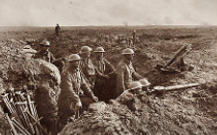
So Remembrance Day in Stormont ends in a “battle”. Irony? Big question, can we ever progress to a situation in Northern Ireland where both sides can come together through commemoration without one side grandstanding or using it as a political weapon? It is often very frustrating when commemorative events (or historical events) expose the gulf between historical interpretation of the same event, “history knows no resting places and no plateaus.”
I would replace Edmund Burke’s famous quote “Those who don’t know history are destined to repeat it” with “Those who don’t know history are destined to misinterpret it.” Historical narratives are often proclaimed and manipulated, particularly in Northern Ireland, to suit a political mindset or agenda. Jonathan Powell sums this up well when he states, “The real or objective History didn’t matter so much, what was important was their (two sides) view of it.” WW1 is often seen through the eyes of Unionists, it’s been claimed by them. What gives anyone a right to claim history? Many Nationalists refuse to acknowledge or give it recognition. For too long we have often just heard of the sacrifices of the Protestant 36th Ulster Division at the Somme, as the rest of the War is often neglected. I have often spoken to people who make irrational claims about WW1 and know only of the Somme, the snippets that suits their political viewpoint. Yet, aside from the mass casualties, this Battle was unique in that it brought two Irish Divisions together as friendships and co-operation flourished on the battlefields of France and Belgium. In these same battlefields, men from Unionist and Nationalist backgrounds served side by side, fought side by side and died side by side and are now buried side by side. Many Catholics were in the ranks of the 36th Ulster Division. Some Protestants fought in the 16th Irish Division, the same division who fought in the Somme from September 1916 on. Does this suit all historical narratives of the War? Of course it doesn’t – but such narratives that are misinterpreted are often a weapon, a dangerous weapon to divide, conquer and to be used dangerously. Professor Richard Grayson rightly states, “What people are offended by is bad History”, but it’s this bad history that seems to dominant certain sections of communities and certain narratives.
Last year I stood on Messines Ridge in Belgium and was captivated by the fascinating story of two opposing loyalties, with opposing viewpoints, in different divisions, who met in a very peculiar situation on the battlefields of WW1. This sentimental story of comradeship and mutual respect between a Northern Protestant and an Irish Nationalist struck a chord with me as humanity superseded political ideology. Do such stories exist? Not in some narratives.
Major Willie Redmond was a Catholic officer in the 6th Battalion, Royal Irish Regiment, who formed part of the 16th Irish Division. Willie was the brother of Nationalist MP and leader, John Redmond, the man who held the balance of power after the 1910 General Election and encouraged the Liberal Government to enact a third Home Rule Bill for Ireland. Willie, also active in politics, was a Nationalist MP for East Clare and he enlisted for the War after his brother John’s famous Woodenbridge speech, committing the Irish Volunteers to the War: “Go where the firing lines extend.” The hope was that this would strengthen the cause of later implementing the Home Rule Act. John Redmond, was convinced that experiences between Catholics and Protestants in the trenches would help alleviate the problems incurred in the previous years between Nationalists and Unionists.
Private John Meeke was from Benvarden, County Antrim and a member of the Ulster Volunteer Force who thought that by signing up for the War, this would ensure they would be no Home Rule. Meeke was a Protestant in the 11th Battalion, the Royal Inniskilling Fusiliers, who were part of the 36th Ulster Division. Two men so different, they had little in common – by August 1914, these men could have been enemies in a civil war, yet emerged as comrades in WW1.
On 7th June 1917 at Messines, Belgium, the 16th Irish Division and 36th Ulster Division, side by side, advanced together into fierce battle. Major Redmond, first over the top, led his Battalion into no man’s land. As the 16th Irish reached their objective, Redmond was seriously wounded by enemy fire. As he lay wounded he urged his men and comrades forward. Some distance away, John Meeke was searching the battlefield for wounded when he saw Major Redmond fall. Risking his life, stretcher-bearer Meeke braved the heavy machine gun fire and struggled to Major Redmond’s side. As the firing continued, Meeke bandaged Major Redmond and was suddenly wounded on his left side. Major Redmond saw the young Private bleed profusely and ordered him to retreat behind British lines. Meeke refused and openly disobeyed his senior officer. Under a constant barrage of fire, Meeke and Redmond were eventually rescued by a patrol of the 36th Ulster Division. Major Redmond was thus carried to the safety of a Field Dressing Station. Unfortunately, Major Redmond, was not strong enough to survive his injuries and he subsequently died.
Protestant and Catholic men in the 36th Ulster mourned with their fellow soldiers in the 16th Irish Division. The War had succeeded in changing Redmond’s thinking. In 1916 he commented that “Out of this War we should try and build a new Ireland … Over their graves build a bridge between North and South.” Reconciliation, Redmond alluded to. Yet, nearly 100 years later, that reconciliation is as far away between the two communities and the sacrifices of the War are often interpreted for political gain or political hijack!
Particularly, around remembrance, I often see this as a powerful and inspiring story, and one that many of us could learn from. What can we learn from this heroic act? An Ulster Unionist risking his life for an Irish Nationalist! A symbolic act of unity.
Can our politicians not use the example of this sacrifice to tackle tribalism, sectarianism and division use this poignant act of reconciliation ? Those who fought and died were willing to leave their political and religious divisions aside; can our politicians and communities across Northern Ireland not do the same? Instead of using misinterpreted History to divide us, use such stories and shared history/narratives to bring us together?
These soldiers were willing to fight a war for future generations – can our politicians and communities not sacrifice their entrenched positions for future generations?
When there is sacrifices for the common good or a greater ideal, the religious and political differences become of secondary importance. It’s a pity our current politicians play political games with remembrance, keeping two communities remembering past differences as opposed to commonality, similarity and opportunity. Some politicians often state that WW1 was truly for the future of small nations. Then what hope has this small nation ?
If only the bravery of John Meeke can be transcended into our modern society, to provide an example that political ideology can divide, but survival, life, humanity and the future are more important. In the battlefield of Northern Ireland politics, can politicians bring the two communities together? Are the two communities capable of coming together? Is it possible for the communities to reciprocate such an act as shown by John Meeke?
I had four uncles two of them my mother’s brothers, two of them her brothers in law, all of them Irish who fought against the Germans in the Great War. Her brother Jack was wounded at Jutland in May 1916 and her brother Ned badly gassed during the great German offensive
of 1918.
I’m still angry that millions of men of all creeds and nations were sacrificed for the criminal
schemes and the folly of politicians.
I have seen, in France graves of German soldiers showing the Star of Israel and of French
soldiers showing the Crescent of Islam.
And I have seen, side by side, graves of Dublin Fusiliers and Inniskilling Fusiliers. In one
British graveyard the nearest grave to the entrance covered a J Connolly.
The sacrifices of Jews, Moslems and Irishmen were poorly rewarded by Governments in
Berlin, Paris and London. The sacrifices of honest men everywhere have been hijacked
to dragoon later generations into predatory aggression and to oppression and repression.
John Redmond’s bones should be exhumed and a firing squad ,equipped with Old Howth
Guns should give him the salute due to a man who, before the 1916 Rising wanted those
opposing enlistment in the British forces shot.
“Instead of using misinterpreted History to divide us, use such stories and shared history/narratives to bring us together?”
And where are we going to present these stories and shared history/narratives to bring us together?
I was debating elsewhere on this site whether a history of the troubles museum located at the maze would be the perfect opportunity to portray Irish history in all its complexity for the benefit of just that, reconciliation and ensuring a peaceful future.
Each event including the rising presented in multiple presentations, each with differing interpretations and explanations of how each side can come to polar conclusions from the same events and related events.
Irish history is convoluted and to learn anything from it. must be told in multiple narratives.
A museum would give the opportunity to do just this. Many of our problems are because we don’t listen enough to opinions of the other side.
But another benefit and the reason for it being at the maze is I believe there would be substantial tourism interest if you could see first hand the listed buildings at the prison and could potentially be the biggest tourist attraction on this island.
Love to hear what others think about this and hopefully it does go along with the ethos of your post Ciaran.
What a fascinating story – never heard of this before – but agree it doesn’t suit viewpoints to promote these stories. Enjoyed this Jude.
All thanks due to Ciaran C…
Thought provoking – interesting – going to read into this tragic story.
My great uncle Tim died of his wounds in Clifton Street military hospital in 1918. His family was left in poverty, his country was partitioned, his sacrifice was for nothing.
Many Catholic veterans were discriminated against when they went for jobs, houses some even died in the pogroms of the early twenties. I’m sure Private Meeke faced no such problems.
Remembrance day is no longer about remembrance but has morphed into a celebration of the British military. I will never give it any support.
Came across your blog site by accident Jude and some great, educational articles. I’m a regular reader now. This article is brilliant! My family have connections to the war and as someone from the South, this was embarrassing to the state at one time. This article challenges some myths and does allows the reader to think about the myths in history! It is often told the way of the interpreter! Keep it going Jude.
Failte romhat, Stephen – good to have you as a reader. All credit to Ciaran C, though…
Some evidence to support what belfast Dan wrote: https://eurofree3.wordpress.com/2013/11/14/catholic-ex-servicemen-dont-count/
As far as regards Unionist/Loyalist Somme worship – it was transformed into their 1916.
They had to latch on to something to offset the 1916 Rising which actually led to an irish republic commanding the allegiance of the majority of irish people
So they chose a dead-end battle with millions dead
“Many Catholics were in the ranks of the 36th Ulster Division. ”
I new my granddads father had fought in the war but it was never really talked about in my family.
I was visiting my mother and she called her cousin who knew more about him and apparently he fought with the 36th (Ulster) Division.
I followed this up and found the following records on ancestry.com
He was in the following:
Princess Victoria’s (Royal Irish Fusiliers)
9th Battalion
Killed in action on 16 Aug 1917 in Flanders
Apparently my second cousin who I never knew has all of the details which are available in british legion.
From our conversation, he was blown up running to get some sort of machine gun, no body was returned.
The medals he won were binned by his wife, her grandmother. He had fought believing it was in return for home rule but after the war the families were not treated well and they were dumped and it was more or less forgotten about as something to be ashamed off.
Our family never wore the poppy for this reason she told me.
His name is on war memorials in lurgan, derry and in france.
She also told me as a schoolgirl, she was showing a friend her grandfathers name on the war memorial in lurgan, and was spotted by an RUC officer.
He asked what she was doing and when she told him, he told her fenians were not allowed near the war memorial and chased them.
Her words to me were, that’s what he fought for.
Not sure how I feel about this. He was a republican who wanted home rule, he lost his life bravely in France and was pretty much forgotten about by his/my family.