
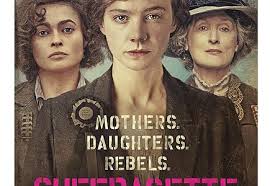
The movie, ‘Suffragette’, does not ostensibly intend to establish parallels with other protest movements elsewhere but as the action unfolded, the early days of the Sixties Civil Rights movement in the Six Counties and, specifically in Derry where I had an active role, were vividly recalled. The action opens in an East London laundry where Maud (Carey Mulligan) has worked for a pittance from childhood. Shirt factories were the biggest employers in Derry and the labour force was 99% female. When the notoriously bigoted Home Affairs Minister, Bill Craig, in 1969, banned all marches within the City walls, except by his fellow Orangemen, the factory women downed tools and paraded around the town for two days.
The movie chooses a point in the suffragette journey when the activists realise that peaceful petitioning of Parliament is a waste of energy and only militant activism will have real impact. When sections of the right wing media describe a woman as ‘militant feminist’ , they give voice to those men who feel that women should know their place. Social awakening and patriarchal lawmaking have no place in their lexicon. In time, civil rights activists, in the eyes of some commentators, would become rebels, republicans and communists who sought to bring down the State.
The film uses a documentary style with hand held cameras for some of the scenes at Epsom and to great effect in depicting police brutality against protesters. The cynical Special Branch officer ( a bear-like Brendan Gleeson ) sees no merit in ‘Votes For Women’ and relishes watching his thuggish police violently attack a rally which had gathered to hear Emily Pankhurst ( a posh Meryl Streep) speak from a town house balcony and encourage increased action. My mind’s eye clearly recalls Chief Inspector Ross McGimpsy’s brutal attack on a cub reporter in Duke Street on the 5th October 1968.
In the movie , working class, courageous women were the foot soldiers for middle class leaders; they saw peaceful protest achieve nothing and the gradual change to more militant confrontation – blowing up post boxes , the burning of Lloyd George’s summer home and eventually the ultimate, blood sacrifice on Derby Day.
The director (Sarah Gavron) makes clear in the end that the suffragette movement may have obtained votes for women but their struggle against a well entrenched, male establishment continues.
Similar rigidity is a hallmark of some Northern Ireland, Unionist thinking; much remains to be done.
John Patton’s website is http://phototilly.eu
The movie, ‘Suffragette’, does not ostensibly intend to establish parallels with other protest movements elsewhere but as the action unfolded, the early days of the Sixties Civil Rights movement in the Six Counties and, specifically in Derry where I had an active role, were vividly recalled. The action opens in an East London laundry where Maud (Carey Mulligan) has worked for a pittance from childhood. Shirt factories were the biggest employers in Derry and the labour force was 99% female. When the notoriously bigoted Home Affairs Minister, Bill Craig, in 1969, banned all marches within the City walls, except by his fellow Orangemen, the factory women downed tools and paraded around the town for two days.
The movie chooses a point in the suffragette journey when the activists realise that peaceful petitioning of Parliament is a waste of energy and only militant activism will have real impact. When sections of the right wing media describe a woman as ‘militant feminist’ , they give voice to those men who feel that women should know their place. Social awakening and patriarchal lawmaking have no place in their lexicon. In time, civil rights activists, in the eyes of some commentators, would become rebels, republicans and communists who sought to bring down the State.
The film uses a documentary style with hand held cameras for some of the scenes at Epsom and to great effect in depicting police brutality against protesters. The cynical Special Branch officer ( a bear-like Brendan Gleeson ) sees no merit in ‘Votes For Women’ and relishes watching his thuggish police violently attack a rally which had gathered to hear Emily Pankhurst ( a posh Meryl Streep) speak from a town house balcony and encourage increased action. My mind’s eye clearly recalls Chief Inspector Ross McGimpsy’s brutal attack on a cub reporter in Duke Street on the 5th October 1968.
In the movie , working class, courageous women were the foot soldiers for middle class leaders; they saw peaceful protest achieve nothing and the gradual change to more militant confrontation – blowing up post boxes , the burning of Lloyd George’s summer home and eventually the ultimate, blood sacrifice on Derby Day.
The director (Sarah Gavron) makes clear in the end that the suffragette movement may have obtained votes for women but their struggle against a well entrenched, male establishment continues.
Similar rigidity is a hallmark of some Northern Ireland, Unionist thinking; much remains to be done.
A well put together and thought-provoking piece John.
I sometimes wonder when reading histories of the civil rights movement here, if someone would ever fill in the background of figures like Chief Inspector Ross McGimpsy on what fuelled his hatred of Catholics and protesters?
Was it blind hate-filled bigotry or was it purely a right-wing Unionist mentality which insisted on doffing its had to the upper-class establishment and resented anything that resembled an alternative opinion of how things could be done?
After all the hype about 11/11/15, male dominated political unionism and some in the media might reflect on the changing role of women during World War II. Prior to the war it was necessary for a tradesman to undertake lengthy apprenticeships. As part of the war effort, women were quickly trained to undertake a variety of occupations in factories. They were even allowed to work in factories, operate heavy machinery and drive lorries. As soon as the war ended all the restrictions returned as Harold Wilson discussed,
“a prosperous new Britain, forged in the white heat of a scientific revolution.”
Meanwhile back on the hill, unemployment, redundancies, zero hour contracts, a pay freeze, welfare cuts, waiting lists, legislation for equal rights…no, let us discuss poppies.