
The British National Anthem has a verse which is explicitly anti-Scottish. It should also be anathema to atheists and secularists who deny the existence of a deity and also to those who believe in numerous deities.
The French National Anthem has a final verse so bloodthirsty that it might have inspired jihadists. Perhaps those who proclaim solidarity with Charlie Hebdo should campaign
for the banning of the Marseillaise?
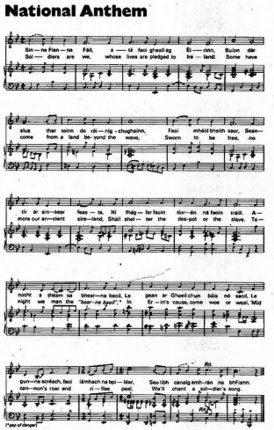
Ireland’s National Anthem – “A Soldier’s Song/ Amhran na bhFiann” appears to embarrass the Irish Government which launched the Centenary Commemoration of the 1916 Rising on Bum Notes, particularly a ditty commissioned by the Irish Rugby Football Union and entitled “Ireland’s Call.”
When the IRFU were casting about for an inspirational song I suggested they adapt the Village People’s “YMCA” and substitute “IRFU.” It might have put the wind up their
opposing teams and knocked the All Blacks’ HAKA into a cocked hat. But they commissioned Phil Coulter, whose line “there was music there, on the Derry Air” which sounds like a plagiarism from a “Carry On” Farce. Seems that music and poetry got rucked up by the IRFU which can’t tell its farce from its oboe.
There’s a story told that after the Insurgents surrendered in 1916, a British NCO told the prisoners that they would all be shot and that some of them started saying their prayers
but that one Volunteer persuaded them to give a defiant rendering of “A Soldier’s Song” which had been a favourite of some of the GPO garrison. It lifted the prisoners’ spirits and baffled their captors. I thought I had read that story in “Enchanted by Dreams” an account written by veteran Joe Good for his family in 1946 and published by his son fifty years later. If I’m right the prisoner who rallied his comrades with the song was Liam O Rinn, who translated it into Irish in 1923. I hope some reader will find out where I got the story because I can’t find it in Joe Good’s book. Anyhow “A Soldier’s Song” is intimately associated with the 1916 Rising for its lyric was written by Peadar Kearney, who took part in it.
Kearney also wrote a satirical ditty …”-Whack Fol The Diddle” lampooning Irishmen and women who adopted a slavish attitude to British Imperialism. It would not surprise me if it were to become the official Anthem of the Irish State, before this Commemorative Year is out.
THERE WAS A WILD COLONIAL CRINGE… A sports writer for the Irish News whose name escapes me made a case some years back for the replacement of Amhrán na bhFiann with something less militaristic. He justified our neighbours’ retention of ‘ The Queen’ and La Marseillaise by saying that these countries had a long military tradition whereas Ireland did not. (I don’t know if he wrote the article with a straight face or not, Virginia) (Sorry Jude).
The Irish News man spoke of the “Saxon Foe” verse as being particularly objectionable, despite the fact that it Only the chorus is ever sung at the all-Ireland final.
Mind you when the Welsh sing lustily of the ‘fine patriots’ who ‘shed their blood for freedom’ and decry the enemy who ‘trampled my country underfoot’ , I don’t think it was a disagreement with Moldova they had in mind. And the ‘Scots wha hae wi’ Wallace bled’ did not cut themselves shaving. Even Cornwall sings of a ‘good sword and trusty hand’. In fact the only anthem I know devoid of militarism is the Manx one, perhaps they are fearful of swords since their cat lost its tail.
Football matches are metaphorical battles and the anthems sung at them should reflect this.
Incidentally perhaps GAA clubs could be persuaded to take time off from promoting our rich Irish Culture, as in ‘Strictly Come Dancing’ and ‘Mr and Mrs’, in order to teach members, particularly players, to sing Amhrán na bhFiann as Gaeilge.
“In fact the only anthem I know devoid of militarism is the Manx one, perhaps they are fearful of swords since their cat lost its tail.” – Brilliant, Brian