
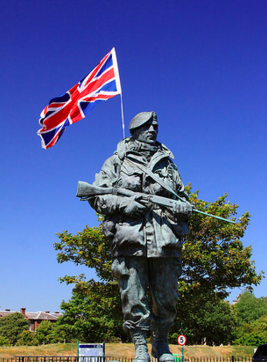
Recently I stumbled across a reactionary headline in the Scottish Daily Mail which described the ongoing investigations into the actions of British military personnel as a ‘witch hunt’. The author of the article deliberately chose the emotive language in the headline; it is designed to present the soldiers as victims of a betrayal by the country that they served and demanded that the investigations be stopped.
One thing that hit me whilst observing this article was the plain arrogance that the journalist in question showed and also the ignorance of what is now well documented cases of torture and abuse of POWs which is contrary to the Geneva Convention. The arrogance shown by the journalist angered me as it demonstrated clearly to me that there are those in positions of influence in Britain who still believe, and would have the general public believe, that the British army is a benevolent, peace-loving force for good which only serves the interests of peace. Furthermore the journalist asserts that British military personnel are ‘heroes’ who sacrifice their lives for the greater good of humanity.
Being an Irish republican I am full aware of the role that the British army played in the conflict in my country. Revisionism and the forces which unite to oppose republicanism will still today maintain that the British army was merely a peace-keeping force in the six counties, sent in to maintain law and order and serve as a barrier between marauding tribes of Roman Catholic and Protestant youths. They conveniently ignore the true legacy of the British army. No republican can be in any doubt that the British army were an invading force, sent in at the behest of Faulkner and his unionist cronies to smash the Civil Rights movement and to return Orange/British rule to the six counties.
The arrogance of those who support the British army is astonishing. For nearly thirty years the family of Pat Finucane have valiantly struggled to ascertain the truth of the events surrounding his murder. It is public knowledge that the man who provided the murder weapon, Brian Nelson, was an MI5 agent and a soldier in the notorious MRF unit which carried out sectarian killings with bloodthirsty zeal. Remember the struggle that the Bloody Sunday families had to finally force the British government to admit the truth: that the Parachute Regiment opened fired on a crowd of innocent protestors and murdered 13 people in cold blood. There are still questions to be answered over the Ballymurphy massacre by the same disgraced unit. What about the role of the SAS and shoot to kill operations such as the Loughgall massacre and the murder of the Harte brothers and Brian Mullin in Drumnakelly, Co Tyrone?
The British government refuses to acknowledge their destructive role in Ireland. They wish to hide behind lies and armies of lackeys who will continue to block access to the truth for the families affected by the actions of their soldiers. However they cannot hide forever. Pressure must be kept by republicans all across the 32 counties of Ireland. Eventually the British government will be forced to choose between two options. The first is to tell the truth about their actions in Ireland and face international condemnation and scrutiny over their actions. The second is to declare that they were at war with the IRA. This admission would leave them only one choice: revoke the criminal records of all IRA POWs who were held during the conflict and pay out sums totalling hundreds of millions in compensation for discrimination faced by the POWs and their families, which continues today.
Either option will be an uncomfortable one for the British to make. But pressure must be kept up to force them to make one. We all should support those in the struggle for truth and justice. Then and only then can relations between our countries be truly normalised.
welcoming the head of the paras to ireland wont bring much pressure.
Not sure that “revisionist” is the right way to describe people who don’t agree with the republican view of the world. It’s not like they ever did.
Can’t argue with that BYC
It is said that ‘an Englishman’s home is his castle’, a legal precept in England, that no one may enter a home, unless by invitation. This was established as common law by the lawyer and politician Sir Edward Coke, in The Institutes of the Laws of England, 1628.
On the radio, a few days ago an Englishman made some comments about the fact that Syrian’s were fleeing from their homes. The gentleman concerned insisted that if he was in a similar situation he would stay and defend his home and family. It is strange indeed that resistance in England becomes labelled terrorism in Ireland.
The following evidence was given to the Scarman Tribunal in 1969:
On 23 August the Cardinal, together with the Bishops of Derry, Clogher, Dromore, Kilmore, and Down and Connor, issued a statement which included the following.-
“The fact is that on Thursday and Friday of last week the Catholic districts of Falls and Ardoyne were invaded by mobs equipped with machine-guns and other firearms. A community which was virtually defenceless was swept by gunfire and streets of Catholic homes were systematically set on fire.”
What then was heroic or peaceful about military personnel breaking into homes armed with rifles and batons? What was heroic about a group of heavily armed soldiers dragging men out of their beds and taking them to be tortured and then interned without trial? What was heroic about driving into Ballymurphy or Derry in armoured cars in order to shoot people? What was heroic about colluding with some loyalists in the execution of Irish citizens? What was heroic about using rubber, plastic and lead bullets on a population demanding Civil Rights? Many Irish men lacked houses or castles in 1969.
The following evidence was given to the Scarman Tribunal in 1969
On 23 August the Cardinal, together with the Bishops of Derry, Clogher, Dromore, Kilmore, and Down and Connor, issued a statement which included the following.-
“The fact is that on Thursday and Friday of last week the Catholic districts of Falls and Ardoyne were invaded by mobs equipped with machine-guns and other firearms. A community which was virtually defenceless was swept by gunfire and streets of Catholic homes were systematically set on fire.”
Given the activities of some ‘heroes’ in Iraq and Afghanistan, it is clear in 2016 that,
“Peace comes dropping slow”.
“Pressure must be kept by republicans all across the 32 counties of Ireland.”
The southern state should be ashamed of their response, not only from the Dublin monaghan bombings and in their abject failure to assist families where evidence of direct state involvement in murders of their loved ones was discovered in state sponsored inquiries often by accident and then quickly protected under national security.
Not only that, but they know the state continues its use of informers and paid agents today and is still using black, white and grey propaganda which Fine Gael have co operated with and even forced the current garda commissioner to publically support.
Whether people like it or not it is obvious the British state recognises they were at war with the IRA. Even those who regularly comment and complain about former state forces being investigated for war crimes, inadvertently confirm this fact when they demand that the IRA should be afforded the same scrutiny too. The irony doesn’t register with some that they demand that state forces and IRA combatants should be treated the same.
Although much of what you say in your piece is very true and I would agree with a lot of your observations, I would question whether or not the British army was simply sent in “to smash the Civil Rights movement and to return Orange/British rule to the six counties.”
i’m not saying that the intention in the corridors and darkened rooms of power weren’t just that very thing. That’s very possible if you are a fan of “Yes Minister” or “The Thick of It” , but casting my mind back to the actual chain of events of those very fractious days , actually reveals that the british army were actually welcomed at first …especially into nationalist/catholic communities. My memory is of young and baffled English soldiers being offered tea and sandwiches when they first arrived…on the tea-time news items. Those people( Catholics and Nationalists) thought that their rescuers had finally arrived to save them from rampaging loyalism..which was what was actually happening on their streets..Now that might sound simplistic but the truth is that there really wasn’t much IRA activity in those early times….at that very moment in time Of course it wasn’t too long before “NO TEA HERE!” began to appear on terrace walls ,but that wasn’t the initial reaction at all. Republicans might like to think that today but that is not the facts. It’s best not to start re-writing the details of actual events .We’ve seen enough of that recently from some in the unionist establishment and in the southern media. Just this week we’ve heard from Ruth Patterson, for example , that Saint Patrick was in fact a Protestant even though he lived a right few years before the 16th century (Like around 1200 years!), so ..like I say it’s better to get the story straight .There is agreat synopsis here ……http://www.iisresource.org/Documents/DM01_Outline_Answer.pdf
That is correct Harry, they were sent over to restore order after the UVF declared war on the IRA, had started killing and bombing which in turn was indeed over civil rights to Catholics who needed to be kept in place or driven out of the north altogether.
They were welcomed indeed as they provided relief at least for the first few months there was a break in the relentless attacks from unionism including the police upon a defenceless nationalist community who was offered no state protection. There were offered tea and treated well by nationalists.
The first real IRA activity was in north Belfast repelling loyalist gunmen from attacking an outnumbered nationalist enclave while the british army stood by with the police and watched.
It wasn’t until the eagerness of unionism to attack nationalists and continue their pogrom that forced them into a man in the middle situation, to which they bottled it against the aggressors chose then to attack the irish nationalists and also decided then who their enemy was. The actions that followed gave life to the PIRA and ignited the conflict.
The british army picked out their enemy and started the conflict, they were not impartial observers and chose sides from the off. Their orders were to restore control to the unionist state including the police who where involved in the sectarian attacks including murder.
Lets do keep to the facts
“That is correct Harry, they were sent over to restore order after the UVF declared war on the IRA, had started killing and bombing which in turn was indeed over civil rights to Catholics who needed to be kept in place or driven out of the north altogether.”
They weren’t sent over to declare order after the UVF declared war on the IRA. That was in 1966 and the Unionist Government dealt with the UVF successfully on its own.
They were sent in three years later to “aid the civil power” because the police had been exhausted by Catholic rioting in the Bogside and then by further Catholic rioting in Belfast (deliberately organised to stretch the police even further). In Belfast, however, the rioting on the Falls, the sectarian burning of the Isaac Agnew car lot and the murder of a Protestant man by the IRA, provoked the Protestants out to respond in kind (and worse), and they ended up burning Bombay Street.
That’s when the Army erected the first peace lines between the Shankill and Falls. And its still there.
The army were sent over at the request of the state because the police lost control, because they supported and killed along with loyalist mobs turning the catholic people against the state resulting in the rioting which led to more unionist aggression as conflict always does.
Unionism started the conflict but are unable to face the responsibility.
The English warned against getting the British army involved, saying it would be much harder getting them out again.
Their orders were to restore order to the state and help the police, as I say which were not an impartial party but a loyalist enforcement squad.
Here is a more detailed assessment of events, if you can find a more truthful and accurate summary, please post a link MT.
http://www.judecollins.com/2015/12/truth-justice-and-reconciliation-part-3-by-jessica-mcgrann/
Well, I’m glad you now accept the Army’s deployment was nothing to do with the UVF in 1966 as you originally claimed.
The Army was deployed, as I already explained, and you seem partially at least to have accepted, to relieve the police who were exhausted after two days of serious rioting by Catholics in Derry and then by their co-religionists in Belfast, which provoked the Protestants out. It wasn’t because of police and loyalist killings.
Much of what you say here is true, MT. But the’which provoked the Protestants out’ suggests Unionists (forget the Protestant thing) weren’t out before this. Check the records – the civil rights marchers were continually attacked well before 1969. The British army was indeed hailed as heroic rescuers by most people in Derry when they arrived. What you say happened that they changed so radically in their views on said army?
“Much of what you say here is true, MT.”
Thank you, Jude.
“But the’which provoked the Protestants out’ suggests Unionists (forget the Protestant thing) weren’t out before this.”
It’s not intended to suggest that. The comment relates only to the August riots that were the direct cause of the request for military aid. I’m well aware of Protestant violent attacks in previous months.
“What you say happened that they changed so radically in their views on said army?”
Wasn’t it the Falls curfew?
I honestly amn’t sure what it was. I’d think the Falls curfew certainly didn’t help. But it was a turn-around with a vengeance. I’ve heard people say that when they found the British army pointing their guns towards them (nationalists/republicans), they decided their deliverers were their warders…
“Wasn’t it the Falls curfew?”
That was the point the British army chose who the enemy was and made their own rules after that.
Do you think the UVF bombing infrastructure and blaming it on the IRA had any bearing on their decision MT?
“Do you think the UVF bombing infrastructure and blaming it on the IRA had any bearing on their decision MT?”
Given that it happened long before and everyone knew it was the UVF, of course not. Your ignorance is quite remarkable.
“Well, I’m glad you now accept the Army’s deployment was nothing to do with the UVF in 1966 as you originally claimed.”
I don’t know where you got that from.
The reason for the rioting was because unionists feared Catholics getting equal rights from the civil rights campaign, this led Paisley to whip up fear then attacks on the civil rights marches and to encourage the UVF to start killing in 1966.
The UVF bombing campaign which they tried to blame on the IRA resulted in army being assigned to guard the infrastructure and was of course a key part of the decision to bring them over against Westminster advice.
The police were part of the problem, the request for military support was not simply backup for a UK police force, it was to restore order to a colony who had gone too far resulting in civil discontent which the police could no longer deal with.
There is a big difference.
“I don’t know where you got that from.”
From what you’ve written. You’re not still saying troops were deployed because of the 1966 UVF murders, are you?
“The reason for the rioting was because unionists feared Catholics getting equal rights from the civil rights campaign, this led Paisley to whip up fear then attacks on the civil rights marches and to encourage the UVF to start killing in 1966.”
The UVF 1966 murders were nothing to do with civil rights. The civil rights campaign didn’t begin until 1967. More ignorance.
“The UVF bombing campaign which they tried to blame on the IRA resulted in army being assigned to guard the infrastructure and was of course a key part of the decision to bring them over against Westminster advice.”
It didn’t form any part of the decision to deploy troops on the streets in August 1969.
“The police were part of the problem, the request for military support was not simply backup for a UK police force, it was to restore order to a colony who had gone too far resulting in civil discontent which the police could no longer deal with.”
Obviously it was to restore order. I never said it was for any other reason. NI wasn’t a colony.
“There is a big difference.”
Difference in relation to what?
“From what you’ve written. You’re not still saying troops were deployed because of the 1966 UVF murders, are you? ”
No, but the two are definitely connected MT.
The troops were deployed at the request of the unionist parliament in northern Ireland by Chichester-Clark and actioned by James Calaghan in May 1969.
The UVF bombs were in March and April of 1969 and blamed on the IRA.
I am not certain of the date it became clear it was the work of the UVF and perhaps someone could clarify, but I it would make sense that the purpose of the bombs were to bring the british army into northern Ireland. Yes, the army initially had orders to restore order to the unionist parliament which meant initially keeping both sides apart and supporting the police who were a key part of the trouble which caused the riots to begin with.
It was inevitable that they would with continued aggression come own on the side of the unionist parliament, what other choice would they have?
We know Nairac organised killings on both sides to bring the sas over, it is not hard to believe the army were brought over deliberately also.
What I am saying to you MT, is it is more complex than any one date or event caused the troubles, it brewed up over 9 years from the civil rights movement began in 1960 and it was unionism that made sure the conflict happened
“The UVF 1966 murders were nothing to do with civil rights. The civil rights campaign didn’t begin until 1967. More ignorance. ”
I disagree.
The civil rights movement began in 1960, it did not start with NICRA.
Here is some info for you.
https://en.wikipedia.org/wiki/Northern_Ireland_civil_rights_movement
“It didn’t form any part of the decision to deploy troops on the streets in August 1969.”
Again, if the unionist parliament believed the UVF bombs to be the work of the IRA even for a short period , I think it only reasonable that it would have influenced that decision to some degree.
Why do you think it would not have?
“Difference in relation to what?”
A difference in army being deployed as simply support the police on behalf of a parliament on a civil disturbance matter and being deployed to assist the police in the aims of that parliament after losing control of a sectarian state for which the police were insufficient in numbers to prevent an uprising against them.
“No, but the two are definitely connected MT.”
They’re not connected at all. If they were, you’d be able to provide some evidence.
“The troops were deployed at the request of the unionist parliament in northern Ireland by Chichester-Clark and actioned by James Calaghan in May 1969.”
We’re not discussing the deployment of NI-based troops to protect utilities in May 1969. Red herring.
“I am not certain of the date it became clear it was the work of the UVF and perhaps someone could clarify,”
It was before August 1969 and this was not a factor in the decision to deploy troops on the streets.
” but I it would make sense that the purpose of the bombs were to bring the british army into northern Ireland.”
How would it make sense? Make sense in what way?
“What I am saying to you MT, is it is more complex than any one date or event caused the troubles, it brewed up over 9 years from the civil rights movement began in 1960 and it was unionism that made sure the conflict happened.”
I never said anything to imply it wasn’t complex. I merely corrected your claims that the troops were deployed because of Gusty Spence’s UVF murders.
Ironically you tell us the causes were complex but then simplistically conclude that “unionism” (whatever that means) “made sure the conflict happened” (whatever that means).
“I disagree.”
Then provide some evidence to support your claim. .
“The civil rights movement began in 1960, it did not start with NICRA.”
That does not provide any evidence that the UVF murders were in response to a civil rights campaign.
“Again, if the unionist parliament believed the UVF bombs to be the work of the IRA even for a short period , I think it only reasonable that it would have influenced that decision to some degree.
Why do you think it would not have?”
So you’ve no evidence and you’re guessing. The culprits behind the bombs were known not to be the IRA by August 1969 and the reason troops were requested was because the police couldn’t cope with the riots happening there and then not because of bombs at utilities several months previous.
“I never said anything to imply it wasn’t complex. I merely corrected your claims that the troops were deployed because of Gusty Spence’s UVF murders. ”
I never said that MT, I have been continuously saying it was not one incident or one event but many events interconnected.
Whether you care to admin it or not, the recent conflict did not start overnight or as the result of any single incident.
The militarisation of unionism in the 60s and indeed earlier escalated over many years. The UVF formation in 1966 was directly influenced by the UUP in response to Paisleys new wave of militarisation over the rise of Catholics seeking civil rights and public housing etc.. in the mid 60s which he was against them having.
The british army did not come over as a response to any event whatsoever, including the rioting.
They were requested specifically by clark to regain control of the state including the police who were more unionist enforcers than a police force.
This happened in May 1969, if the UVF bombs were believed to have been the work of the IRA until August, what justification have you for saying they had no bearing on the decision to bring the army over?
Would it not be reasonable to assume they had some influence and therefore the bombings could well have had more planning behind them than a bunch of drunks killing Catholics which was what the UVF were only few years earlier?
It simply does not make sense to me that what started out as drunken gangsters could within a few years gain the capability to mount a bombing campaign which would play a part in bringing the British army back to Ireland.
“I never said that MT.”
Yes you did. Go back and read the thread.
“Whether you care to admin it or not, the recent conflict did not start overnight or as the result of any single incident.”
But nobody has said that it did.
“The british army did not come over as a response to any event whatsoever, including the rioting. They were requested specifically by clark to regain control of the state including the police who were more unionist enforcers than a police force. This happened in May 1969, if the UVF bombs were believed to have been the work of the IRA until August, what justification have you for saying they had no bearing on the decision to bring the army over?”
You’re getting all confused. You’re mixing up the assignment of NI-based troops to guard utilities in May 1969 in response to the UVF bombing with the deployment on to the streets of Army regiments from outside NI in August. The two are unconnected.
“It simply does not make sense to me that what started out as drunken gangsters could within a few years gain the capability to mount a bombing campaign which would play a part in bringing the British army back to Ireland.”
Eh? The British Army had never left Ireland. And again you’re mixing up two different things.
“Eh? The British Army had never left Ireland. And again you’re mixing up two different things.”
Then how were they requested and deployed in 1969?
I believe my general assessment is more accurate but accept more clarity is needed on this period.
Leave it with me.
“Then how were they requested and deployed in 1969?”
Presumably Chichester-Clark contacted the PM. Not sure. How does it matter and what’s this got to do with your apparent ignorance about the Army in Northern Ireland. Every day you seem to expose a little more ignorance.
“Presumably Chichester-Clark contacted the PM. Not sure. How does it matter and what’s this got to do with your apparent ignorance about the Army in Northern Ireland. Every day you seem to expose a little more ignorance.”
It isn’t ignorance to have a different point of view MT, it is ignorance to refuse to try and understand an alternative point of view.
I am struggling to see yours also.
“It isn’t ignorance to have a different point of view MT, it is ignorance to refuse to try and understand an alternative point of view.”
Eh? Nobody said it was. We’re discussing a question of fact, not opinion or point of view, namely your apparent claim that the Army wasn’t in Northern Ireland before 1969.
Does Maurice Morrow and Ruth Patterson know something that we do not know?
Oh that paragon of virtue….” The British Establishment ” , how confidently they occupy the moral high ground , incontestable cockerels, crowing atop their own dung-heap unaware of the contempt and odium they generate around the world .They flaunt those incontestable oxymorons ” British Justice” and ” British Democracy ” at every opportunity and have cleverly deceived their own population to believe their feigned integrity and righteousness. Forgotten are the ghosts of massacre after massacre throughout their inglorious Empire , too numerous to mention but their ignominy will out ….we will have justice. Lois McMaster Bujold once said ” The dead cannot cry out for justice. It is a duty of the living to do so for them”
The sickening hypocrisy of the British taking the moral high ground in accusing Vladimir Putin of involvement in the killing of Alexander Litvinenko whilst at the same time blocking attempts of relatives to get to the truth of killings by the British and their agents is almost too much to stomach.
When the British come clean on their own nefarious activities which cost the lives of many people not just here but throughout her colonial history only then can she criticise another nation.
Very true. I think there is more evidence to claim Maggie thatcher,Tom King,Patrick mayhem,Ronnie Flanagan ‘probably’ gave approval of the murder of citizens inside their state and outside, than there is to allege Putin of murder.
It must irk the British state that there are still people in Ireland that won’t sing from the same hymn sheet that others in Ireland sing from. The hymn sheet that any bad deeds the British carried out must be forgotten,hidden or removed from public scrutiny. Move on? We can only move on when the Brit state cease to be tyrants,hypocrites and liars.
We must never let the British Government get away with what they got up to here in Ireland, not only in the recent troubles but before that too. It wont be easy, they will try everything to hide the truth but if we put enough relentless pressure on them they will give in eventually. The truth always comes out in the end.
“We must never let the British Government get away with what they got up to here in Ireland,”
I endorse this completely.
We must find ways to increase the pressure even more on the British army, who are incensed at even the thought of being held accountable for their actions in Ireland.
There will be no reconciliation without truth.
Sorry, pressure on the British Government though the army are feeling the pinch at the success of legal teams in even getting as far as questioning them
“Revisionism and the forces which unite to oppose republicanism will still today maintain that the British army was merely a peace-keeping force in the six counties, sent in to maintain law and order and serve as a barrier between marauding tribes of Roman Catholic and Protestant youths”
Revisionism? So the original historical consensus about the role of the Army in the Troubles was a republican narrative? That’s interesting. Can you provide some sources?
Friday: Just watched the Rev Nicholas Mercer, who, as a Solicitor in the British Army became a Lieutenant Colonel and since 2003 has championed the rights of prisoners tortured and or
murdered by the British Forces. He blew away a TORY MP’s defence of indefensible
Crown Forces nehaviour.
Nicholas Mercer is an honourable man, of the same stamp as Colonel Sir Francis Vane
who defied the British Government in 1916 to expose the murder of Francis Sheehy
Skeffington and others by Captain Bowen Colthurst.
If there isn’t a memorial to Sir Francis Vane in Dublin, there should be one, and if Prince
Charles is to visit Dublin he should be invited to unveil it jointly with the President, Taoiseach or Lord Mayor.