
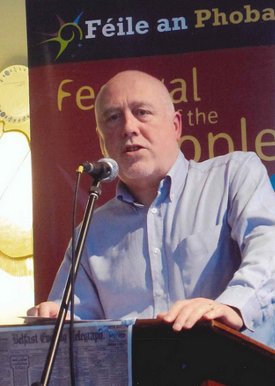
(This article first appeared in The Irish Examiner and is now available on Danny Morrison’s website: www.dannymorrison.com )
No one, not the IRA, not Sinn Féin, not Fianna Fail or Fine Gael, or any party or organisation, owns or has a monopoly on the Rising or its legacy.
But you can see from the reactions and opposition to the powerful re-enactment of O’Donovan Rossa’s funeral through the streets of Dublin last August that someone “fears to speak of Easter Week”, that someone is embarrassed about 1916 and all that.
And you can understand why Irish republicans would want to give due honour to those brave men and women who fought, if others lack the enthusiasm.
The government’s very first foray into the commemoration was disgracefully to produce a video about 1916 which didn’t even mention the names of the signatories and those who were executed.
What a glaring but telling omission. It would like be talking about the Cuban Revolution and omitting the roles of Fidel Castro or Che Guevara. Or talking about the struggle against apartheid and omitting Nelson Mandela.
But those GPO veterans who the government did manage to include in the video were such strapping physical force republicans as Field Marshall Bono, General Bob Geldof, Queen Elizabeth, David Cameron and the late Ian Paisley.
The government also managed to turn the Proclamation into gibberish by using Google to translate it into Irish. The government is certainly free to do its own thing in its own peculiar way, as are others. But what the government fears most is an analysis and debate about why the Rising was the proper reaction to what was happening at that time. It fears – with some justification – the drawing of certain parallels.
For all its good intentions the failure of the Irish Parliamentary Party (IPP) to understand imperialism and colonialism, that party’s flawed and damaging compromises, showed that its leaders were putty in the hands of the British. It had played by the constitutional rules, had assiduously, peacefully and patiently for decades worked hard for Home Rule and its position had been overwhelmingly endorsed in nine successive general elections across the 32 counties of Ireland.
Unfortunately, the IPP swallowed everything it was told, and that included buying into the War, recruiting and sending 300,000 Irishmen to the trenches of France and Gallipoli who believed, naively, that by fighting, Ireland would get a better post-war deal.
In 1914 Redmond accepted the exclusion of four counties of Ulster, then in talks in 1916 Lloyd George got him to agree to include Tyrone and Fermanagh, bringing the number of excluded counties to six – allegedly, on a temporary basis during the emergency period of the war. However, in talks with Edward Carson Lloyd George assured the unionist leader that the exclusion of six counties was to be permanent.
But there were other Irish men and women, like Pearse and Connolly and Markievicz, who had the measure of the British government, and who knew that once the war was over, Ireland’s sacrifices in the trenches would be forgotten. They saw the necessity of striking out at Easter 1916 and staking a claim regarding the freedom of this small nation.
Even before the run-up to the centenary of the Rising we got a taste of the distaste to the honouring of our patriotic dead. Ten years ago at the re-interment of Kevin Barry and nine other IRA Volunteers in Glasnevin Cemetery, one Sunday newspaper asked, “Why could they not be exhumed and reburied in private?” The funerals, wrote another leading commentator, will offer “a great boost to those who want us to feel that the only difference between a terrorist and a patriot is the passage of time.”
So now we are getting to the crux of the matter: whether there are any parallels between the aims, objectives and modus operandi of the IRA during the War of Independence, and the IRA’s armed campaign in the North from 1970 until the ceasefire.
To justify or to sympathise or, at the minimum, to understand 1916, is to justify, sympathise or, at the minimum, understand the IRA’s armed struggle in the North. It is inescapable, regardless of what sophistry is employed to argue otherwise.
But the IRA didn’t need that comparison to justify itself: partition did that.
If 1916 was about the denial of freedom and British misrule in Ireland, the recent armed struggle in the North was about the denial of the same freedom and a more egregious form of British misrule in the form of partition with its ‘Protestant parliament for a Protestant people’. Where a Prime Minister could boast that he wouldn’t have a Catholic about the place.
In Ireland’s major cities prior to 1916 there was, of course, extreme poverty and high unemployment. There had been two deaths in baton charges during the Dublin lock-out in 1913, which preceded and helped define the radical nature of the Proclamation. There had been three deaths at the hands of the British army after the Irish Volunteers’ Howth gun-running incident in July 1914.
So what did northern nationalists suffer in comparison? Fifty years of humiliation; the physical persecution of any outward expression of their identity; discrimination in housing, employment and investment; its minority position entrenched; a people denied access to government or power to change government; more deaths than occurred in Dublin prior to the Rising, deaths at the hands of the RUC, B-Specials, loyalists and the British army, long before the IRA re-organised and launched its armed struggle.
Debate around commemoration also exposes just how little successive Dublin governments have lived up to the principles enshrined in the Proclamation or pursued the cause of Irish independence and reunification. Celebrating 1916 triggers certain imperatives, including an examination of the malignity of British rule in Ireland, the divisions it caused between brothers and sisters, families, communities, political parties.
It is easier to repeatedly attack Sinn Féin, and internalise our problem, than it is to confront the British government on collusion, its agencies’ involvement in bombings and assassinations, including the killing of dozens in Dublin and Monaghan.
We have yet to achieve full independence; we are still undoing the damage which partition wrought on our people, nationalist and unionist, who from their respective positions paid heavily for this division and the political mistakes of the past. We have all hurt each other.
But we have, undeniably, come a long way. Peace has come ‘dropping slow’. The state I live in is not the state I grew up in – it has been transformed. But it has not been transformed enough. We still have major problems socially, economically and politically, but none that we cannot redress through skill, good political leadership and patience.
If Sinn Féin and the DUP can share power in the North, given our bloody past, then isn’t it about time that Fine Gael, Fianna Fail and Labour ‘cease-fired’ in the South, stopped using the Troubles as a substitute for political debate, and simply agreed to disagree about the legacy of 1916 whilst honouring the undoubted bravery of the men and women who fought at Easter Week?
The DUP did not have a choice, they may do things differently if that is ever an option.
How may times have they already tried to end power sharing?
Until Sinn Fein are elected to lead the Dail and prove one way or another their ability to do a better job than the current corrupt pantomime politicos then the people of Ireland will just have to suffer the continuous joint Fine Gael and British intelligence led propaganda war.
Clearly their own pockets mean more to them than the memories of those who gave their lives for the freedoms they now take for granted.
it has been transformed..not much sign of it about here.
This should be compulsory reading for Enda and his cronies, Aodhan O’ Riordhan etc!! Brilliant article Danny, Maith thu
Was the article not by Jude Collins?
No, by Danny Morrison. Jude posts articles/blogs by other authors as well as his own.
Thanks for that info!
An irrefutable analysis.
Let’s have Eoghan Harris, Ruth Dudley Edwards, “Professor” Roy Foster, Fintan O’Toole,
and the Tara Street Walkers of the Irish Times, individually or collectively fault it.
Great stuff, Danny.
PS “Walkers” is not a Typo, though one might be forgiven for thinking so!
Sorry only if you are dolt what part of the easter rising justifies shooting policemen in the back bombing towns and cities killing innocent people and disappearing people?
Danny has spent a lifetime pendling half truths and defending terrorist crimes so I won’t pay very much credence to his latest ramblings
“Sorry only if you are dolt what part of the easter rising justifies shooting policemen in the back bombing towns and cities killing innocent people and disappearing people? ”
The Easter rising did not intend to justify any conflict neill, it said to England, we are taking back our country for benefit of every Irish man, woman and child, now and in the future, to build a country of our own based on equality and fairness for all.
It said we intend to build our own destiny and we will fight and die to achieve it, if we must.
Jessica try reading what Danny said.
Respect’s a two way street Danny. It’s pretty clear that the southern government’s agenda is to show how far the nation has come and to celebrate what’s been achieved. Yours is to show what still needs to be achieved and to justify/contextualise the armed campaign.
I’ve attended 4th July parades including what I was told was the oldest in the States at Bristol, Rhode Island. They aren’t military displays – they’re about celebrating the society living in the USA today. Why should a Rising parade be any different? They celebrate the same thing – a nation’s proclamation of independence.
Also – just putting a thing in quotations marks doesn’t make it a quote. It makes you look like some kind of dishonest propaganda merchant. It only takes a click to find out that no-one ever said a “Protestant parliament for a Protestant people’”. What Craig did say was quite different and about the nature of a secular (‘protestant’) state in contrast to De Valera’s confessional one.
You’re quite right, BYC. Here’s what was said:
“When I made that declaration last ‘twelfth’ I did so after careful consideration. What I said was justified. I recommended people not to employ Roman Catholics, who were 99 per cent disloyal.”
Sir Basil Brooke, Unionist Party, then Minister of Agriculture, 19 March 1934
“The Hon. Member must remember that in the South they boasted of a Catholic State. They still boast of Sourthern Ireland being a Catholic State. All I boast is that we are a Protestant Parliament and Protestant State.”
Sir James Craig, Unionist Party, then Prime Minister of Northern Ireland, 24 April 1934
Reported in: Parliamentary Debates, Northern Ireland House of Commons, Vol. XVI, Cols. 1091-95.
I think the message is pretty clear. Partition was created to make sure of a Protestant state in the north and, by default, a Catholic state in the south. The net result was that it brought out the worst all round, in this case in gerrymandered Stormont.
“They celebrate the same thing – a nation’s proclamation of independence.”
So will Ireland when independence is achieved.
no-one ever said a “Protestant parliament for a Protestant people'”
“All I boast of is that we are a Protestant Parliament and a Protestant State”
Does this read better?
For what it is worth, I don’t want to live in a catholic state either, religion has no place in politics.
Reads a bit better Jessica. Maybe he was an old bigot but let’s at least quote him properly.
It is hardly sophistry to question the notion that justifying the rising equates to justifying the PIRA campaign.
Different times different issues different methods.
One thing that always irks me is when people use phrases like ‘men and women who fought and died’ or ‘gave their lives’ and so on.
I never see the expression ‘men and women who fought and killed’ or ‘they gave their lives and took the lives of others’
It is as though the killing were somehow secondary to the sacrifice they made.
When I see that kind of phrase used in a speech I will have more respect for the honest appraisal of the speaker.
You make an important point – so important, I’ve often thought it myself. So at the next Remembrance Sunday, I’m sure you’ll concede it would be more logical to say ‘We’re here to remember a huge number of killers who were killed’ than ‘We’re here to remember those who gave their lives in defence of Britain’. Right?
Jude
I don’t know why you keep throwing that up as though it will wrongfoot me somehow.
Why say “concede”?
I agree that remembrance should be for all those killed as well as those who fought and those making speeches ought to be clear about that.
Glad we agree.
Sorry, gio – use of ‘concede’ was just me reaching for nearest word – no malice intended.I suppose it came to me because there isn’t a cat in hell’s chance of your description of the ‘fallen’ – killers who were killed – being adopted. All is ‘fell in the heroic line of duty’ or some such. I was on Nolan this morning and made the point that armies teach people how to kill. It was like punching a blancmange – no response.
Exactly jude, god their hypocrisy and double standards know no bounds. Especially considering the fact the Brits were responsible for most of the deaths during the easter rising with their use of heavy artillery guns in a condensly populated city.
Forget about 1916, draw a line on the past, move on, concentrate on 2016, well let us take a look at 2016.
Today, reports form Istanbul state that 10 people have been killed and many wounded in a bomb blast.
In 2008, Tim Collins roused the troops with an eve of battle speech,
“There are some who are alive at this moment who will not be alive shortly…if there are casualties of war then remember that when they woke up and got dressed in the morning they did not plan to die this day…let’s bring everyone home and leave Iraq a better place for us having been there.”
The Iraq Historic Allegations Team, set up by the Ministry of Defence at the tax payers’ expense, has written to 280 individuals about their behaviour while in Iraq. They can be compelled to act as witnesses. Some MPs, have described this as a witch hunt.
In 2016 Tim Collins agrees and suggests that a “disgraceful industry” has emerged to make life difficult for those involved in military operations in the Middle East. I would suggest that it might be more relevant to reflect on the merits of an industry that employs security consultants and mercenaries while people starve in Syria.
In the north of Ireland in 2016, those who wish to move on also wish to protect the band tradition in the DNA of Protestants.
In 2016, efforts to demolish the 1916 site in Moore Street are now a matter for the High Court.
A member of the Fine Gael/Labour coalition was rendered speechless last evening on RTÉ, given evidence of the incidence of suicide, drug abuse and the lack of adequate services and treatment facilities.
It is sad to hear the Irish Government’s video about 1916 being referred to as “ahistorical sxxxe”. It is sadder still, to hear members of the Fine Gael/Labour Coalition give the electorate a choice between Chaos and Stability, given the reality of economic migration, unemployment, stealth taxes, homelessness, trolley waits and drug addiction, the legacy of right wing economic, social and political policies.
Thankfully there are individuals and groups who wish to build on the foundation laid in 1916, a work in progress.
“But there were other Irish men and women … who knew that once the war was over, Ireland’s sacrifices in the trenches would be forgotten. They saw the necessity of striking out at Easter 1916 and staking a claim regarding the freedom of this small nation.”
“So now we are getting to the crux of the matter: whether there are any parallels between the aims, objectives and modus operandi of the IRA during the War of Independence, and the IRA’s armed campaign in the North from 1970 until the ceasefire.
To justify or to sympathise or, at the minimum, to understand 1916, is to justify, sympathise or, at the minimum, understand the IRA’s armed struggle in the North. It is inescapable, regardless of what sophistry is employed to argue otherwise.”
Essentially what Danny is saying is that the 1916 rebels (and the Provisional IRA) knew better than the Irish people themselves. And here we have the essence of violent Irish nationalism. We know better and therefore we give ourselves the right to kill people on your behalf, even if you don’t want us to.
“Essentially what Danny is saying is that the 1916 rebels (and the Provisional IRA) knew better than the Irish people themselves. And here we have the essence of violent Irish nationalism. We know better and therefore we give ourselves the right to kill people on your behalf, even if you don’t want us to.”
He was saying the Britain would not have kept its word over home rule, after all, it made opposing promises to both sides in return for support and could not be trusted to not proceed with partition. He was saying that they gave their lives to pre-empt this betrayal and instead to declare an independent republic that could be built upon later by the children of the nation who followed. He was saying that in conflict, terrible things happen and to deny the similarities between the war of independence and the IRA who fought the same british army from 1970 is folly.
Nowhere does he say there is a right to kill. If you are looking for blame, look first to who started the killing.
No he said the 1916 rebels “knew” that home rule wouldn’t be implemented after the war. That is patent nonsense. Nobody knew that. He implies that they had some sort of special prescient powers that enabled them to see into the future and which gave them a right to act on behalf of the Irish people, regardless of whether or not the Irish people wanted them to.
“Nowhere does he say there is a right to kill.”
Are you saying Danny agrees that the 1916 rebels and the Provisional IRA had no right to kill? That’s interesting. When did he change his mind?
“No he said the 1916 rebels “knew” that home rule wouldn’t be implemented after the war.”
No, here is what he said
“who knew that once the war was over, Ireland’s sacrifices in the trenches would be forgotten.”
To which I concur completely.
Trust England at your peril MT.
“Are you saying Danny agrees that the 1916 rebels and the Provisional IRA had no right to kill? That’s interesting. When did he change his mind?”
Killing is what conflict is all about MT.
I am sure the Carson new this when threatening civil war and creating and arming the UVF in 1912 and it was the UVF who declared war on the IRA in 1966 that led to the second conflict.
Glad I read this today late comer that I am. There was a piece in Irish examiner about what he wrote in same paper and for the life of me either this Michael Clifford read something by another Danny Morrison or I did.his criticism was so off base.