
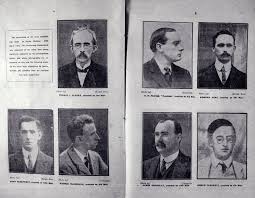
Why have unionists so many jokes about Bobby Sands and the other hunger-strikers? Why are unionist commentators and disaffected republicans so keen to show the hunger-strikers as fools, tricked by Sinn Féin into continuing their strike when they could have stopped? That’s easy. It’s because anti-republicans are very keen to somehow undermine what, by any measure, was heroic self-sacrifice. The slow and agonizing deaths of the ten men showed the world that republicans were determined, in what they saw as their legitimate struggle, to reject the label of criminal. Is there any comparable self-sacrifice within the ranks of those opposed to republicans? No.
Well then, is there any historical event that has parallels with the hunger strikers of the 1980s? There is, and you’ve probably spotted it already – the Easter Rising. The record shows that Pearse, Connolly and the others knew that their insurrection would be crushed in the short term. Or to put it another way, they knew when they entered the GPO that they were going to die. Yet they freely continued, and their sacrifice lit a revolutionary flame throughout Ireland that resulted in independence for twenty-six of the thirty-two counties. The Easter Rising is the seminal event in the formation of what is now known as the Republic of Ireland. The signatories of the Proclamation couldn’t have known for sure that this would happen. But they sacrificed their lives in the hope that they would awaken a nation – a nation that, a few years earlier in 1911, cheered to the echo a visit by King George V. Unionists such as Arlene Foster, Jim Allister and Ian Paisley Jr consider the Easter Rising as a cowardly rebellion, stabbing Britain in the back when she was most vulnerable. But they’re less intelligent than I think they are if they don’t secretly realise that stab-in-the-back claims are outweighed by the selfless nobility of the signatories’ deaths.
Which brings us to the Decade of Centenaries. Had you heard that term used when you were studying History at school? Me neither. It’s called that because there are at least three events – the signing of the Covenant, the Easter Rising and the Battle of the Somme – that involved thousands of Irish people. There is a comparison to be made between the Covenant signing and the Easter Rising, although the signing of a commitment, even in your own blood, is a different matter from spilling your life-blood. There are similarities between the Somme and the Easter Rising, in that Irishmen fought and died in both. But the core difference is that one group fought in the interests of an empire and in the majority of cases died needlessly, their deaths failing to bring the limited Home Rule they’d been promised.
A few years back, I published a book called Whose Past Is It Anyway? – The Ulster Covenant, the Easter Rising and the Battle of the Somme. Interesting though it was (what did you expect, Virginia?), it fell into the trap of presenting events that are linked and comparable with events that are heroic. Those who insist on setting the Battle of the Somme as a counter-balance to the Easter Rising do so because they want to blur the edges of the Rising, to show it as simply another military event. It isn’t. The Easter Rising involved the self-sacrifice of Irishmen in the face of overwhelming odds, men of vision whose deaths lit a revolutionary flame. The Somme involved Irishmen who donned British uniforms and showed courage, but the majority of whom were duped and left stranded on the wrong side of history.
Sorry the Hunger strikers were criminals they committed criminal acts thus they deserved to be in prison they chose to die and for what to callously exploited by their partners in SF.
As for the 11916 rebellion you obviously revere it as its your right but don’t believe any unionist looks at in a positive light and don’t start using it as a cover for the IRA actions over the last 40 years.
So I have a right to an opinion but I mustn’t use it, neill? Mmm – let me think about that…
I didn’t say that Jude as much as you wished me to say it. You assumed Unionists have a slight regard for the 1916 rebellion they don’t.
Neill, is the RUC,UDR,British army criminals in your eyes as I’m sure you know they carried out criminal acts on a large scale( please don’t mention a few bad apples) what the hunger strikers showed was courage beyond belief not for themselves but for their people. I’m sure if they had have been criminals they would be alive today,very well off and I think you know that. Bet you wish you had heroes like them to look up to with pride. Be honest who in your mind even compares
Hero`s like Bobby Sands I should think not.
Oh Neill, not this again.
Neill, you can say the Moon is made of cheese over and over again, a thousand times, a million times, even a BILLION times but……its not going to change anything Neill, the Moon will still be made of rock despite your rants…..
Its the same with the Hunger Strikers Neill. You can scream till your lungs burst, till your head pops, till your pooing out your kidneys that the Hunger Strikers were criminals but…. it wont change anything. Numerous cities in France regard the Hunger Strikers as heroes, so heroic were they that they named streets after them. The Italian city of Florence did the same in 2008. Cities in Cuba, USA, Canada, Iran and Australia did it too.
Joe Doherty was an IRA volunteer that fought extradition from the USA to Britain for over a decade, he was wanted due to killing an SAS captain. Hollywood Actor Mickey Rourke donated most of his £1.5 million wage for the movie “Francesco” to pay for Doherty’s legal fees. Do you think Oscar winning actor Mickey Rourke would agree with you on the Hunger Strikers Neill?
Gene Kelly, a Hollywood legendary actor and singer, was supportive of Irish Republicanism all his life. It was disclosed after his death he had donated large sums of money to help Irish Republicanism in the North in the 1970’s. Do you think he would agree with your stance Neill?
Members of the Indian Parliament stood up for a minutes silence to mark Bobby Sands death when he passed away and Nelson Mandela even noted in his diary (currently in a museum in South Africa, i believe) while in prison that Republican hero Bobby Sands had passed away and that all political prisoners in South Africa and in Palestine sent condolences to Bobby Sands family. Do you think they would be championing your outlook Neill?
No offence Neill but your a little fart, a nasty little fart too (No offence) compared to the people I mentioned. Your opinion on the Hunger Strikers matters not to me nor anyone else because the Hunger Strikers died for freedom and showed the world the Republican struggle was legitimate, hence how Thatcher failed in her agenda to criminalize them. Now if Margaret Thatcher failed in criminalizing the Hunger Strikers Neill, seriously, what hope have you or any other Unionist got? lol
I think your point is well made, Jude. If we take the maze stadium climb down, it showed in stark terms that unionists fear the legacy of Bobby Sands more than anything. They know rightly that no criminal gives his life for a cause. That’s the difficulty for them. They use the common criminal epithet, but know that it’s completely inappropriate. The old ‘shrine to terrorism’ was wheeled out. They know that if the world was to come and hear both narratives ( and they had an opportunity to offer theirs) what light unionism would be shown in. Very similar applies to the men and women of the rising.
I think most people opposed the Maze stadium because it wasn’t a great idea to be fair. Even the GAA is rebuilding Casement now rather than relocate to the countryside.
If you’re talking about the Daniel Libeskind peace centre proposal – most objection from that came from victims, not politicians and unionist support was withdrawn because something that was supposed to help peace was undermining it. If people want to indulge in troubles tourism it’s everywhere from murals to propaganda posters in the Linenhall Library, to Colin Davidson’s portraits of victims and their families at the Ulster museum to the Andy Tyrie interpretive centre where someone will tell you with a straight face that loyalist 3:1 reprisals forced the IRA to end their campaign and saved democracy. How was all that going to fit into one pointy box in a field outside Lisburn?
Niel, answer the question on RUC, UDR, British army. If Bobby Sands had been unionist/ British, there would be streets named after him, statues erected, and countless films made. I would imagine in your one track mind that Nelson Mandela was also a criminal
No there wouldn’t be and I think you know that.
So your hero was in prison for bombing the Balmoral furniture company. Could you explain to me how this action was going to get a united Ireland by putting people out of work?
disaffected republicans to anti republicans wonder you didnt bring alcoholics in to it.
No, billy – alcoholism is a disease…
why is any republican disaffected or anti republican for not supporting s/f.
See my response to gio, billy..
Sinn Fein do not have a monopoly on republicanism. On the island of Ireland they do not make up a majority of those who would call themselves republican.
Calling anyone who disagrees with that version of republicanism anti-republican is mistaken, perhaps even arrogant.
Well gio, the Shinners are certainly the biggest republican party in the country. And it would depend on what points they disagreed with SF on, wouldn’t it? And I think you’d agree that there are quite a number of critics of SF which is certainly a republican party.Ergo…
Jude
Have dissident republicans or disaffected republicans stopped being republicans?
To be a critic of Sinn Fein is not the same as being anti-republican is it?
It depends on what aspects of SF republicanism you’re criticising – and vice versa, of course.
Neill, if it helps you at all here are a few simple sequiturs (if there is such a word). A criminal is one who commits a crime. That means he has broken the rules of the state under which he lives. Who.makes the rules? The state, so the state can make anything illegal. If it chooses it can criminalise bestiality or decriminalise it. As you see, laws change with times. They also change with circumstance. To cut a throat in the Malvinas is ok if you have declared war on them but not ok now as war jas been undeclared. It is a crime to rob a filling station but not to head a bank which spirits away millions. It is ok for British double agents to break the law here because their government has given them the ok but it is a crime for a republican to do the same. Just muse on the above before you bandy about words like crime and criminal.
Once again what part of freedom fighting does bombing a furniture business amount to?
“Once again what part of freedom fighting does bombing a furniture business amount to?” About the same as what part of shooting innocent people down in the streets by the forces of “law and order” have to do with “peace keeping”.
Or what part of “regime change” does bombing schools, wedding parties, hospitals, shepherds, bottling plants etc. that Britain and her allies have done and continue to do in the Middle East and elsewhere.
It may be what a boutery but it’s true what a boutery.
I asked a simple question please answer it without whataboutery please
The same as carpet bombing German civilians?
Comparing the second world war to a terrorist campaign is foolish in the extreme.
Neill you need to do your homework on WW2 Poland murdered 250,000 Germans Act of terror I think,, which forced Germany to go to war with them . After the war from 1945 – 1950 the British army RAPED and MURDERED up to 5 million German civilians..Do some homework plz .. Now what would you call that
Well Neill, you undoubtedly know why IRA volunteers decided to target commercial premises during the dirty war. As soldiers they acted under orders. It’s similar to other soldiers in other armies who have carried out operations that may not be the ‘conventional’ method. Say for example the two undercover SAS soldiers arrested in Basra a few years ago who posed as terrorists(easy peasy for them) and planted huge bombs in Sunni and Shia districts to foment sectarian conflict between the two peoples? Or closer to home British soldiers who were ordered to adorn vacant houses with elaborate black mass paraphernalia in an effort to spook the catholic community?
I guess if Bobby sands and the IRA had the ability to invoke an trade embargo on the 6 counties, much like NATO do with countries they want to undermine, then Bobby sands et al would have had no call to bomb furniture stores etc? Different methods same strategy Neill as well you know. You are far from green.
So who gave the orders and who were the IRA answerable to? The British army has done some truly horrendous things but in the end is answerable to the government who was the IRA held responsible to?
So bombing factories and businesses helped the freedom struggle how again?
Well if it’s good enough for mi5/mi6/f.r.u etc to answer to no one only their superiors then why is it not good enough for the IRA?
Bombing factories and businesses in their eyes was an attempt to make the state unworkable(economic warfare). Again you know that. If they had the power to force countries to boycott the state via trade embargoes(economic warfare)etc then there would’ve been no need to bomb. Alas they hadn’t that privilege. To obtain that privilege you have to weild great influence or threat. They played the hand they were dealt. I am sure Jim Lynagh,Pete Ryan etc would’ve jumped at the chance to use some of the ‘conventional’ methods of warfare if they had obtained it. Alas they had to play the cards they were dealt. In fact it is commendable that the likes of them people did manage to strangle the state in spite of the cards stacked against them.
Let’s be honest Neill, any Brit squaddie who has been punished for doing ‘some truly horrendous things’ is but a patsy. The vast amount of crimes carried out by British state forces in whatever guise have been protected/awarded or excused. Again you know that.
The British Army is responsible to the British Government?…..And?…..how many British soldiers or British Government officials served time in prison for collusion and the murders of scores of innocent people, mostly Catholics? Exactly, none.
So why does it matter if the British Army is responsible to the British Government? lol it doesn’t mean anything Neill.
Reality is Neill your entrenched in your bigoted views, there’s no point to debating with you, your just as likely to open your mind to others views as Gregory Campbell is.
Though this isn’t my blog and I’m sure Jude welcomes everyone’s views, I honestly don’t know why you comment here Neill. Your comments always come across as nasty, vicious and very bigoted. You very rarely construct an argument, never mind a decent argument and nor do you reflect on others views.
You come across as no better than a Loyalist fleg protestor squealing about “them’uns takin our fleg!” and someone who foolishly, very foolishly, believes that Unionists can once again regain their “Protestant Parliament for a Protestant People”. Its never gonna have Neill, time to move on….
Still waiting on Niels opinion on RUC,UDR,British army…. If you can’t answer NIEL you should Barr yourself from debating forever
Putting a ceart before the horse
TG4 broadcast a documentary on 12.1.16. In 1905, Niall Mac Giolla Bhríde from An Craoslach, appeared in court. His crime, he had his name painted on his cart, as Gaeilge. Niall was represented by An Piarsach, Barrister-at-Law. The court ruled that it was illegal to write a name in Irish on the cart and Mac Giolla Bhríde was fined. He stated he would not pay the fine asserting his right to use his native language. His alternative was to spend time in prison. He opted to go to prison, however, the fine was paid by person or persons unknown.
Ruth Dudley Edwards appeared in the documentary and surprise, surprise, was a trenchant critic of An Piarsach. She stated,
“Pearse was jabbering…He did not have a legal mind…He argued as an orator…”
An Piarsach was awarded a BA Degree in Modern Languages, (Irish, English and French). He was an educationalist, a poet and a writer. He was executed aged 36. He was a man of vision and his death, lit a revolutionary candle which still burns brightly much to the chagrin of his detractors, lay and clerical.
Neill , once again you have nothing constructive to say,( a general malaise exhibited throughout Unionism ) just a bitter snipe from the sidelines. I wish you would graduate from an opinion to something worthy of a debate. Your constant berating of Bobby Sands has become tedious , but is not unpredicted .At the time of Bobby’s death the British Embassy in Tehran was situated on “Winston Churchill Street”.After his Death the Iranians re-named the street “Bobby Sands Street” .So outraged were the British that a diplomatic cacophony ensued ,and when they got no satisfaction they promptly sealed the front door and opened a side entrance on Ferdowsi Street ……diplomatic pressure remains to this day. For a “common criminal” ,Neill , Bobby Sands is remembered and honoured throughout the world , something NO British statesman or Monarch has or is ever likely to achieve !
I see you didn’t answer my question Seamus that’s a surprise
“The Somme involved Irishmen who donned British uniforms and showed courage, but the majority of whom were duped and left stranded on the wrong side of history.” Because the history of Ireland since then is totally over shadowed by the 1916 Rising. We’ll never know which direction the course of Irish history would have taken if there was no rebellion in 1916. Would we have obtained home rule? , I don’t know but of this I am sure this would have been a better country with a live James Connolly as a political leader rather than a nationalist martyr. Look at the legacy of 1916 ….. Eamon Devalera’s Ireland, was the rebellion worth putting the country into his hands. Turning it into a sterile, puritanical, priest ridden back water. That even today we are still feeling the ill effects of his political legacy.
So would you prefer Ireland had stayed under British rule, Donal?
Always about the British Jude you would almost believe you have a hang up about them.
Well I have actually, Donal. Got two British (well, English) daughters-in-law, both of whom I love dearly. Is that the same as having a thing about them?
Got the wrong person here Jude, it’s Niall who posted that remark.
Ta bron orm, Donal….
Donal, “We’ll never know which direction the course of Irish history would have taken if there was no rebellion in 1916. Would we have obtained home rule?”
I agree, we will never know what direction history could have went if there had been no Rising. Although, I think the evidence suggests, that before any Rising took place, All Ireland, 32 county Home Rule was doubtful – the British Government had already prevented Home Rule twice and a third time would not have been a surprise. It is clear that the third Home Rule Bill wasn’t a choice for the Liberal government – they had to agree to implement it, as the price of power. It’s very clear Asquith, Churchill and George were not commited to the Home Rule enterprise, Asquith famously stated in 1908 that he had absolutely no interest in Home Rule, because he didn’t have to, he was reliant on his electoral majority from 1906. It’s only when parliamentary arithmetic was unfavourably to the Liberals did Home Rule become a concern of theres. During the Home Rule Crisis, as time progressed, it was clear some form if partition was inevitable. Before the Bill was even presented before parliament the Liberal Cabinet were urging Asquith to make some provision for Ulster – with this mentality, I believe Home Rule was never going to be implemented in the form Redmond thought. Redmond even secretly accepted some form of partition himself. Did he have to? Well, the British government had been scheming behind his back with Carson and Bonar Law to sort something out. I feel this compromise was always going to be difficult to renege on or renegotiate. So, I believe 32 county Home Rule was not going to be achievable, even before the planning of the Rising began. One things clear, the Rising served to radicalise the Irish people and push them further away from the failed enterprise of Home Rule. But, by 1916, the War was already doing that, as it became unpopular in Nationalist circles and Redmond’s own popularity was beginning to come under intense scrutiny.
What I say is James Connolly would have made a better political leader then Eamon Devalera. Look what his political legacy Fianna Fail did to the country. Do you honestly believe we are the better because of Devalera?. Even Pearse’s great hope and wish that we would become an Irish speaking people was buggered up.
Jude is right that the hunger strikers and 1916 rebels have something in common: not only the fanaticism that caused them to kill themselves, but also a cruel disregard for human life generally and a willingness to kill and maim other humans for their own ends, and a sense of self-importance so great that they could act on behalf of the Irish people even without the consent of the Irish people.
Explain to me how the 1916 rebels killed themselves? Factually speaking, they didn’t kill themselves, they were executed by a firing squad! In relation to the Hunger Strikers, in your attempt to demonise their sacrifice, you fail to understand WHY they chose this option, as a last resort, in an attempt to win back the status that Republican prisoners once occupied! These ten men were allowed to die – these deaths could have been prevented!
Well, they knew they were going to die: “blood sacrifice” etc.
As for the hunger strikers killing themselves wasn’t a last resort. They could have chosen to live but as fanatics they preferred to participate in an act of emotional blackmail even to the death rather than accept the horrific crimes they had committed.
I agree, however, that they shouldn’t have been allowed to die: they should have been fed, at least once they lost consciousness. But Sinn Fein made sure they continued starving themselves in order to maximise political capital. A shameful episode on so many levels, but the greatest shame was perpetrators trying to portray themselves as victims.
If you can’t do the time don’t do the crime.
“Jude is right that the hunger strikers and 1916 rebels have something in common: not only the fanaticism that caused them to kill themselves, but also a cruel disregard for human life generally and a willingness to kill and maim other humans for their own ends, and a sense of self-importance so great that they could act on behalf of the Irish people even without the consent of the Irish people.”
This is coming from a Unionist and someone who supports British Imperialism…….
In fairness you supported the armed campaign Ryan so what is your problem with MT`s comments?
I note you didn’t address the points made.
I don’t support British, or any other, imperialism by the way .
The Prattle Lines are truly drawn for the Easter 2016 Shindig, Esteemed Blogmeister: on the nuanced side are those who consider each and every one of the the Early Risers as (a) a knave and those on the non-nuanced side who look upon them each as a (b) naomh.
Two words, two languages, one pronunciation; ‘naomh’ being the Leprechaun for saint.
Oh, a nation of nuancy boys and nuancy girls are we, alright. Virtually impossible to predict which side this celebrity will take and for which side that celebrity will plump. On one side of this Shindig we have the Shinners who would dig the Early Risers up to canonize them. Then we have the other side, the measured, the thoughtful, the analytical, the nuancy side who would direct their critical yet oddly cringeworthy canons at those old bones newly dug up.
Take, for instance, the following two celebrities: (a) a former Kelly from Fermanagh and (b) a Kelly formerly from Fermanagh.
We are all familiar with the attitude of Arlene Alannah / aka (a); but which of us is quite sure of the views on the matter of (b) aka John ‘Cool’ Kelly. As the latter is now a big-hitting broadcaster south of the Black Sow’s Dyke and the former a mere politician in Norneverland, it is arguably of far more moment that we are aware of the latter’s take. (‘arguably’, Joxer, is a daaarlin’ word).
Not sure about north of the Black Sow’s Dyke but down here in the Free Southern Stateen all the parties with one unmentionable exception are an obedient lot who do what the monopolized media tell them to think, say and do.
John ‘Cool’ Kelly is the go-to guy on Radio South if one is to have any hope of acquiring a sophisticated, nay, eclectic take on what to listen to in contemporary music etc and, even more to the point, what not to. And if that awesome attribute were not enough, Kelly, formerly of Fermanagh, is also responsible for introducing not one but TWO innovations into how we in the FSS talk.
One is a pronunciation (‘Nawleans’ where once ‘New Orleans’ was heard) and the other, the collective noun: ‘bunch’.
When Perkie was young in Old God’s Time the b-word was only used in the collective when ‘keys’, ‘bananas’ , and ‘thyme’ (the latter two chosen this time to represent fruit and flowers) were under discussion. Now, anything goes, i.e., ‘a bunch of jazz musicians’.
In fact, a clearly distressed John ‘Cool’ Kelly managed to integrate both into the one phrase (‘a bunch of jazz muscicians from Nawleans’) during the course of paying a muted yet heartfelt and sobworthy tribute to the late, grating David Bowie. For John the passing of his friend David was evidently akin to a death in the family: respect.
Or, Ziggy Topes , as the musically unsophisticated and uneclectic might disparagingly refer to John’s dear, dear friend David. This would be, of course, a clear rip off from the unworthy Private Eye’s infamous denigrating of St. John Lennon as Spiggy Topes.
Thankfully, we have the footfall from the High Priest of High IQs to thoughtfully echo the emotional tribute of Kelly, formerly of Fermanagh. One who put on his red shoes to dance away the blues, with this typically low key and understated piece:
-David Bowie changed the way we think about the self.
Must say, all the same, tis a bad day one does not learn something new. Decoding Fintan O Toole (for it is he !) this reads as: ‘David Bowie was the infra red and the ultra violet of the Rainbow Day of Days in Dublin Castle’.
Before moving on to the meat of this piece, i.e , to deduce the take of the meatless, mighty one of the major media, John ‘Cool’ Kelly, on the minor matter of 1916 (see clue below) it is perhaps not instructive to instance one other example of just how the dispassionate celebrities of the microphone steer ideas, tastes and orthodoxies along the Great Information Highway.
Take two contemporaries of the pop world, both not unalike yet so unalike: David Bowie and Robin Gibbs. Both resembled the other in looks; each had haunted faces with gaunt cheek bones. Both, however, differed from the other in musical gifts. Where Robn’s talent as a musician was gem-like, small but undeniable and utterly durable (think his vibrato voice on ‘Massachusetts’, ‘ I started a joke’ ’Don’t forget to remember me’, etc etc etc etc etc ) that of David was…. (what’s the word?)….ah, yes, genuine rhinestone.
Diamond and diamente.
So, how did the commentariat deal with them ?
As It happens, 2016 is the 20th anniversary of what was a definIng moment of 20th century tellyland; when the Brothers Gibb, having had enough of the smarmy Clive Anderson’s charm-free jibes, did something which is the abnormality rather than the norm. They ripped off their studio mikes, and , one after the other, upped and stalked out of that den of conceit. They had had a belly full of swimming against the snide.
Perkie’s sweaty nightcap got thrun so far up into the sky that night (having climbed to the turrets of Warbeck Towers the better to celebrate) that it went, alas, into orbit.
By way of a Caravaggio-like contrast, fast forward to an interrogation which RTE in its wisdom opted to rerun over the Jolly Holly Season. It had previously got aired a few years ago, by all accounts, but no reason was given for its reshowing. The license-payer was left to speculate. Could it, perchance, have been a sort of scene-setting for the farce to come, i.e., (gulp) ‘Rebellion’?
The host was the incisive, the b.s. spotting John ‘Cool’ Kelly; the guest was Gary Hynes, global giantess of the theatre and former headmistress of the Abbey, the taxpayers’ theatre. After a joyful mystery of the litany, in which the host was the giver out and the guest was the respondent, the former lovingly fingering each fawn-coloured bead as decades of stage successes were listed, the mood suddenly darkened.
When the guest suddenly went into a Beckett-like staccato outburst, apropos nothing in particular;.
Thus:
Ms Hynes: I spoke Irish till I was four years old. My father was a Gaeilgeoir. I haven’t spoken Irish since.
(As the G-word got spat out with all the warmth of a wizard in a Nawleans chapter of the Klan expectorating the N-word, , one leant forward in full anticipation of hearing one of Kelly’s justifiably famous interjections:
-Hold on a minute there, hoooold it right there, before you go any further.)
Alas, the host opted to sing dumb. Or, did he?
Perhaps, the original transmission had been edited to exclude such a boringly predictable and obvious question as:
-So, what made you think, Ms High and Mighty Hynes, that you could disenfranchise a sizeable cohort of the Abbey’s audience who pay your wages by bringing the pigtailed hang-up which still rages to hang-up in the Green Room?
Who knows, who can tell?
Still not quite sure which way the Kelly, formerly of Fermanagh, will teach us how to take Easter 2016.
Buachaill on Eirne me, is ni bhreagfainn callin deas og
Is ni iarfainn fein bo spre lei, ta me fein saibhir go leor.
How’s about ye then, wee lassie, I’m one classy high earner meself
I can say moo to a cow dowry, I’m well to do as the Commonwelf.
Jude
Only the other day you conceded that when referring to those who fought and died whether at the Somme or in Irish conflicts it would be good to mention how they spilled the life blood of others as well.
In this piece you frequently refer to self sacrifice, being prepared to die, etc but I am disappointed you did not think to add the crucial sacrifice these people made in choosing to take the lives of others
Neill ,you didn’t ask me a relevant question ..you were dealing with puerile innuendoes….I will ,to the best of my ability, endeavour to answer any relevant or pertinent question posed but I will not satisfy your ego by replying to simple inanities.
Er yes I did and you choose not to answer which of course is your prerogative
You think he is a hero I think he is a common criminal I am equally sure we will never come to agreement on this
What are you smoking Niel,the British army, RUC,UDR and their friends in the loyalist death squads carried out horrendous acts on behalf of the government. Ballymurphy-springhill massacre, Bloody Sunday and I could go on are still being covered up by your government. You are an embarrassment in the arguments you put forward and aren’t worth responding to. IGNORANCE IS BLISS……. UPTHEMURPH
As above martybo just answer the question?
Neill doesn’t answer questions Martybo, he deflects and tries to change the subject when faced with the facts, you’ll learn that quickly when you interact with him.
Ryan I asked the question how would you get a united Ireland by bombing furniture retailers?
Because you could answer it or perhaps ask some of the people who were involved in it to answer the question?
As a business man and an ardent supporter of British Imperialism,Neill , you understand implicitly what an economic target is so we can dispense with that red herring now ! I don’t wish to appear condescending ,Neill , but were you ever part of a debating society at university, or college perhaps? The ultimate aim is to convince the opposition with reasoned arguments and facts the validity of your position…..one line convictions, without much veracity, hold very little sway.Unfortunately Unionism ,whether from the weakness of their argument or a lack of conviction in their cause seem unable to rise to the occasion !
ardent supporter of British Imperialism
What Empire?
you understand implicitly what an economic target is so we can dispense with that red herring now !
If you were hitting banks or monition factories I would understand your point but furniture factories?
So by making people unemployed you were more likely to have a united Ireland?
One last try Niel. The RUC UDR BRITISH ARMY all carried out criminal acts, ARE THEY CRIMINALS
“There is a comparison to be made between the Covenant signing and the Easter Rising, although the signing of a commitment, even in your own blood, is a different matter from spilling your life-blood”.
I was also under the impression that the Covenant signing was in blood Jude.
Turns out this is another misconception, and not a single signature was in blood. One guy apparently signed in some reddish ink which was thought to have been pigs blood but later tested and found not to be blood at all which would have deteriorated but just reddish dye.
The signing in blood is more dramatic and does indeed show a degree of commitment.
Seems like it is only a rumour possibly started for the above reason but has no foundation, like much of unionisms beliefs it appears.
As for the Somme, I also thought this was a UVF sacrifice.
Now I find out not only was my own family in the 36th, but many northern republicans fought in it also.
My numbers could be wrong, but perhaps someone could clarify.
The UVF was 100,000 strong at the time, the 36th had up to 75,000 I believe.
I would live to know what the actual figures were.
It would be no surprise to me if 25,000 of the 36th were Irish nationalists and less than half of the UVF numbers bothered to fight at all with the better off half instead suddenly suffering the usual carditus and leaving it to the poorer working class loyalists only.
The Ulster Division waa 100,000 strong. What’s your source for the claim that 25,000 of these were Irish nationalists?
I didn’t claim, I said I suspected.
Seems I might have been on to something though by these figures.
http://www.qub.ac.uk/sites/irishhistorylive/IrishHistoryResources/Articlesandlecturesbyourteachingstaff/IrelandandtheFirstWorldWar/
Ulster
17,092 catholic
45,798 protestant
62,890 total
So 100,000 in the UVF therefore less than half signed up.
Over 17000 of the ulster 36th were catholic, I doubt there were many catholics in the UVF.
Seems like my great grandfather want the only republican to fight in the ulster 36th MT.
Would that make him a better republican in your eyes I wonder?
Oh dear, Jessica. Another error.
Those are figures for total recruitment, not for membership of the Ulster Division.
“Oh dear, Jessica. Another error.
Those are figures for total recruitment, not for membership of the Ulster Division.”
Why am I not surprised MT?
So you tell me what was the correct number of catholics in the ulster 36th?
I am sure my great grandfather wasn’t the only republican in the trenches fighting along with the ulster 36th?
Also, why do you think half of the UVF membership did not sign up?
I think it is perfectly reasonable that those that fought were the working class and it was the better off, probably orange order membership that bottled.
“Why am I not surprised MT?”
I guess because you get it wrong so often.
“So you tell me what was the correct number of catholics in the ulster 36th?”
I’ve no idea. I suspect it was very small.
“Also, why do you think half of the UVF membership did not sign up?”
How do you know half didn’t sign up?
Of those who didn’t I’d say many were too old.
“I guess because you get it wrong so often.”
It must be great being a genius MT.
Even queens university cant get it right by your standards, even with statistics.
What these figures show, overall, is that more Catholics than Protestants (and hence we can assume more nationalists than unionists) joined up in Ireland during the First World War.
We can break down the statistics by location and religion, though not quite for the whole war. The figures for recruitment by religion and province from August 1914 to January 1918 (which is the period for which we have more-or-less reliable figures) are as follows:
Province, Catholics, Protestants, Total
Ulster, 17,092, 45,798, 62,890
Leinster, 25,357, 4,989, 30,346
Connacht, 4,316, 410, 4,726
Munster, 17,842, 1,168, 19,010
Totals, 64,607, 52,365, 116,972
Keith Jeffery, Ireland and the Great War, Cambridge University Press, 2000
“So you tell me what was the correct number of Catholics in the ulster 36th?
I’ve no idea. I suspect it was very small. ”
You have no idea???
You just said I have it wrong and the figures from professor Jeffery were wrong.
Now you are saying you have no idea!!!!
“Also, why do you think half of the UVF membership did not sign up?”
How do you know half didn’t sign up?
Of those who didn’t I’d say many were too old.
Figures for the UVF membership in 1914 were 100,000.
Less than half that number signed up.
I have said why I think, because only the working class protestants were sent to their graves along with their fellow Irish catholic soldiers.
The protestant elite of the UVF stayed safely at home.
“Even queens university cant get it right by your standards, even with statistics.”
How? What has Queen’s got wrong?
“What these figures show, overall, is that more Catholics than Protestants (and hence we can assume more nationalists than unionists) joined up in Ireland during the First World War.”
And? Nobody has disputed that. What’s in dispute is your claim that 25% of the Ulster Division were nationalists.
“You just said I have it wrong and the figures from professor Jeffery were wrong.
Now you are saying you have no idea!!!!”
Eh? I didn’t say Jeffery’s statistics were wrong. I said you posted the wrong statistics, i.e. those for total recruitment and not those for the Ulster Division.
“Figures for the UVF membership in 1914 were 100,000. Less than half that number signed up.”
How do you know?
“And? Nobody has disputed that. What’s in dispute is your claim that 25% of the Ulster Division were nationalists.
Eh? I didn’t say Jeffery’s statistics were wrong. I said you posted the wrong statistics, i.e. those for total recruitment and not those for the Ulster Division.”
Ok, that’s fair enough, I am no expert on this.
But are you therefore saying the figures for total recruitment in Ulster could be somehow less than the number in the Ulster Division alone?
If so, how could that be possible?
If not, then the total figures for ulster recruitment between 1914 and 1918 are less than half the 100,000 number who were in the UVF in 1914.
How could that be?
“But are you therefore saying the figures for total recruitment in Ulster could be somehow less than the number in the Ulster Division alone?”
No.
“If not, then the total figures for ulster recruitment between 1914 and 1918 are less than half the 100,000 number who were in the UVF in 1914.”
Indeed.
“But are you therefore saying the figures for total recruitment in Ulster could be somehow less than the number in the Ulster Division alone?”
No.
“If not, then the total figures for ulster recruitment between 1914 and 1918 are less than half the 100,000 number who were in the UVF in 1914.”
Indeed.”
So unless there was another ulster unit, then 25% of the 36th was catholic and less than half of the UVF membership signed up.
That is actually a surprise to me but appears to be the case.
“So unless there was another ulster unit, then 25% of the 36th was catholic and less than half of the UVF membership signed up.”
Eh? How on earth do you come to that conclusion?
“So unless there was another ulster unit, then 25% of the 36th was catholic and less than half of the UVF membership signed up.”
Eh? How on earth do you come to that conclusion?”
Take another look at the figures MT?
http://www.qub.ac.uk/sites/irishhistorylive/IrishHistoryResources/Articlesandlecturesbyourteachingstaff/IrelandandtheFirstWorldWar/
The statistics for Ulster recruitment between 1914 and 1918 excluding officers etc…
17,092 catholic
45,798 protestant
62,890 total
This is the figures for ulster only. More than that total signed up in Dublin alone.
17,092 is 27.177% of 62,890
Have I gone wrong somewhere?
There were three Irish divisions. The other two recruited all over Ireland.
“Turns out this is another misconception, and not a single signature was in blood. One guy apparently signed in some reddish ink which was thought to have been pigs blood but later tested and found not to be blood at all which would have deteriorated but just reddish dye.”
Fred Crawford, the gunrunner, who went to Germany to acquire weapons that came in via Larne in April 1914.