
(These reviews first appeared in the Andersonstown News)
REBELLION (RTÉ) Episode 1
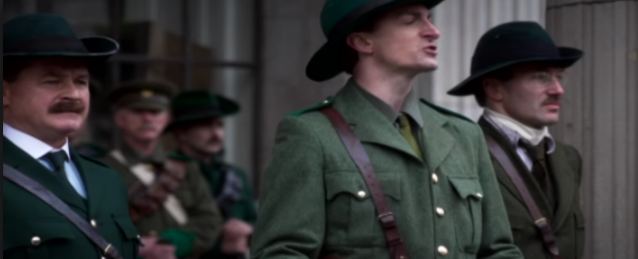
Even allowing for the fact that this was Episode 1, REBELLION (RTE1) was a bit frothy. Mind you, it’s tough going at the start of a series – you’ve got to introduce all the main characters, get credibility built into them and their relationship with each other, kick-start the plot AND, in this case, try to paint the political backdrop in convincing colours.
The opening scene – ‘Three Little Maids From School’ , from a Dublin production of Gilbert and Sullivan’s The Mikado – went on so long, I thought I’d got the wrong channel. But no – each of the Three Little Maids would be playing a different part in the lead-up to the Easter Rising.
The Gilbert and Sullivan bit was Dublin 1914 and the start of the First World War; shortly after which we fast-forwarded to Holy Week 1916. Augustus Birrel, Chief Secretary for Ireland is being told that “some kind of attack may be imminent!” by some high-up British officers. Birrel is unmoved. Nothing pressing, lads.
Elizabeth is a medical student but she’s also planning revolution with Countess Marcieviez’s unit. Then her fiancé Stephen comes home from the front. Elizabeth is seriously conflicted – marriage to Stephen is imminent but so too is the Rising.
Besides, there’s Jim the socialist who’s in with the Citizen’s Army crowd. Jim’s brother-in-law comes back from France in British uniform and finds Jim’s rifle in the tenement flat. “Do they pay you well down in Liberty Hall?” the brother-in-law sneers. “Freedom doesn’t have a price” Jim responds.
Up in Scoil Éanna, Patrick Pearse doesn’t look a bit like himself and is training his pupils in making bombs. May, secretary to Charles Hammond, the Chief Secretary’s assistant in Dublin Castle, is having an affair with her boss. But when Charles goes back to his wife and leaves May pregnant, May throws the head and smuggles out British plans to arrest leading Volunteers and Sinn Féin people. Then just as May is about to get the boat for England, a peeler arrests her – they want to ask her some questions up at Dublin Castle. Cue credits for end of Episode 1.
As I say, first episodes have to cram a lot in. But there are scenes that jar – fathers hugging and kissing their children, grown-up brothers hugging each other. People say “I’m up for that!” while an RIC man glowers at James Connolly and snarls “Your day will come, Connolly!”
There’s obviously been quite a bit of money put into this series – glossy film quality, loads of extras. Can it recreate the passion and fears of Easter 1916? The kindest I can say is, ask me after Episode 2.
REBELLION (RTÉ) Episode 2
Yes I know, Virginia, I reviewed this programme last week, but this is the second episode of what is advertised as ‘Home-grown Drama’.
Last week we left little May, the plaything of the swine Charles Hammond, who is the Chief Secretary’s assistant – we left little May being lifted by a peeler who said he’d been sent to “fetch” her to the Castle . (Did Dublin peelers say “fetch” back then?) But whew – they hadn’t twigged she’d stolen that document and passed it on to Subversive Elements after all! It was to get her to do a bunch of typing for her boss/lover Hammond. Whew again.
Meanwhile back at the Rising, it is off, thanks to “this clown” Eoin MacNeill (James Connolly’s description, not mine). But here – it’s not off. “Jimmy – where have you been? It’s on again!” Lisa (about whom Jimmy the socialist is mad) was just about to get married to a British officer she didn’t love, but when she hears the word she sneaks out the back in her wedding dress and runs to report for duty to Constance Markievicz. Then Charles the swine with May in tow runs into some Citizen Army men. May gets a bit disrespectful with one of them, to which he replies “Rather Citizen’s army than an Englishman’s whore!”
In no time a policeman gets shot, and then a looter. Jimmy and Lisa nearly cop it when Jimmy’s brother-in-law, who’s in the British army, encounters them on the stairs of City Hall. But the brother-in-law hasn’t the heart to shoot and lets them go. Awww.
“We put a ring of steel around the city and we crush this rebellion!” General Maxwell raps, pointing at a map. Then we’re inside the GPO and a priest has made his way in, to convey His Grace’s instructions that they must stop this madness. But they won’t, so the priest hears some confessions. Then Patrick Pearse says “Would you lead us in the rosary, Father? It’s a great consolation for men about to face their death to have a priest near”. So he does. Then in another part of Dublin Jimmy tells Lisa “I have to go” and …he kisses her! Revealing his love at last. Finally we’re at British Army headquarters and they’re a mean lean fighting machine, all neat uniforms and big shiny boots responding to the command “Companeee – aten – shun!” And you know the rebels will be no match for them.
I said last week I’d suspend judgment about this Home-grown series until this week. This week let me suspend the series on the end of a rope. In its eagerness to provide a ‘human story’, the imagined characters – Lisa, Jimmy, May and all that – they crowd the stage with their stories so that Connolly and Pearse, never mind the other signatories, are lucky to get thirty consecutive seconds. The acting is OK but the lines people have to say (“I’d sooner die free than live as a slave!”) make the buttocks clench with embarrassment betimes. The rebels are shown as a raggle-taggle band who by and large don’t realize a Rising will mean they have to kill people; in contrast, the efficiency and humanity of the Irishmen in British uniform is emphasized at every turn.
It can’t have been that bad? Let me whisper a sad truth. Earlier on Sunday I watched George Clooney in a movie called The Peacemaker. I felt more concern for George and Co, the tension was more gripping than anything in Rebellion. There could hardly be a more dramatic, colourful, harrowing story than the Easter Rising, yet when the opportunity came RTÉ, Home-grown drama and all, fluffed it. After two episodes Rebellion is at best half-baked.
You’re twice the man that I am,jude. I could only stomach one episode. Can you remember the reasonable job that RTE did in 1966 with the special issue RTE guide?
Agree with you 100%. A dreadful production with embarrassing dialogue. Can I suggest you catch seachtar na casca which is currently being repeated on tg4 at 7.30 on Wednesdays. An excellent series first broadcast about 5 years ago which gets behind the men of 1916 in a way this current RTE mess never will.
Haven’.seen.it.jude.
Lucky.You.Jim…
It really does sound a bit dire, but it’s probably what the soap fans will lap up.It’s probably aimed at Downton Abbey fans. At the moment they’re also having a bash at an eight episode version of “War and Peace” on another channel on sunday nights. Episode three airs this weekend. To say that it rattles along at a right old rate is an understatement.Blink and you’ll miss it. The first episode also fairly crammed in all the characters into a roomful of introductory , incestuous conversation It’s a bit easier than reading the Tolstoy version, mind!
The events of 1916 were seminal events in modern Irish history and they contributed to the development of a written constitution, a change of government and a social revolution that remains a work in progress. The drama, ‘Rebellion’ is being televised shortly after four commentators appeared in separate programmes about 1916. The phrase, “I knew little about 1916” was oft heard in the programmes. ‘Rebellion’ will not add much to historical accuracy about the events and has more to do with brainwashing. Brainwashing, the darling word used in the production, was a term that first saw the light of day during the Korean War and then there was that bit of high culture, a pièce de résistance, a child playing a piano, in the street. The piano and the tenements appeared to be in good condition.
In fact, the slum dwellings and conditions in Dublin were some of the worst throughout Europe at the time. The social conditions gave rise to and legitimised the revolution. To date many of the 1916 leaders are absent in the drama. Those that do appear, do so as caricatures and there is no context for the anti-sectarian ideal of the Proclamation with its guarantee of religious liberty. As for the role of women, there was the famous one liner,
“All women must report to the medical room or the kitchen.”
This production is proof if proof were needed that there was a counter revolution rather than a civil war after the war of independence. Ably backed by Britain the pro treatyites contrived to wrestle power from irish republicanism. Alas the remnants of that betrayal are clear for all to see in the corridors of r.t.e, Dail etc. The same shower are still trying to dupe Irish people into believing it was somehow honourable for Irish people to have fought for an entity that had been facilitating concentration camps, biological weaponry and genocide at the start of that century. Without the input from Irish republicans over the years, the Irish truly would be a laughing stock in the eyes of the world. Republicans gained Irish people respect from all corners of the world. Could you imagine trying to explain to a Palestinian that they would be more honourable if they had joined the Israelis army to achieve their freedom?
The really funny thing about the 1966 version of ‘Rebellion’ , Esteemed Blogmeister, was the scriptwriter: Hugh Leonard. And look what happened to him.
From turning in a text which any ‘Snaking Regarder’ might not have been altogether unhappy to put his name to, he, Hugh, went to become a ‘Highly regarded Mover and Shaker in West British circles’.
We’re talking serious changes in hue here, folks: from the savage cabbage -green to a refined red, w. and blue victualler’s apron. Who can ever forget Hugh’s sterling sit-down performance on the hand-picked panel aka The Stonebreakers’ Yard Firing Squad ? That was on the most celebrated episode of the Late, Late Show of them all.
When early, early on in the episode the gracious host Gay Byrne reminded the license payers who were paying his inflatable life jacket of a weekly pay packet, just who the Boss was in HIS studio. This he achieved by playing his hand of welcome very close. If not to his heart, then at least to a different, perhaps even more redundant part of his anatomy . He kept the hand of welcome firmly lodged in his trouser pocket.
The condemned guest in question was (gulp) Gerry Adams, aka, Padraig Mac Piarais Brosnan. This was only the second time in the history of the pre-historic show that this Laying Off of the Hand by Cardinal Byrne had happened, fore and aft. The other time, of course, was when the guest of honour was Christy Brown of Left Foot fame.
A reminder that GB (thankfully, still amongst us) had come of good stock and had inherited an indestructible streak of civilized restraint, stiff upper gunship, polished manners, urbanity, that sort of thingy. Byrne Major had worn the khaki with pride in the mud, the blood and the falsehood of the Somme.
Sadly, some unscripted shows just do not run as anticipated. For starters, the verbal bullets the hand-picked panel had been thoughtfully issued with, turned out to be blankety-blankety blanks. They tamely bounced off the fair-game guest, the one with the target attached to his chest.
Worser, (sob), was to follow. Not too long afterwards, there was a huge hue and cry when both Hugh and Gay saw their carefully nourished nest eggs disappear down the plug hole in a messy omelette marked Russell Murphy. He was the saintly and trusted investor to whom the canny duo had entrusted their life savings for further nourishment. That he, indeed, did; by remembering that C. begins at H.
He died a death; they suffered the debt. A profoundly sad outcome which brought to mind the title of a C and W song oddly current at the time to a sympathetic Perkie’s distressed thoughts:
-She got the mine, I got the shaft !
Could there have been a Force which we have not dreamed of in our Philosophies at play here?
Ca fios? / Who knows?
Still, one would have imagined that RTE, fifty years on, might have learned a lesson from (revised) history. They need not have called the series, ‘Rebellion’ at all, all.
Due, of course, to the dearth of well-known names in both the script and the cast the following title was never going to be an option, erm, any time soon:
-Celebellion.
Though they could, for instance, have listened to Charlie ‘Je Suis Charles’ Flanagan’s measured advice to be all-inclusive, and called it:
-World Wide Webellion.
Or, given the preponderance of pretty little maids from school in the series:
-Debellion.
(A toss-up, mind you, this one with ’Much Ado about yet another Mick Ado’).
Indeed, given the fact that Norneverland is the go-to location for costume traumas in these beknighted times,RTE looks like they missed out on a biggie by not opting for Rathlin Island. Somebody, somewhere, in Donnybrook, D4 lacked the foresight to pick Bruce to play the part of Pearse:
-Spider Webellion.
Or, to be contemporary about it, and so that it might, erm, run parallel with the ongoing upheavals in the world of athletics:
-Sebellion.
Or, given that the tide of thoughtful history, ever since the heyday of the calm, measured shrillness of His Mental Illness, Conor Craze O’Brain, continues to run strongly against the very notion of an Irish Nation:
-Ebbellion.
Or, simply, the Trump Card:
-Jebellion.