
In 1887 A J Balfour, Chief Secretary for Ireland introduced a Coercion Bill (for Ireland) in the British House of Commons. These were not uncommon Bills (for Ireland) but so removed from the spirit of Magna Carta that if passed,the Acts lapsed after a year if not renewed by Parliament. But Balfour’s “Permanent Crimes Bill” was intended as an Act to remain in force till the Crack o’ Doom. And it had the support of THE TIMES, which obligingly published a series “PARNELLISM AND CRIME.” Reading this some people might think that Parnell was some sort of Gerry Adams. THE TIMES sought to implicate Parnell with the assassination of Cavendish and Burke in the Phoenix Park in 1883 and published a forged letter as proof.
In October 1924 THE DAILY MAIL published the text of a letter purporting to have been written by Grigory Zinoviev, the Russian head of the Communist International, to the British Communist Party. Publication, four days in advance of a General Election was calculated to damage the chances of the Labour Party .The letter was a forgery by British Secret Service Agents.
On 17 May 1974 three bombs exploded in Dublin and one in Monaghan killing 34 civilians, including one in the womb, and wounding about 300. The coordinated attacks were planned and organised by elements of Britain’s “Security” Forces and carried out by “Loyalist” Paramilitaries, none of whom have had to answer for them to a court of law. Their purpose was to complement a Loyalist Workers’ Strike in the Six Counties which had no Union backing, and was enforced with lethal violence and intimidation and thus to destroy the Power-Sharing Executive established following the Sunningdale Agreement.The Power-Sharing Executive fell, the British Government was rendered impotent and Irish Governments in Dublin from that day to this have been too frightened to pursue justice for their murdered, bereaved and injured citizens.
A couple of years previously, in 1972, a Fianna Fail Government proposed a Public Safety Bill which Fine Gael determined to oppose, either from principle or opportunism I can’t say. An hour or so before the vote a bomb exploded by the door of a CIE canteen, killing a bus conductor. Fine
Gael decided it could not afford to seem to be soft on terrorism, and supported the Bill. At the time everyone believed the bomb had been planted by British agents and no other theory has emerged since. But nobody has ever been charged.
British Agents have a penchant for dirty work. They produced a forged copy of THE IRISH BULLETIN and also forged copies of PRAVDA. And they will stop at nothing to achieve their ends. I don’t think it is standard practice for Prison or Military Doctors to do internal examinations on prisoners executed by hanging or by firing squad to determine the cause of death. And you too may wonder why it was necessary for the Prison Medical Officer at Pentonville to digitally explore the back passage of the corpse of Roger Casement. Did Medical Officers in Kenya carry out similar examinations to all the eleven hundred hanged Mau Mau suspects in the Reign of the current Glorious Queen?
The report of the Pentonville Medical Officer might be considered together with medical records at St Thomas’s Hospital London, where Casement had had surgery for Piles. But where Dirty Work is Concerned all evidence challenging the Establishment Narrative is kept from the public by the Official Secrets Act.
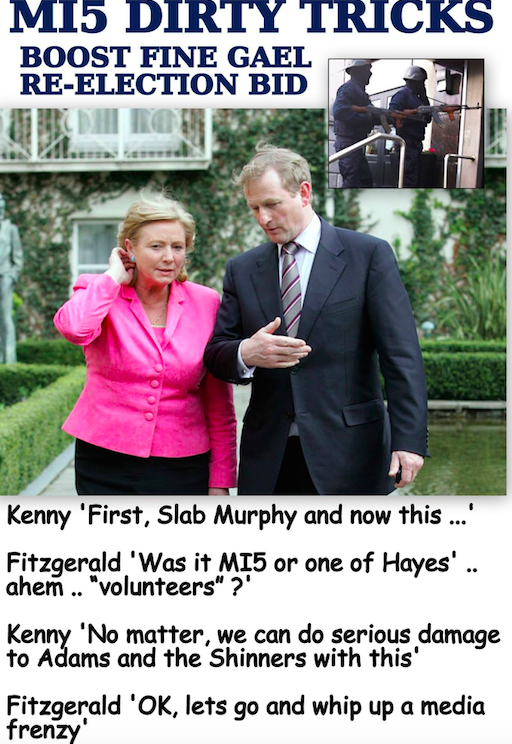
In the immediate wake of the announcement of an Irish General Election, the most public and photographed execution is staged in Dublin. Next a Republican splinter group is purported to have claimed responsibility and to have promised more of the same. It is claimed that the group have a codeword unique to itself. Well, if the Gardai, RTE, BBC and print journalists DON’T THEMSELVES KNOW THE CODEWORD, how can they be so sure they are not being fooled? If they DO KNOW THE CODEWORD surely they don’t think Britain’s highly professional DIRTY TRICKSTERS don’t know it too?
Even if the killings were not set up by MI5, MI6 or other spooks, could not the spooks be exploiting them at a time of political uncertainty? They are creatures of habit. FILTHY HABIT.
As for motive – THE SPECIAL CRIMINAL COURT, which sits without a jury, was intended as an Emergency rather than a Permanent body. But some politicians, with the Balfour bloodymindedness intend to keep it. And media sharing the principles of THE TIMES and THE DAILY MAIL haven’t gone away, you know
whose blog is this, Jude Collins? There seem to be two authors. It’s very wise.
It’s Donal’s, Frank, and no, I don’t have a split personality. If I can persuade Donal to jump through some technological hoops there’ll be just his name but I’m not sure I can…
“A poor thing, but mine own” – Touchstone, “As You Like It.”
Actually he said “A poor virgin, but mine own”, I think, Donal. But in either event, it’s far from poor…
“A poor virgin, sir, an ill-favoured thing,sir, but mine own”
Act V Scene lV
THE OXFORD SHAKESPEARE Complete Works. It’s a verbose passage. probably
shortened by actors and thus improved.
Perhaps other editions use the shorter passage, for I wouldn’t presume to have been
the first to use the easier and more effective line.
Compare the column inches that were devoted to the Omagh bomb and the coverage of the British bombs in Dublin/Monaghan. Only difference in the two were the perpetrators.
It is widely accepted that the Dublin and Monaghan in 1972/73 were a deliberate attempt by England’s Secret Service to influence the Dáil so as to pass the oppressive Offences against the State Act. According to SIPTU General President, Jack O’Connor, speaking on the 40th Anniversary of the Sackville Place and Liberty Hall bombings, which took place on 1st December 1972 and 20th January 1973:
“A controversial amendment to the Offences Against the State Act was being debated in the Dáil when the bombs exploded. A huge swathe of public opinion, including the ITGWU and the Labour Party, was against the introduction of what was perceived as draconian legislation and an attack on civil liberties.
There was also widespread opposition among other trade unions, hospital medical staff, staff and students of universities, mechanical workers in CIE, clergy and even some branches of Fianna Fáil, the party in Government that was introducing the legislation. Senator Fintan Kennedy the General President of the Transport Union and Michael Mullen its General Secretary had spoken against the legislation which they saw as a dangerous infringement on human rights.
In its statement the ITGWU asserted that while it ‘opposed political violence which is directed at civilians, we are equally opposed to the violence that is being done by the Government to democratic institutions and civilised legal procedures.’
As a direct consequence of the bombings the legislation was passed.”
(http://www.dublinmonaghanbombings.org/oration041212.html)
While Labour are now taking the populist option of supporting retention of the Special Criminal Courts, I haven’t heard much from Jack O’Connor or SIPTU on the topic in the present debate.