
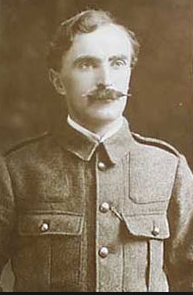
“It is madness, but it is glorious madness.” The famous words of Michael O’Rahilly, more commonly known as The O’Rahilly on Easter Monday 1916, as the Easter Rising commenced. Just hours previously, under the direction of Irish Volunteer Chief of Staff, Eoin MacNeill, The O’Rahilly travelled the country in a frenzy issuing instructions to postpone the Rising. On arriving back to Dublin, early Easter Monday, exhausted and “covered in grime” he was confident a Rising had been averted. Yet, later, “immaculately uniformed” and driving his De Dion car, The O’Rahilly joined the fighting at rebel Headquarters, the GPO, declaring, “well, I’ve helped to wind up the clock, I might as well hear it strike.”
An influential figure in the founding of the Irish Volunteers in November 1913 at Wynn’s Hotel, The O’Rahilly remained loyal to Eoin MacNeill and his faction after the split within the Volunteers. Kept in the dark and sidelined by the Military Council and oblivious to the plans until Good Friday, The O’Rahilly opposed the Rising and supported MacNeill’s decision to call it off. After finding out about the plans for rebellion and the kidnapping of Bulmer Hobson, the O’Rahilly proceeded to Patrick Pearse’s school, apprehended him with a revolver and allegedly said, “whoever tries to kidnap me had better be quicker on the draw.” His arrival on Easter Monday was both a surprise and one welcomed with open arms.
Dick Humphreys, The O’Rahilly’s nephew, had just turned 20 on Easter Sunday, 23rd April 1916. Dick’s Nationalism had been profoundly influenced by his uncle Michael as well as both Patrick Pearse and Thomas MacDonagh as a boarder at Pearse’s school, St Enda’s. After the establishment of the Irish Volunteers, Dick, like many young men, joined the movement. During the Howth gunrunning of July 1914, where 900 Mauser rifles were landed from a private yacht, the Asgard, Dick accompanied his uncle, one of the masterminds behind the operation.
When Dick heard the Rising had initiated on Monday 24th April 1916, he proceeded to the GPO that evening to join The O’Rahilly. Shortly after his arrival, Dick’s mother, the widowed, Mary Ellen, known as “Nell”, had visited the GPO with medals of the Mother of Perpetual Succour and prayer leaflets called the Volunteers’ Shield, previously acquired from the Nuns of the Poor Clare Colletine Convent, for distribution amongst the Volunteers, for protection. Dick was commanded to drive The O’Rahilly’s De Dion on various excursions for supplies, returning to the GPO. On Easter Tuesday evening, Dicks mother Nell returned to the GPO concerned for his safety and well being. As Volunteers looked on, Dick, armed with a rifle, was mortified with embarrassment when he was informed by a sentry “your mother is here, she wants you to go home.” Dick stubbornly refused to budge. Patrick Pearse became involved after Nell had persuaded him to speak with Dick. Pearse said to Dick: “You had better go home. If anything happens to your uncle, there will be no man there.” Reluctantly, shame faced and under pressure from the O’Rahilly and Pearse, Dick proceeded to leave with his Mother. Under the cover of darkness, Dick and Nell proceeded through the desolate and hostile streets. Whilst passing Boland’s Mill, under the command of Eamon de Valera, a shot rang out from the rebel controlled building, narrowly missing both of them.
The next morning, Dick attended early morning mass where he received Holy Communion. After mass, he undertook the unenviable task of slipping back to the GPO amidst the fighting, “he had great difficulty in getting into the GPO building,” according to Annie O’Rahilly. Once inside, Dick was to remain there until there until the end. Professor Michael Laffan has stated that Nell made another visit to the GPO, where “she left him a piece”.
By the end of Easter week, the O’Rahilly commanded the top floor of the GPO. After the decision to evacuate rebel Headquarters as the sustained attack from the British escalated, the O’Rahilly volunteered to lead the charge from the burning GPO to the William and Woods factory. Leading the charge in the green uniform of the Volunteers, sword in hand, a British machine gun cut him and several others down. Fatally wounded, he lay for hours overnight dying a slow death, as blood seeped out of him. Slumped into a doorway, he managed to scribble a farewell letter to his wife as he was heard crying for water, “I got more than one bullet I think. Tons and tons of love dearie to you and the boys to Nell and Anna. It was a good fight anyhow.” Red Cross Ambulance man, Albert Mitchel, approached the body “which appeared to still be alive … When a young English officer stepped out of the doorway and refused to allow us to touch it.” Mitchel questioned the officer and his response was, “he must be someone of importance and the bastards are leaving him there to die of his wounds. It’s the easiest way to get rid of him.” Michael O’Rahilly was buried in Glasnevin cemetery. His two sisters and their friend Austin O’Donoghue were the only people in attendance at his funeral.
Dick Humphreys stayed to the end with the main garrison in the GPO. They surrendered Saturday afternoon, 29th April 1916. He was jailed in Kilmainham where within days, he was transported to Britain and interned in Wakefield Gaol. It took Nell a number of days to find out her son was still alive. She had heard rumours he was killed. Dick was subsequently released during the amnesty of 1917. During the War of Independence, he was to find himself imprisoned in Mountjoy, where he undertook a hunger strike for 10 days with other prisoners, prior to being released.
On 9th May 1916, Nell was arrested, taken to Kilmainham Gaol and then transferred to the Female Convict Prison, along with eleven other women whose offence, as listed in the prison committal register, was ‘rebellion’. Nell, had no active part during the Rising. Radicalised by her detention , the death of her brother and imprisonment of her son, Nell became involved in the struggle for Irish independence, joining Sinn Fein and Cumann Na mBan. During the Irish Civil War, she was imprisoned in Mountjoy and Kilmaimham, at one stage embarking upon a hunger strike.
What a great true story. I never read of the O’Reilly crying for water or that anyone refusrd to tend him as he was dieing. So cruel but then again thats war. Thank you for the post.