
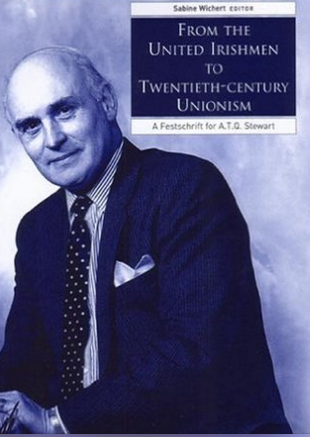
There is a polite convention that one doesn’t speak ill of the dead. In keeping with it a community sought somebody to speak over the grave of a departed curmudgeon and finally chose the local barber, The barber’s words were as eloquent as Lincoln’s at Gettysburg, and, if brevity is truly the soul of wit, a match for those of Demosthenes- “He wasn’t difficult to shave.”
But I think the convention may reasonably be set aside when a commentator seeks, not just to gild the lily, but to canonise a rascal or a brown-nosing sycophant.. Which is why, on 4th January 2011 I sent the folllowing to a friend:
THE TIMES (January 3) carried an obituary of the historian A.T.Q. Stewart whom it described as “the foremost historian of Northern Ireland who dismissed its accumulated myths with a scholarly, penetrating rigour and elegant prose.”
With such an encomium from THE TIMES it comes as no surprise that Mr Stewart was appointed a Commander of the Most Excellent Order of the British Empire “for his contribution to the understanding of Irish history”. Poor Lieutenant Colonel Derek Wilford of the Parachute Regiment’s contribution to that history got that officer a mere OBE, a lesser order of chivalry! In 1937, when THE TIMES carried the obituary of James Bruce Ismay, ex-Chairman of the White Star Line, it didn’t mention the Titanic, of which Ismay was the most noteworthy survivor. So the paper’s Obituaries have at times earned the motto – “De Mortuis Nil Nisi Bunkum.”
Nearly forty years ago I read A.T.Q. Stewart’s first book “The Ulster Crisis: Resistance to Home Rule 1912-1914” which THE TIMES describes as “cast in the mould of a political thriller with tales of gun-running through Ulster ports to equip militant Unionists with the means of resisting a Dublin government, then in prospect.”
It would have been very easy for armed men to resist such a prospective Dublin government, as that government, under Home Rule would not have armed men at its disposal. As for derring-do, I don’t think the obituarist read the book I read. Stewart describes how the aristocracy “in one afternoon raised the sum of a quarter of a million pounds ” and the “business community of Belfast” underwrote the Ulster Volunteer Force in 1913. The year before, that of The Titanic’s launch in Belfast, the total income tax paid by that thriving city was ninety thousand pounds. Stewart reports how Lord Londonderry spoke to Sir Edward Carson :”With tears in his eyes, the peer replied ‘My dear Edward, if I was to lose everything in the world, I will go with you to the end’.”
As the armed anti-Home Rulers would not have to confront armed men serving a prospective Home Rule parliament in Dublin you might think they’d have to confront the forces of the London Government. But they faced no such peril. Sir Edward Carson could boast, and indeed did boast in September 1913 – “We have pledges and promises from some of the greatest generals in the army that when the time comes, if it is necessary, they will come over to us.”
They kept that promise, and the landing of arms for the UVF was not opposed by the Crown Forces.
That threat of war was directed at the British Government. Perhaps that was the stab in the back that the colonists refer to. Algeria mark 1?
By law, the Unionist rebels should have faced the gallows. Oh wait, this is Britain, Britain waives the rules.
Donal
Just to be clear, are you calling A.T.Q. Stewart a brown nosing sycophant?
Let’s say I think he gave a convincing imitation of one.