
Sinn Fein’s first President (1905-1908), Edward Martyn, was a very wealthy and very cultured man. He gave much of his wealth to establish the Palestrina Choir in Dublin’s Pro-Cathedral, the Pipers’ Club in Dublin, and the Abbey Theatre.All of which survive and thrive. The Pipers’ Club gave birth to Comhaltas Ceolteoiri Eireann and the Abbey Theatre to a Ballet School which morphed into London’s Royal Ballet.
On all this, his friend Arthur Griffith, impecunious and more narrowly focussed, cast a cold eye. He thought that Ireland would be better served by the establishment of a daily newspaper with a sound national outlook. Griffith might well have had a point.
Griffith appreciated that British sea power placed one kind of wall around Ireland and British propaganda a paper wall. Griffith and James Connolly and Francis Sheehy-Skeffington did not see eye-to-eye on everything, but all opposed British rule in Ireland and in the Empire, and they all wrote, edited, and printed small circulation papers which were suppressed by the British. Skeffington, the Pacifist, was murdered on the orders of a British officer by cowed British squaddies on Easter Tuesday 1916. The wounded insurgent leader Connolly, a friend of Skeffington, was propped up in a chair 17 days later and shot by a firing squad. And Griffith, though not involved in the Rising, was interned with the surrendered insurgents.
In 1918 the Irish electorate mandated Sinn Fein to set up a Republic and Dail Eireann was established as its Government. The Insurrection of 1916 was history and the armed forces, the Army of the Irish Republic were now the defence forces of a democratically established state. British forces in Ireland were no longer involved in counter-insurgency but in the attempted suppression of the Irish State and the oppression of its citizens.But that is not how British Government propaganda told the story to the world then nor how its champions tell it now.
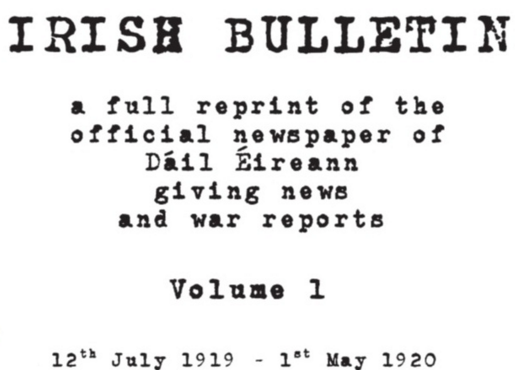
So the elected Irish Government established its own paper to breach the paper wall. It was called THE IRISH BULLETIN. You wouldn’t find it in Eason’s or W H Smith’s nor your usual newsagents. It was clandestinely mimeographed and mailed to journalists, diplomats and selected politicians in Britain and beyond. British Ministers were regularly challenged in the House of Commons to explain events in Ireland by MPs briefed by the IRISH BULLETIN. Two MPs with gallant records in the Great War, Captain Wedgwood Benn (later Lord Stansgate) and Lt.Commander Kenworthy (later Lord Strabolgi) often had the lying Government Ministers on the ropes. The IRISH BULLETIN accounts were denied, but never refuted. The BULLETIN staff worked at the peril of their lives and their equipment moved from place to place in Dublin. It was published daily from 12 July 1919 to December 1921.
The British captured the Bulletin’s address list and printing equipment and, in a Black Propaganda exercise published a counterfeit issue which was laughed to scorn by those who received it. The BULLETIN used a new machine and published the genuine article without missing an issue.
The gathering of information from all over Ireland in 1919-1921 under enemy occupation involved great organisation, none of it paid. The writers included Lawrence Ginnell, Desmond Fitzgerald, Erskine Childers, Robert Brennan and Frank Gallagher. Childers was world-famous for “The Riddle of the Sands”, Fitzgerald was a published poet whose international contacts were invaluable. Robert Brennan, who later served as Minister in Washington, was an experienced journalist and an entertaining writer, whose memoir “Allegiance” has some wonderfully funny anecdotes. On a more serious note, he was the author of Sinn Fein’s 1918 Election Manifesto, probably the most electorally successful political manifesto in history. His daughter, Maeve Brennan ,became a columnist for THE NEW YORKER. A great nephew of hers, Roddy Doyle, also makes a living as writer.
But the greatest and longest running input came from a 22 year old Corkman, Frank Gallagher who had been Editor of the Cork Free Press. He was a longtime Editor of the IRISH PRESS. His account of the years 1918-1921, THE FOUR GLORIOUS YEARS, was published at Christmas 1952 and I used the book token sent me by my Aunt Eileen to buy the book and have it autographed by the author, whose daughter was a classmate of my sister. A wonderful book, and his account of THE IRISH BULLETIN is inspirational.
You’d imagine that the official bulletin of Ireland’s first democratic government would have been reissued by an Irish Government, or an Irish university, or some other reasonably competent and reasonably funded learned body.
That is, if you hadn’t been watching such institutions these past few decades.
But, but, Ireland has not completely run out of brains, hearts, guts and public spirit. The Aubane Historical Society and Belfast Historical and Educational Society have produced three volumes, so far, covering 12 July 1919 to 1st January 1921, a total of 1668 pages, and they intend persevering in the work until everything published between July 1919 and December 1921 is widely available.
But England too produced one heroine whose story should be recorded here. The mother of Edward MacLysaght. Edward had a copy of every issue of the Bulletin on his farm in County Clare. His mother borrowed a couple of issues to read on the train from Killaloe to Limerick in February 1921. The train was stopped by Crown Forces who arrested Mrs MacLysaght and court-martialed her in Limerick for possession of the paper. She was sentenced to one month’s imprisonment or a £20.00 fine. She chose imprisonment, but her husband, who arrived home that day after a long business trip to Australia, insisted on paying the fine.
The British Government had reason to fear THE IRISH BULLETIN in 1921. Today the apologists for British rule in Ireland, the mercenary hacks, begrudgers and Gobshites With Attitude have reason to fear it still.It does not contain recollections written in tranquillity but the immediate reality of a war waged on largely defenceless Irish citizens by a merciless Imperial enemy.
To the ROLL OF HONOUR of those who produced THE IRISH BULLETIN between 1919 and 1921 should be added the names of those who have republished it including Jack Lane, Brendan Clifford, Philip O’Connor,Geraldine Conway, Jenny O’Connor, Angela Clifford, Sean McGouran and Cathy Winch. They did it as a labour of love.
And I recommend their work with pleasure.
First class blog Donal. A wealth of information. Thanks.
Where can we obtain a copy of this now Donal ??
see Jude’s facebook page for advertisement .
http://www.atholboooks-sales.org/online-catalog.php?s=70&np=19
Belfast Historical & Educational Society
Sinn Fein bookshop, Falls Road, Belfast