
Remember that appalling and irrelevant video the Irish Government rolled out to mark the Centenary programme of the Easter Rising? That same video that did not mention the Rising, the executed signatories to the Irish Proclamation and in actual fact, it had nothing at all to do with the Rising? Remember the state commemoration of Jeremiah O’Donovan Rossa last year, where it was wrongly and inaccurately claimed that on his death bed, he was a convert to constitutional nationalism and a supporter of Home Rule? Remember RTE’s Rebellion programme … Ok I could go on. The conspicuous nature of this revisionist mentality will continue to permeate through society as we approach the 100th Anniversary of the Easter Rising. All this contrived political correctness has gone mad and in essence only served to try and rewrite the history of 1916.
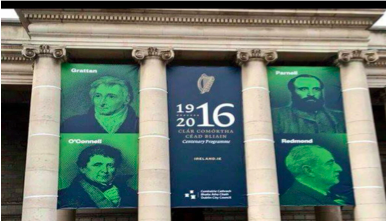
Something as absurd has recently appeared. Dublin City Council have erected a banner at the Bank of Ireland building at College Green. On the 1916 centenary banner, uniquely, it emblazons the pictures of four constitutional leaders of Irish Nationalism throughout the 18th, 19th and 20th century: Henry Grattan, Daniel O’Connell, Charles Stewart Parnell and John Redmond. What relevance do these four leaders have to the events and significance of 1916? These four constitutional leaders who were supporters of Home Rule at various stages, and had absolutely nothing to do with the 1916 Easter Rising. On the flip side, the leaders of the Rising had absolutely nothing to do with the four constitutional leaders, if anything their Rising was an assault on the constitutional politics they stood for. The same Easter leaders were disillusioned with, loathed and despised constitutional politics. The advocates of constitutional nationalism were viewed as traitors by the men of 1916. Of the seven signatories to the Irish Proclamation, their distaste for constitutional politics was so great only one stood for political office in their lifetime, Connolly’s unsuccessful attempt to be elected on Dublin City Council, that same council who seemed to have forgotten him. If anything, these four constitutional leaders would have been appalled by the events of 1916 as they were with other Irish rebellions. Can anyone make the assimilation between 1916 and these constitutional leaders? Nope! Nor can I! Why have these constitutional leaders appeared on a banner to commemorate 1916?
Home Rule and the ideology of 1916 were opposing traditions and it is historically wrong to link them and try to equate them through the Centenary commemoration. If anything, the 1916 Easter Rising was a repudiation of the Home Rule movement and the failed attempts by those who tried to achieve limited legislative independence, under the remit of British rule. Putting the 1916 Rising into context, and in the words of the Irish Proclamation it was in tradition with establishing national freedom and sovereignty by “asserting it in arms.” The same arms taken up by the United Irishmen in 1798, Robert Emmet in 1803, the Young Irelanders in 1848 and the Fenian movement in 1867 – all periods of militant revolution, that aimed like the leaders of 1916 to establish an Independent Irish Republic. Why does this banner not make reference to the militant tradition of Wolfe Tone, Robert Emmet, Young Ireland, the Fenians and even the 1916 Easter Rebels? Is Dublin City Council embarrassed with the 1916 Leaders and subsequent events, like the State are? Why are they choosing to airbrush and rewrite history? Surely, they claim the Easter Rising was a seminal event in the creation of the Independent state, yet their revisionist mindset is clearly redrafting the narrative.
I am not claiming that the four leaders of constitutional nationalism should not be commemorated, of course they should. But, perhaps this context is historically wrong and inappropriate. To connect them to 1916 is wholly ridiculous and revisionist injustice. Grattan had short term legislative success. He was a devoted constitutionalist who had witnessed the 1798 rebellion and the consequences it had on his Parliament. Once a member of the United Irishmen, O’Connell abhorred violence, “liberty is too dearly purchased at the price of a single drop of blood”, even though some of his rhetorical speech were quite militant in nature. His fallout with Young Ireland indicated his unwillingness to support militancy. Parnell, although linked to violence, was keen to bring revolutionary Nationalism under his control and into constitutionalism, with the New Departure. Redmond, the only constitutional leader of the four alive during the Rising was totally against the events of Easter 1916, referring to it as a “misery” and “heartbreaking.” Redmond condemned the actions of the leaders and supported the actions of the British, “It has been dealt with with firmness, which was not only right, but it was the duty of the government to so deal with it.” The banner – I’m struggling to comprehend it’s purpose or reasoning – in those famous words of Diarmuid Ferriter, it is “unhistorical shite.”
If it was accurate it would only be “historical shite” anyway.
Maybe it’s an attempt to move away from the cult of violence?
You are having us on, MT?
Rupert Brooke, an overprivilleged Englishman on the outbreak of War in 1914 –
“Now God be thanked, Who matched us with this hour”
There’s scarcely been an hour since when Englishmen, and their uncritical admirers have
not been in lethal conflict with other peoples. And they’ve had sycophants, paid and unpaid
lauding their cult of violence.
Most Irishmen engaged in lethal violence since Rupert Brooke thanked God, wore British
Uniform and were paid for so doing.
“Ireland accepts the generally recognised principles of international law as its rule of conduct in its relations with other state” BUNREACHT NA hEIREANN enacted by the free electorate in
1937.
Precisely my point (although don’t agree with your wording), MT – revisionist mindset trying to move away from the past and rewrite it! The past cannot be denied although some are trying to deny it!
“Precisely my point (although don’t agree with your wording), MT – revisionist mindset trying to move away from the past and rewrite it! The past cannot be denied although some are trying to deny it!”
As a general comment, there’s nothing wrong with revisionism. I’m fact it is a very necessary process in improving our understanding of history.
I’m not disputing revisionism in a general sense (I agree, revisionism at times is both necessary and benefical) – but, specific to the article, revisionism can purposely distort historical fact, deviate from the truths of the past and clearly misinterpret an event – which is in its own right, is dangerous. To quote Lewis again, “their aim is to amend, restate, replace or even recreate the past in a more satisfactory form.” This is clearly the case with this banner. I’ve yet to hear rational justification as to why Dublin City Council have chosen to run with the four leaders of constitutional nationalism. Clearly, we see an attempt to airbrush history for whatever unknown reason that in my opinion makes no sense.
Ciaran
Have you tried contacting the organisers to ask what the relevance of the banner might be?
My own purely speculative guess is that it is an attempt at providing context to the rising, possibly reflecting a certain ambivalence about the violent methods used.
As if to say:
“Look here all you tourists we’re not just a bunch of fighting bogmen. We tried the peaceful way for long enough before this happened.
Oh for God’s sake, gio – contacting the reasoning behind putting up a banner that depicts people who had nothing to do with/were opposed to the Easter Rising, under the headlines of the Easter Rising. You don’t need contact and discussion to see that that’s absurd.
Jude
Are you speaking for Ciaran?
His post was asking the question, as he is clearly baffled.
Perhaps asking the people behind it might have drawn out some detail on the thinking.
But you are right. Best just to work on assumption.
Another example of a country embarassed by its history. Would America ever have their fourth of July without George Washington? absolutely not. Not having any of the signers of the proclamation is bad enough but to include John Redmond makes it all the worse, a man who not only advocated Irish men to fight for England in WW I , but as the article states fully supported the measures taken by Gen R Maxwell in executing the leaders and others as well. Shameful but not surprising, as the Irish Govt has attempted to airbrush the Rising. Not surprising, as the newly formed government executed Mellows, O Connor, McKelvey and Barrett and perpetrated such outrages as the Ballyseedy massacre.
“Another example of a country embarassed by its history. Would America ever have their fourth of July without George Washington? absolutely not. ”
Very poor analogy. Washington led a mandated army accountable to the people’s representatives and in pursuitof their wishes. Nothing to be ashamed of and a far cry from the 1916 rebels.
I must have missed the part in American history where the American people gave a democratic mandate to the Continental Congress to sever ties with Britain. Can you pioint me to the source that says a clear majority of Americans were in favour of this?
Furthermore, how can we realistically say that the people of Ireland definitely opposed independence in favour of home rule? Home Rule was the only electoral choice nationalists had, so nationalists of all stripes voted for it. When a realistic alternative emerged as an electoral choice in 1918, the majority of nationalists voted for that.
The only thing shameful about 1916 is that a century on we still have cowering West Brits like yourself shaking & shivering from colonial cringe.
“I must have missed the part in American history where the American people gave a democratic mandate to the Continental Congress to sever ties with Britain. Can you pioint me to the source that says a clear majority of Americans were in favour of this?”
It was the 1770s. There was no universal suffrage then.
“Furthermore, how can we realistically say that the people of Ireland definitely opposed independence in favour of home rule? Home Rule was the only electoral choice nationalists had, so nationalists of all stripes voted for it. When a realistic alternative emerged as an electoral choice in 1918, the majority of nationalists voted for that.”
The onus was on those advocating independence to stand for election and seek a mandate. And the onus is on you to provide evidence of anysignificant, never mind majority, support for a violent republican rebellion. There isn’t any.
We can only hope Unionism and the British Government will move away from the cult of violence, sectarianism and bigotry MT.
As Ó Direáin observed, money talks.
Éire Ina bhFuil Romhainn
“…Mar ní tú feasta…/Céile an Phiarsaigh ná rún na laoch,/Ach más éigean an cumann a chur i gcrích/Agraim thú a shearc na bhFiann,/Gan ceangal leo gan raidhse dollar.”
To Ireland In The Coming Times
“…For you are no longer…/the mate of Pearse nor the beloved of heroes,/But if the attachment must be consummated/Let me beseech you, you darling of the Fianna,/To make no contract without wads of dollars.”
Looks more like an advertising billboard from afar. If I was American I’d be saying, “Oh here look Martha, Guinness have got a new ad up”
Ronan Fanning, makes a worthwhile contribution to this debate in today’s Sunday Times – he cites Benard Lewis, historian of the Middle East, “Lewis has written of how those in power control to a larger extent the presentation of the past, and seek to make sure that it is presented in such a way as to buttress and legitimise their own authority.” This applies as much to the Middle East as it does to today’s Ireland.
Lewis goes on to say, there are those who “rewrite history not as it was, or as they have been taught it was, but as they would prefer it to have been.”
Redmond was the man who, along with the British Government, fooled and tricked tens of thousands of Irish men to give their lives in WW1. They were promised Home Rule in return but this promise was empty and false from the beginning. Even Indians too were promised home rule and they were bluntly denied this once WW1 was over and thousands of them died in the muddy trenches of Europe. Their sufferings and deaths were for English Imperialist toffs.
Edward Carson did the same to those Loyalists. He told Loyalists to fight for “King and Country”. The Ulster Division was used as cannon fodder. In one day alone over 5,500 Loyalists died when they “went over the top”. It was said that many shouted “Fuck the Pope” and “One for the Shankill!” as they ran into a hail of German machine gun fire wearing Orange sashes. Indeed, the Ulster Division was given the nickname: “the suicide division” by some Loyalists then. They didn’t die for freedom, as is often asserted, they died for British Imperialism. That’s what WW1 was all about. Its important to remember Britain declared War on Germany, not Germany on Britain.
The politicians in the South, especially those from Fine Gael, are nothing but Free State traitors. They fear any threat to their cartel that they have set up in the 26 counties over these past 9 decades and hence are engaged in history revisionism, much like the Unionists in the North, who lost their own wee cartel when Stormont collapsed in 1972.
Excellent article. Clearly illustrates the apologist attitude of some of those in positions of power in the South. Why bother commemorating 1916 and ignoring the truth of it? Using people not connected to the Rising is like commemorating the Boyne with no reference to King Billy.
Gearoid
Are the 1916 commemorations making no reference in all the planned events to the likes of Pearse and Connolly or Tom Clarke?
I am shocked.
Well said
Similar situation in Waterford City w/ recent 1916 Commemorative notice featuring a photo, taken in July 1922, of victorious Free State soldiers, commanded by American Prout and Waterford’s Paul, outside the Granville Hotel.
Perhaps attributable solely to historical ignorance?