
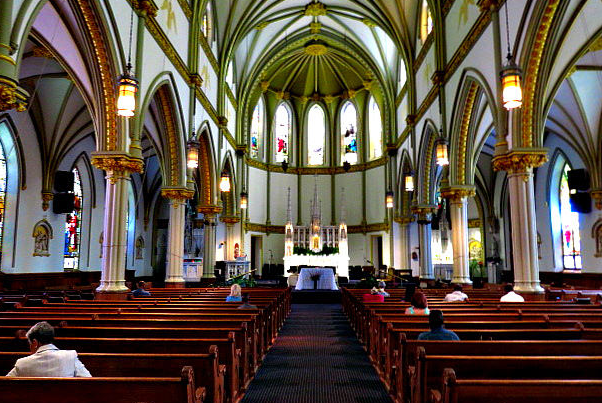
One of the questions asked at the Second Vatican Council was – “what’s the point of having a Latin Liturgy?” This was before Jumbo Jets and “mass tourism” – no pun intended, and if you tell me their decision was divinely guided, I can’t Adam and Eve it.
I was a few weeks in London and had decided that Cockney speech was the most ‘orrible sahnd wot hever hemanated from hanimal horiface and once a week was consoled by
a blessed half hour or so at a Latin Mass. I felt at home there, as I still do in the embrace of the Catholic Church, the greatest collection of sinners you could meet. And then the
liturgy was translated into English. The Church of England adopted an English Liturgy when that language was at its most powerful and beautiful, but I was not enamoured with
the new rite particularly when zitty yoof with guitars and all the musical art of a Cliff Richard or a Rolf Harris strutted their guff before the altar. And then many of the churches
had their sltars stripped. What had the Council been smoking – Pol Pot?
And then they laid the Holy Ghost and de-Anglicised and Latinised it as The Holy Spirit. What blessed inconsistency and incoherence. Those of us brought up with the Latin
liturgy could get Missals with Latin side by side with a language of their choice. My father, who liked to keep in touch with the French he’d learned from his teacher parents
had a Latin/French Missal, and my elder Brother a Latin/Irish one.
When holidaying on the continent which I do frequently, I delight in worshipping in old or even ancient churches, for very few Catholic churches in these islands are even 200
years old. During the Penal Days when Mass was celebrated in nooks and crannies or on a rock on a hill or in a glen, students for the priesthood smuggled out to Salamanca,
Paris, Louvain, Prague and Rome must have been awed by the beauty of their churches, but familiar with the liturgical language common to them. Today I’m at a loss in
such places because I can’t speak or read their languages.
For my sins, and they must have been many and grievous, I spent two years in a boarding school run by the Holy Ghost Fathers – Congregatio Sancti Spiritus, shortened
to C.S.Sp. which we translated as “Cigarette Smoking Strictly Prohibited.” Nowadays they call themselves “Spiritans” like some patent carpet cleaner or quack medicine.
They were a fine body of men and damned good rugby players. I don’t know what got into them.
A few years ago, with my long-suffering English wife, I holidayed in Connemara and went to Sunday Mass in Spiddal, the capital of that Gaeltacht, expecting to worship in
the vernacular. For some perverse reason the Mass was in Sacs-Beurla (literally the twittering of Saxons) the Second Official Language of the State. After reading the Good News
of the Gospel, instead of a sermon the priest gave evidence of his crisis of faith and apparent despair. If he’d done so in Irish, like Mary Kate Danaher’s confession to Father
Lonergan in THE QUIET MAN, his shame would be kept in the immediate neighbourhood, but to tell the World and my Lancashire Catholic wife (Anthem: “Faith Of Our Fathers”)
was letting the side down.
These are, you’ll recognise, the meanderings of a man past his prime, who needs to get up at least once a night and sometimes wears hearing aids, and sometimes, for
greater convenience, does not.
David Lodge, an English Catholic whose earliest novels, such as “THE BRITISH MUSEUM IS FALLING DOWN” and “HOW FAR CAN YOU GO” briliantly and wittily
explored moral dilemmas and scruples unintelligible to Catholics now under 50, wrote about losing one’s hearing in “DEAF SENTENCE” . (He also wrote “GINGER YOU’RE
BARMY” about National Service, in which the only sympathetic character was a conscript from an Irish family, who helped the IRA.) But that’s another story. When one’s
BARMY” about National Service, in which the only sympathetic character was a conscript from an Irish family, who helped the IRA.) But that’s another story. When one’s
hearing starts failing, one hears vowels clearly but cannot distinguish consonants so well.
It seems our Irish-speaking ancestors understood this very well. My late father learned enough Irish for his Matric in 1919 but remembered little of it. But he told a joke in
Irish he’d heard from a friend which I recognised as very funny at the time, and only appreciated its scientific accuracy when I read David Lodge.
A farmer in his 70s took a bride of 20. He sought advice from an Oracle in Lisdoonvarna on the prudent fulfilment of his duties.All as Gaeilge. The Oracle advised –
“Dha uair sa MHI agus mi gan TADA.” “Wha?” went the Greybeard, not once, but several times, and the Oracle repeated his prescription just as often. Finallly
his Bride shouted in his ear – “DHA UAIR SAN OICHE – AGUS ARIS AR MAIDIN!”
I’ll bet she wasn’t long in inheriting the farm.
Excellent article
Jaysus, she must have been a brave woman!
I only discovered the Latin liturgy about six years ago; I was about 22 and at college in Dublin. I felt like a great treasure had been hidden from me my entire life; concealed behind polyester vestments, felt banners, terracotta chalices and tambourines.
By comparison the old mass was a trove of beauty, reverence, soaring sounds and evocative scents. It completely renewed my faith, everything from the language, to the chant, to the incense, the vestments, everything drew the mind of the congregation toward God. The modern mass seems to be turned inward with focus on the people, or worse – the priest.
Interesting points, Kevin. I think much of what you and Donal say is true. But my major stumbling block is that I was very good at failing Latin at school, so the Mass in Latin made little or no sense – the words, that is. Not sure that heading back to those days when we as altar boys chanted ‘Ad deum quae laetificat, juventutem meam’, which could have meant “Ice lollies, 3d and 6d for the big ones!” for all we knew…
I wish I’d been given the opportunity to fail Latin Jude! It had long since been consigned to the dustbin of history in Downpatrick when I was at school.
I know what you’re saying. It just has never been an issue for me because the Latin mass I go to has Latin/English missals for the entire congregation so I was able to follow everything from day one. After a while the rhythm of the prayers becomes very comforting. When I’m at mass abroad and here “Introibo ad altare Dei” it stirs something deep within me.
I know what you mean, Kevin. My daughter graduated from Oxford and I attended the ceremony. Guess what? Not a word of English from start to finish. All Latin. I didn’t understand more than a phrase or two but it was impressive. …