
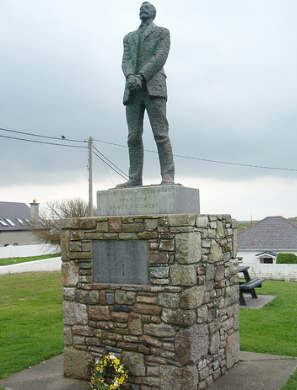
THE TIMES, on August 4 1916, carried an Editorial which, as part of its continuing commemoration of the First World War, it reprinted on August 4 this year. I reproduce its heading and opening paragraph below.
“THE EXECUTION OF CASEMENT
Casement paid the last penalty for the greatest crime that it is possible for any man to commit against his country. No one even questions the justice of his fate.He had a trial of acknowledged and even exaggerated fairness. Every possible assistance was accorded him in meeting charges to which in fact there was no defence.Such agitation as there has been for a reprieve has admitted that the case for clemency must turn purely on questions of expediency; and of that case the Government, who must be presumed to have full knowledge of all the relevant considerations, are the only possible judges.It is in this conviction that we have absolutely refused during the last few weeks – in spite of some very curious pressure – to have the case retried in these columns. Newspapers have many and great responsibilities, but the function of a final Court of Criminal Appeal is not one of them.”
It seems to me, unlearned in the law as I am, that an Irishman, arrested in Ireland, for a crime against his country, might more appropriately be tried, in his own country, by his own countrymen or own countrywomen. Not having the many and great responsibilities of a newspaper I suppose I have no locus standi.
Back in the Dark Ages before colour television I watched a British TV programme about Casement’s trial. One of the commentators, a very learned ex-diplomat from the Irish Department of External Affairs, suggested that one rum feature of the trial was the role of the Chief Prosecutor, Sir F.E.Smith, Attorney General of England. Not only had Smith’s political career been driven by opposition to (Parliamentary) Irish Nationalism, but, between 1912 and the outbreak of the Great War, he had helped organise and arm the Ulster Volunteers, who were pledged to fight against the British Army if the British Parliament and Government ceded Home Rule to Ireland.The Ulster Volunteers, bankrolled mainly from London, had acquired 50,000 rifles FROM GERMANY in early 1914 and Smith, and his predecessor as Attorney General Sir Edward Carson, had fomented disaffection amongst British Army Officers who made clear they would not oppose Carson’s private Army.
Recently, on my all-colour, multi-channel, all-singing-and-dancing TV set I stumbled across a pre-recorded programme on the Parliamentary Channel, where a serving official of the Irish Department of Foreign Affairs, His Excellency Daniel Mulhall, Ambassador to the Court of St.James, was hosting a discussion on Casement. I was astounded to hear a Professor named Sean McConville of Queen Mary University, London, assert that Casement’s trial was fair and above board.
I was further taken aback when that scholar produced a copy of Casement’s writings “The Crime Against Europe” with “The Crime Against Ireland” published by Athol Books to support his case that Casement was clearly a traitor.
I first came across those writings when I bought them outside Pentonville Prison on 3rd August, the Centenary of Casement’s execution. The excerpts quoted by the Professor had been printed in July 1913 in The Irish Review in Dublin, in a piece called “Ireland, Germany And The Next War” and was in answer to a piece by Sir Arthur Conan Doyle called “Great Britain and the Next War” in the Fortnightly Review. (Casement’s “Treasonable” piece was published 8 months BEFORE F.E.Smith’s friends bought 50,000 rifles from Germany.) Arthur Conan Doyle was one of many favoured writers who had been brainwashing the British public for nearly ten years with warmongering propaganda against Germany, and Casement’s piece was a reasoned reply to it.
Professor McConville did not give the context the pieces he quoted.
Unfortunately he so angered me that I turned off the programme, intending to find it on “playback” when I cooled down. Alas, I was unable to do so. The learned ex-diplomat who, in the black -and-white days, highlighted the rum role of F.E.Smith, was Conor Cruise O’Brien.
Casement’s authentic writings are very interesting and reflect well on him. They should be better known.
The quote from Professor McConville illustrates that there are many Irish people and people of Irish extraction who will use their “expertise” to assert England’s right to the piece of territory she most covets. A territory which she as struggled and will struggle,cheat, lie suppress, imprison and murder to secure. The territory I refer to is The High Moral Ground.
I am surprised to hear Sean McConvilles comment. I have met him and thouht him to be fair and pro Republican. Jaysus you can trust nobody!!!!