

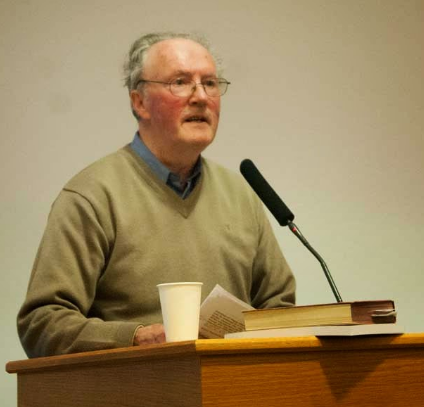
DEBATE AT NLI.
EXTRACT FROM PODCAST AVAILABLE ON HISTORY IRELAND WEBSITE
Yeats 150
Published in podcasts channel
@ National Library, Kildare Street, Dublin 2. 7pm Fri 12 June 2015
Roy Foster, Catriona Crowe, P.J. Mathews & with readings by Theo Dorgan
In her contribution Caitriona Crowe speaking about Maud Gonne’s relationship with men said:
“She had a very bad time with Lucien Millevoye, who was not a nice man. She had a very bad time with John MacBride, who was not a nice man, despite his many qualities, just in case any relatives are here…”.
During questions from the floor a verbal exchange occurred between Anthony J. Jordan and Professor Roy Foster on allegations made against Major John MacBride.
Jordan speaking from floor said:
“Unlike Caitriona Crowe, I think John MacBride was a very nice man. John MacBride has suffered due to what Yeats has said about him and about what Maud Gonne said about him and what Yeats wrote to Lady Gregory about him. And when people put that in their books, as Nancy Cardozo did, they don’t emphasise that there was good reason for Yeats to hate MacBride. And Roy Foster, if he doesn’t mind me saying, has been the poster boy in that area: condemning MacBride and without emphasising enough the reasons behind Yeats’ hatred and also mentioning the fact that MacBride faced the charges that were made against him in a French court and he walked out innocent. Now I’m disappointed but not surprised Roy, that in your recent book “Vivid Faces”[i] you continue to repeat the mantra about MacBride. And while you do refer to my two books on the subject you regard them as ‘defensive’[ii] . One of my problems is there is a whole wealth of material in the National Library here in the Fred Allen Papers”.
Foster intervenes saying;
“I’ve looked at it”.
Jordan continues:
“You have looked at them, but I think that is what you have done, with respect, looked at them. But could I bring to your mind and to the mind of other people who want to have a genuine look at this: Caoimhe nic Dhaibheid[iii] has published a very long article in the Irish Historical Studies based on her research on the Fred Allen Papers. And there’s a new book out from a lady in Oxford called Senia Passeta[iv] on Irish Women in Nationalist Ireland. She had also studied those papers and she comes to a very different conclusion than you. I think that in the run-in to Easter 2016 people should try and keep an open mind about Major John MacBride.
Foster replies:
“ O.K I’m just going to say two things; I know Caoimhe nic Dhaibheid’s article very well and she certainly does not take a different line to me; I know Senia Passeta’s work possibly even better, nor does she exonerate MacBride from those charges . I think it very odd that the word of someone who was abused, who told both Francis Stuart and Ezra Pound that she was abused by John MacBride, that her word should not be taken and that the word of the abuser should be taken instead. There is other evidence; there is other testimony than the testimony in court because Maud would not bring Iseult into court. But you will find as I’m sure you know both in Francis Stuart’s writings and in Ezra Pound’s writings that they testify that Iseult told them that MacBride had made advances to her”.
Jordan intervened to say “Iseult hated MacBride from the start” to which Foster responded… “It’s the victim’s angle and I find it very odd that the victim’s evidence is not taken seriously”.
[i] . Foster Roy, Vivid Faces The Revolutionary Generation in Ireland, 1890-1923 Penguin 2015.
[ii] . . Jordan Anthony J. Jordan ‘Willlie Yeats and the Gonne-MacBrides. Westport 1997. + The Yeats Gonne MacBride Triangle Westport Books 2000. P. 141 ‘It is my view that there is no moral or legal justification for Foster to write ‘ the truth was spectacularly shocking’ and ‘the catalogue of MacBride’s crimes’. What actually happened in the disputed case must remain conjecture. In the meantime, John MacBride has the right not to be denigrated. His good name stands …Could it be, that those who seek to worship Yeats, feel that they too must vilify Major John MacBride, in deference to their Master?”
[iii] . nic Dhaibheid Caoimhne no. 144 November 2010 issue of Irish Historical Studies. “ The veracity of the charges against MacBride centring on the crucial issue of the alleged molestation of Iseult, has attracted some historical attention in recent years, largely as a result of the energetic writings of Anthony Jordan, who has been anxious to correct what he views as ‘the easy acceptance of other people’s prejudices and errors [ Irish Literary Supplement 1998]…that she fabricated a series of fantastic charges that, according to Jordan, were unproved: MacBride emerged [from the divorce court] an innocent man. The target of Jordan’s argument has been a number of biographies of WB Yeats, particularly Roy Foster’s landmark 1997 The Apprentice Mage. The most recent analysis of the divorce refrains from overt judgement on these difficult questions, but appears to endorse Jordan’s position”.
[iv] . Paseta Senia, Irish Nationalist Women 1900-1918. Cambridge University Press 2013. Pp. 92-99.Senia Passeta of Oxford University has recently researched in great detail the breakup of the Gonne-MacBride marriage. Her measured summary says, “Maud Gonne’s near-exit from public and Irish life was triggered by her unfortunate marriage in 1903 to John MacBride and, more destructively, by their separation in 1906”.
Comments are closed.