
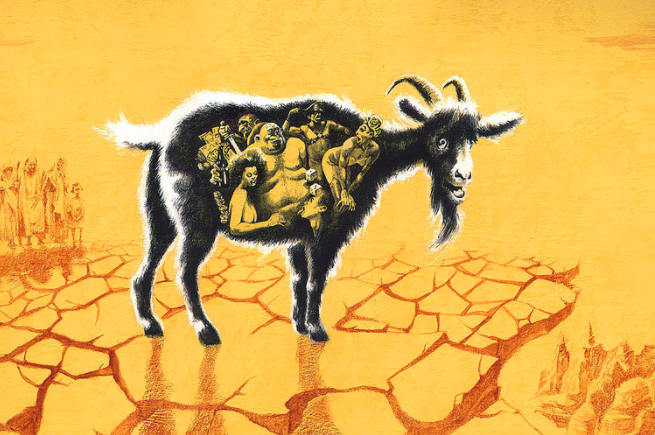
Richard Rohr is a serious spiritual writer and Franciscan priest based in New Mexico who tackles all the big questions in his writings. I think he helps us to understand a lot about religion and the world we live in and about ourselves. He is a deep thinker and a man who practices what he preaches. One of the big questions he asks is: Who runs your life? You or your ego? You or your thoughts? It is an important question. It is necessary to distinguish between yourself and your thoughts. You are not your thoughts. It may take time to discover that because we are so programmed or brainwashed. It may be difficult to become an observer, observing your thoughts and your reactions. The consequences of not making that distinction can be disastrous. It results in the practice of scapegoating others for your own problems. That can have terrible consequences as we see all too clearly in history and in the world today.
Richard Rohr states: “If your ego is still in charge, you will find a disposable person or group on which to project your problems. People who haven’t come to at least a minimal awareness of their own dark side will always find someone else to hate or fear. Hatred holds a group together much more quickly and easily than love and inclusively, I am sorry to say.”
If you want to understand the Bible and its radical relevance for the world and for ourselves today you might focus on this notion of scapegoating. It is so prevalent throughout human history. It is first highlighted in the Old Testament (Leviticus 16) when on the Day of Atonement a priest laid hands on a goat and put the sins of the people of the previous year onto it. The goat was then beaten and tortured and was ‘escaped’ into the desert to die. “And the people went home rejoicing, just as European Christians did after burning a supposed heretic at the stake or American whites did after the lynching of black men. Whenever the “sinner” is excluded, our ego is delighted and feels relieved and safe.” But Rohr concludes: “It sort of works, but only for a while. Usually the illusion only deepens and becomes catatonic, blind, and repetitive—because of course, scapegoating did not really work to eliminate the evil in the first place.”
This is a powerful insight and explains an awful lot about the Bible and about the world as we know it. It is forever the primary example of how human beings, who are not aware, get involved in so much cruelty and evil.
“In the New Testament we discover that Jesus came to undo this illusory scapegoat mechanism, which is found in every culture in some form. He became the scapegoat to reveal the universal lie of scapegoating.”
It seems “the sin of the world” referred to in the gospel is ignorant killing, hatred, and fear. As Blaise Pascal so insightfully wrote, “People never do evil so completely and so cheerfully as when they do it with a religious conviction.”
“The Gospel is a highly subversive document. It painstakingly illustrates how the systems of both church and state (Caiaphas and Pilate) conspired to condemn Jesus. Throughout most of history, church and state have sought plausible scapegoats to carry their own shame and guilt. So Jesus became the sinned-against one to reveal the hidden nature of scapegoating, and we would forever see how wrong power can be—even religious power!
Jesus says from the cross: “Father, forgive them, for they don’t know what they’re doing” (Luke 23:34). The scapegoat mechanism largely operates in the unconscious; people do not know what they are doing. Scapegoaters do not know they are scapegoating, but they think they are doing a “holy duty for God” (John 16:2). You see why inner work, shadow work, and honest self-knowledge are all essential to any healthy religion.
“The vast majority of violence in history has been sacralized violence. Members of ISIS probably believe they are doing God’s will. The Ku Klux Klan used the cross as their symbol! With God on your side, your violence becomes necessary and even “redemptive violence.” But there is no such thing as redemptive violence. Violence doesn’t save; it only destroys in both short and long term. “
Jesus replaced the myth of redemptive violence with the truth of redemptive suffering. He showed us how to hold the pain and let it transform us, rather than pass it on to the others around us. Spiritually speaking, no one else is your problem. You are first and foremost your own problem. There are no bad goats to expel.
Excellent article I endorse every word.
Thank you so much Joe. So helpful and succinct. You demonstrate that Christianity if properly understood still has huge relevance for today’s problems, both locally and globally. Unfortunately, for the most part the churches (protestant and catholic) are lumbered with out-dated and formulistic penal substitution atonement theology that falls well short of your (and Rohr’s) important understanding. Thankfully this is increasingly being called into question by theologians and thinkers and alternative understandings such as you have expressed are increasingly coming into focus. (The fact that it has now sprung up here in Jude’s blog demonstrates this). However it will be many years for these views become mainstream. Meanwhile the out-dated formulisitc narrative still dominates most sermons and liturgical expression, allowing a shallow caricature of what it means to be christian be the main perception of many in secular society toady.
Penal substitution atonement theology? Eh!