
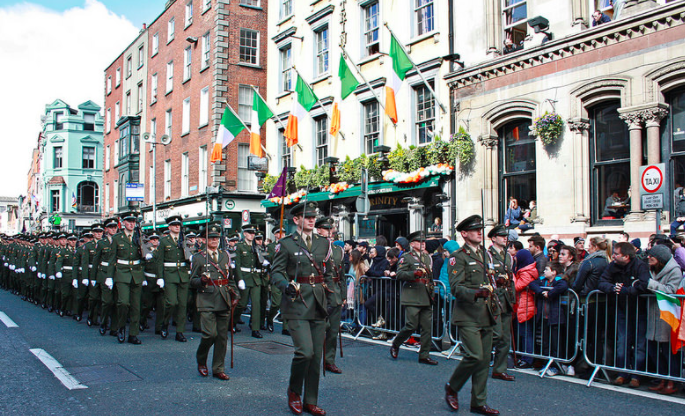
As the US gathers itself to enter a new era – probably (and ohpleasegod) the Hillary Clinton era – Ireland looks back on the centenary year that paid homage to the leaders of the Easter Rising. We don’t know how things will develop in the US; we can reflect on what difference the commemoration of 1916 has made in Ireland.
My own feeling has been one of deep disappointment. Like most Irish people, I had circled the year on my mental calendar. It would be an opportunity for the Irish people to assess how far they’ve come and what if anything remains to be done. It would contain unforgettable exhibitions, speeches and drama. If the marking of the Rising in 1966 had been exhilarating – and it was – 2016 would be twice as good.
It wasn’t. When I look back on the year, I can’t recall a single exhibition which brought home the fierce commitment of those who gave their lives for national freedom. And I’d rather forget that ghastly commemorative video the Irish government launched, where Bono and Apple replaced Pearse and Connolly. I can’t recall a single speech that was truly memorable, in the way Pearse’s speech at the graveside of O’Donovan Rossa was memorable, or even JFK’s speech as he prepared to end his 1963 Irish visit. Granted, people respond to speeches differently; but I don’t recall anyone saying to me “Did you hear that speech? Fantastic!”
As for dramas, the most memorable was the RTÉ series ‘Rebellion’, which was noted only for its appalling smell. There were no unforgettable interviews with descendants of the Rising’s leaders. Yes, there were programmes about that seminal event, but programmes that slipped into the mind and out again like a flavourless smoothie.
Above all, I had anticipated the Irish government being confronted with the fact that the country for which the leaders of the Easter Rising fought and died had yet to complete its freedom journey. Yes, yes, we had the Good Friday Agreement, and yes, yes, the north is on the window-ledge of the Union. But those who believe in the right of the Irish people to make a democratic decision, free from outside interference, about the kind of Ireland they want – did their voices emerge above the celebrations? Uh-uh. And nobody succeeded in debunking the absurdity of the southern government’s attitude to the Troubles, which insists that the Troubles of the 1970s and 1980s had nothing to do with and were even a betrayal of the Troubles which gave the twenty-six counties freedom from Britain.
If you want to measure the impact of the Easter Rising centenary, put it alongside the aftermath of Brexit. The results of a referendum about Europe has provoked more radical thinking in Ireland within a few months than any exhibition, speech or drama – and there were many of them – produced throughout the centenary year.
My feeling is one of satisfaction that the whole thing passed without much impinging on my life; sadness that the dizzies murdered somebody but glad that they didn’t manage any kind of ‘spectacular’; disappointment that large numbers in the South still seem wedded to old-school mythical Irish nationalism, and that more reasonable and realistic interpretations still haven’t been accepted by many; and finally relief that the Provos didn’t get to hijack the commemorations and their efforts were sidelined.
” disappointment that large numbers in the South still seem wedded to old-school mythical Irish nationalism”
Your going to be disappointed for a very long time MT….and rightly so.
“old-school mythical Irish nationalism”
Accurate and factual History is hardly mythical. Of course MT your the same person that believes World War 1 was Britain fighting for “freedom”, talk about mythical….
“the Provos didn’t get to hijack the commemorations and their efforts were sidelined.”
If by the Provos you are referring to Sinn Fein then your wrong, Sinn Fein already held their own commemorations in the North and South. Gerry Adams, Martin McGuinness, etc was at the main commemoration in Dublin. I believe there was a “talk” about the Easter Rising arranged by the Orange Order last month down in Fermanagh somewhere. Judging by the reaction from certain “super prods” on Facebook afterwards the event must’ve been a balanced and fair event.
“Accurate and factual History is hardly mythical.”
Of course not. Did somebody say it was?
.”Of course MT your the same person that believes World War 1 was Britain fighting for “freedom”, talk about mythical.”
When did I say that? Or are you making things up again?
““the Provos didn’t get to hijack the commemorations and their efforts were sidelined.”
If by the Provos you are referring to Sinn Fein then your wrong, Sinn Fein already held their own commemorations in the North and South. Gerry Adams, Martin McGuinness, etc was at the main commemoration in Dublin.”
Yes, exactly my point. The Provos held their own separate events and merely attended the big official ones.
When needs he must, yet faintly there he praises,
Somewhat the deed, much more the means he raises
So marreth what he makes, and praising most, dispraises.
The year went well for myself, a year that got me off my backside and finally got to do things I’d been meaning to do for years.
I visited kilmainham, stood in the Chapel where Joseph-Mary and Grace wed and paid my respects at Arbour Hill. I enjoyed the parades in Dublin and went to various theatre productions and exhibitions regarding the rising.
I’m not surprised that critical analysis of the rising was lacking from politicians or media. I knew they’d go nowhere near the elephant in the room.
From a cultural perspective, I thought some things went really well. Other things such as naming British soldiers alongside Rebels in monuments was just cringeworthy and highly political.
“naming British soldiers alongside Rebels in monuments ”
That was ridiculous and insulting, you cant equate the servants of an oppressive power and the men/women who fought for freedom against that same oppressive power.
Hopefully somewhere down the line a new government will be voted in and someone will have their names removed.
It’s very sad that the whole thing passed without impinging on MT’s life. I, and others have
tried to broaden readers’ horizons.
Put John Redmond’s St Patrick Day 1913 speech beside the 1916 Proclamation. Put Pearse’s
order in the 6th Day of the Rising for his men to surrender, although no Republican Garrison
had been captured by the British “in order to prevent the further slaughter of Dublin citizens”
with the behaviour of any other commander in any war anywhere.
M.T. : Invertebrate, Heartless Begrudgers cannot be moved!
But Men and Women of Goodwill,( Peace be upon them!) will respond.
and
Revisionism is so hard to wtite.Even the Witches Coven (Ruth Dudley,Maria Cahill Eilis O`Hanlonand Suzanne Breen) found it difficult.
Lazy personal abuse and misogynist to boot.
Is this what republican ideals are about?
Sorry spelling mistake meant to say write!!!!
Unfortunately it was a year of obsequious grovelling by the Irish state!
Mentally they still haven’t grasped the meaning of ‘independence’.
Or maybe the fact the Uk is still their biggest trading partner, they didn’t want to offend.
But did they have to invite the Brits, including their supposedly royal family to what should have been an Irish commemoration?
And did they have to desecrate that remembrance wall by including the names of Brits who came to Ireland to harass and murder Irish people?
No dignity, no self respect – I felt ashamed!
Sin e Sherdy, the 26 counties has a Stockholm mentality to Britain to this day
Maybe they’ve been eating too many swedes!
Or maybe they just live in the real world where countries can trade with each other despite a difficult history.
There is no-one suggesting we should not trade with Germany despite the horrors of 2 world wars.
Most people in Ireland seem to have put aside this adolescent bitterness towards Britain with the exception of a small sad rump in the 6 counties.
When you combine that with the equally bitter extremes of unionism which seem to fear anything Irish,well it is no wonder our friends in the South are in no hurry to take us on.
“Most people in Ireland seem to have put aside this adolescent bitterness”
But it seems you have not. Same old………
“Or maybe the fact the Uk is still their biggest trading partner, they didn’t want to offend”
Sherdy, I was glad to read last month that Fianna Fail Leader Micheal Martin believes its time for Ireland stop being dependent on Britain for Trade. Its not true to say we’re as dependent on them today as we were in, say, the 1930’s or 1940’s. We do a lot of trade now days with other states as well.
But Micheal Martin believes because of Brexit we should be doing a lot more trade with European countries like France, Germany, etc instead of Britain because of the economic limbo Britain is going to be in now for the foreseeable future.
I always thought it was ridiculous to be dependent on Britain for Trade. We’re talking about a state that has been historically very hostile to Ireland and still occupies 1/5 of our country. We should be looking to states that are friendly to the Irish for Trade, we should be making the USA our biggest trading partner, along with France and Germany. Trade is also increasing year on year with Belgium. But Canada and Australia, who have huge populations of people with Irish heritage, should be another market we should try to foster deeper trade links.
“And did they have to desecrate that remembrance wall by including the names of Brits who came to Ireland to harass and murder Irish people?”
If you’re referring to services personnel and policemen, they didn’t come to Ireland to harass and murder Irish people. In fact, many were Irish themselves.
The Glasnevin memorial is one of the few positive legacies from.the centenary, but sadly the only.official memorial that recognises that Irish history is rather more nuanced and complex than the Tim Pat Coogan-style green-tinted specs version.
“If you’re referring to services personnel and policemen, they didn’t come to Ireland to harass and murder Irish people. In fact, many were Irish themselves”
Tell that to the present day relatives of the 15 men and boys murdered by the British soldiers of the South Staffordshire regiment on Dublin’s North King st and the hundreds of Irish civilians killed by the shells of the British naval gunboat Helga during Easter Week, MT. Those troops were not on a sightseeing tour but were sent to snuff out violently the flame of Irish freedom. Thus the Glasnevin memorial is a symbol to false ecumenism in it’s attempt to equate the murderous repressive actions of British troops with the courageous and honorable stand of a group of Irish citizens, both men and women, representative of a wide strata of Irish society, who sought to end the colonial interference of the British empire once and for all.
“Tell that to the present day relatives of the 15 men and boys murdered by the British soldiers of the South Staffordshire regiment on Dublin’s North King st and the hundreds of Irish civilians killed by the shells of the British naval gunboat Helga during Easter Week, MT. Those troops were not on a sightseeing tour but were sent to snuff out violently the flame of Irish freedom. Thus the Glasnevin memorial is a symbol to false ecumenism in it’s attempt to equate the murderous repressive actions of British troops with the courageous and honorable stand of a group of Irish citizens, both men and women, representative of a wide strata of Irish society, who sought to end the colonial interference of the British empire once and for all.”
But they were responding to the anti-democratic unjust rebellion. Without the rebellion, nobody would have been killed.
It’s the inclusion of the rebels on the memorial that should be causing upset, not the innocents and the soldiers.
There was no Universal Suffrage in Ireland in 1916 so your use of the word “anti-democratic” is problematical to say the least. Britain has imposed her will on Ireland through an Act of Union (1801) whose passage was achieved through bribery and corruption and therefore fails all the democratic tests we would apply in our age. Coupled with the unjust nature of British rule down the centuries, I think the actions of the men and women of Easter week in comparison can be looked on with national pride
The rebels were honorable men and women who fought a clean fight and did not indulge in atrocities. Ceasefires were honorably observed which allowed each side to collect their dead and wounded. Pearse called a halt to the Rising to prevent further civilian casualties.
“There was no Universal Suffrage in Ireland in 1916 so your use of the word “anti-democratic” is problematical to say the least.”
There was a very significant franchise, the same as that in the rest of the UK, and bigger than almost anywhere else in the world at the time.
“Britain has imposed her will on Ireland through an Act of Union (1801) whose passage was achieved through bribery and corruption and therefore fails all the democratic tests we would apply in our age. Coupled with the unjust nature of British rule down the centuries, I think the actions of the men and women of Easter week in comparison can be looked on with national pride.”
You already said that. Trying to justify events in 1916 based on a retrospective criticism of events 115 years previous is fatuous.
“The rebels were honorable men and women who fought a clean fight and did not indulge in atrocities.”
There’s nothing honourable in going out and killing people without justification and without the permission of those whom you purport to represent. No different to today’s dissidents and yesterday’s Provos, or the other minority groups who’ve destroyed lives as part of the deadly and terrible legacy of 1916.
“Ceasefires were honorably observed which allowed each side to collect their dead and wounded. Pearse called a halt to the Rising to prevent further civilian casualties.”
If he hadn’t begun the “Rising” -there’d have been no dead to collect and no civilian or any other casualties.
You’ll be glad to hear, then, that the Glasnevin memorial has been sanitised and all the offending names have been removed!
“You’ll be glad to hear, then, that the Glasnevin memorial has been sanitised and all the offending names have been removed!”
I’ve no idea what that means, sorry.
Your take on the Easter 1916 Centenary Year, Esteemed Blogmeister, was the Masters’ equivalent of a hole in one at Amen Corner.
-You the man !
Certainly, none of the Regional Government blazers in Dublin (Ireland, not Georgia) charged with running the commemorations showed any stomach for wearing the Green Jacket. It was all done through gritted teeth such as a Maiden Aunt shows when compelled by a fussy byelaw to stoop down and scoop up . To clean up the pavement after it has been fouled by her pooch.
To make matters worse, the pooch is not one of her own choice but was given to her when a pup as a Christmas gift (alleged). Instead of her longed for beloved Bulldog she ended up with this ginormous and ungainly Irish Wolfhound, called, of all things, The Easter Beastie.
-Big dump, awful pong !
In the alphabet of events held south of the Black Sow’s Dyke one will confine oneself to the ABC, beginning with an Australian dimension and ending with a peculiarly Canadian one.
To start from the back, C : this event took place in the all too aptly chosen venue of Grangegorman which for most of its grey and grim Victorian existence was A Centre of Excellence for the Deranged of Dublin.
The event was held to honour the honorable role played by the Security Forces of Law and Order in the Dublin of 1916, including the soft-hearted firing squad in the Stonebreakers’ Yard all the way to General Maxwell and his Silver Hammer.
If Brigadier K. Myers, CBE was not present in person, that was probably down to the understandable fact that he was reclining in a semi-recumbent posture on Cloud Nine, all his unerring efforts down the lonely years in his sniper’s nest in The Unionist Times, having come to pass, as in pass urine on the Easter Parade of Pat.
The solemn occasion was mournfully described for those privileged to be in attendance by the Irish Minister for Foster Affairs, Charlie ‘Je suis Charles’ Flanagan as ‘symbolic of the reconciliation between Britain and Ireland rhubarb, rhubarb, rhubarb ’, that sorta thingy.
Sadly, as the minster droned mournfully on in a strangely celebratory tone of modest satisfaction, his address was rudely interrupted by a Dublin man of no prepared address who suddenly stood up to voice his unhappiness at this:
-Insult to the Irish men and women who gave their lives for Ireland.
What transpired next is best left to the gleeful report in The Irish Dependent which was uncannily similar to the report in the same paper’s edition of a hundred years prior to this:
-The Canadian Ambassador has been hailed as a hero by many at this side of the Atlantic for tackling a protestor in Grangegorman yesterday.
Turns out the diplomat’s inner Mountie who made such a discreetly diplomatic intervention had been used to, erm, getting his man, always. In a prior professional existence. Even if it necessitated the mounting of his man in the manner approved by tradition and the law.
Two assaults took place on that day of remembrance and reconciliation: one verbal, the other physical. Only one of the assaulters ended up in court, to be sentenced to a term in chokey, suspended. Where truly does one need a suspension of disbelief to survive in the Free Southern Stateen.
-Call in the somersaulting clowns !
On and up then to the B: from the symbolic to ‘some bx. called Bob’ which is how Sir Knob Geldoff is affectionately known by his legion of self-admirer.
The A for Australian dimension was provided in Croke Park, April 24, 2016. The occasion was the GAA Commemoration which accompanied the final of the Football League in front of a full house, 80 thousand plus.
Dublin (gasp) hockeyed Kerry in the football and the Duracell Bunny of Dublin was named man of the match. Ciaran Kilkenny (for it was he !) conducted his onfield interview on TG4 in Leprechaun, as fluent and understated as it was unapologetic.
When he’s not mimicking the concept of Perpetual Motion this 23 year old phenomenon is training to be a Primary School teacher in a college not unknown to yourself, EB. One mentions this because three years ago he had been recruited by the Hawthorn club of Melbourne to play in Aussie Rules, despite competition from Carlton.
Not finding the life of the Wild Colonial Boy to his liking, however, he returned home to Castleknock after a few short months. Thereby giving up the prospect of a lucrative if one track career in professional sport.
One mentions this latter economic fact in the context of a much ballyhooed annual event to be held on the banks of the Nore this coming weekend. Called, erm, Kilkenomics, all to do with the dismal science.
Now, the ebullient David McWilliams is the Dismal Scientist in chief of this Men of Means in Jeans Jamboree . And as he is a self-confessed Fan of Footie (across the water) and so, endlessly fascinated with the bonker economics of the (gulp) Premier League , it is unlikely (rather) that the likes of Ciaran Kilkenny will feature in the roster of spoofers, oops, speakers in his namesake of a city on the Nore.
Which city is, of course, notorious for its Statutes. Any athlete of stature less like a statue would be difficult to imagine than CK. Wrong ballgame, though, wrong body language.
Ah, yis, we free men and true in the FSS have come a long, long (yawn) way from, erm, Tipperary and 16, if not 14-18.
It was a year in which I proudly remembered the actions of my great, great grandfather who was involved in the Easter Rising and fought for True Freedom. I also remembered those who died far more recently for Irish freedom too, such as Bobby Sands and the other Hunger Strikers. Hollywood Actor and Irish Actor Michael Fassbender also spoke of the Easter Rising in one interview and spoke of how he was fascinated by Bobby Sands, of course he would be since one of his first acting roles was being Bobby Sands in Steve McQueens 2008 film “Hunger”. Indeed Fassbender is a distant relation of IRA founder Michael Collins, his mother is Irish and his father German.
This current Irish Government is in no way a successor to the Men/Women of 1916. The powerful people behind the Irish media don’t care for the Irish people or Ireland itself but for their own greedy interests. Even Michael Collins came across these types of people and smashed their printing press because of the lies they were spewing. I’m not advocating that action now but the Irish people, North and South, will get their eyes open with the current Irish Government and the shadowy figures in the media and other positions of power, then hopefully they will be removed.
Brexit has changed everything. It has obviously brought the prospect of Irish Unity closer, so close in fact that even Fine Gael Youth voted in favour of a border poll and that’s saying something. More and more are seeing the absurdity of having a border running through the country. With Brexit, the changing demographics and a new generation coming forward then that can only be a good thing for those aspiring to Irish Unity. Putting Irish Unity to one side, we could literally be seeing the UK itself break up. Even if the SNP don’t win another referendum on Independence (its likely they actually will win) that still doesn’t stop the reality that the UK is going Federal, drifting further and further apart. Even we here in Narnia will getting more and more powers to the point of semi independence.
As 94 year old former PIRA Leader Billy McKee said in his most recent interview: “If I was young again I would still be pursuing the Unity of our country, by hook or by crook”.
By ‘Unity’ I can only assume you mean geographical unity, because, ‘by hook or by crook’ won’t unite hearts.
“By ‘Unity’ I can only assume you mean geographical unity, because, ‘by hook or by crook’ won’t unite hearts”
Nor does the antics of Unionism PF, but yet the more divisive you are as a Unionist politician, the more votes you seem to get. The irony is that’s one of the major reasons why Narnia is a failure. Your talk of “Uniting hearts” would be better put to people within the DUP and UUP, not me.
The truth is I want to Unite my country, geographically yes. I have no intention of wasting my time on some people whose hearts are rotten to the core with sectarianism, nor do I need to use my time in that manner.
“Your talk of “Uniting hearts” would be better put to people within the DUP and UUP, not me.”
As far as I know they don’t post here, but you do.
My view is simple, if you don’t (if we all dot) n’t your time into uniting hearts, Ireland will never be united. You may celebrate redrawing a line on a map, but that is a poor substitute for unity. I could cite the Proclamation again, but I think I’ve probably done enough of that recently. Actually, I’ll go further, a geographic union without a uniting of the people is a contradiction of the Proclamation – and would be hollow.
In the same way, a redrawn border would be a poor substitute for for a loss of sovereignty to the EU.
“I have no intention of wasting my time on some people whose hearts are rotten to the core with sectarianism”
That, then, excludes a lot of people on both sides.
“Narnia is a failure”
Narnia was never a failure; rather Narnia, is a magical land which points the careful reader to a reality greater than Ireland, Northern Ireland or the Republic of Ireland.
As I said once before – if only you’d give more time to reading children’s literature.
“It was a year in which I proudly remembered the actions of my great, great grandfather who was involved in the Easter Rising and fought for True Freedom. I also remembered those who died far more recently for Irish freedom too, such as Bobby Sands and the other Hunger Strikers.”
There’s no pride in being involved in a bloody anti-democratic and unjust rebellion that took the lives of several hundred people. The fact that you link it to the Provo death squads demonstrates why the legacy of the euphemistically-named “Rising” is so terrible.
There’s no pride in being involved in a bloody anti-democratic and unjust rebellion that took the lives of several hundred people. The fact that you link it to the Provo death squads demonstrates why the legacy of the euphemistically-named “Rising” is so terrible.
The 1801 Act of Union which took away the independence of the Irish parliament was brought about by wholesale bribery and corruption and the vote itself was based on a very limited franchise. Thus the “democratic” basis of Britain’s constitutional hold on any part of Ireland was and still is very dubious to say the least, MT. Militarily British garrisons were spread throughout Ireland and were an overt reminder that Ireland was held at the point of a gun for centuries.
It would be fallacious to compare Ireland of the early 20th century with our modern democracies as Irish women(majority of the population) did not even have the vote and only received it in 1918 on a limited basis as the Act passed only granted it to women over 30. Thus nothing like Universal Suffrage existed in Ireland on the eve of the 1916 rebellion. It is rich for unionists to question the “democratic” credentials of the men and woman who rose on East Week, as their ancestors were blatantly anti-democratic in their defiance of the will of parliamentary democracy in 1912 with guns imported thanks to the Kaiser himself. They simply did not and still do not want to live on equal terms with the rest of the people of Ireland.
Would you apply the same epithets “anti-democratic” and “unjust” to the various insurrections across the world carried out against imperialist powers down the centuries? Could you with any justification throw those accusations against George Washington and his generals as they prepared to launch the American War of Independence during the late 18thC? I think not as they also did not have the benefit of Universal Suffrage to gauge their people’s viewpoints electorally.
The Modern UVF who were reformed in 1966 and see themselves as the successors to the paramilitary force of that name founded by Carson, carried on a vicious and sectarian terrorist campaign against the Catholic population for the duration of the Troubles. You can dispute the link if you want to but the fact remains it is there and therefore one can see this as one of the terrible legacies bestowed to us by the threat of force used against the will of parliament in 1912.
“The 1801 Act of Union which took away the independence of the Irish parliament was brought about by wholesale bribery and corruption and the vote itself was based on a very limited franchise. Thus the “democratic” basis of Britain’s constitutional hold on any part of Ireland was and still is very dubious to say the least, MT. Militarily British garrisons were spread throughout Ireland and were an overt reminder that Ireland was held at the point of a gun for centuries.”
Trying to justify anti-democratic violence because of an absence of democracy 115 years earlier is just silly. What mattered is what people wanted at the time.
“It would be fallacious to compare Ireland of the early 20th century with our modern democracies as Irish women(majority of the population) did not even have the vote and only received it in 1918 on a limited basis as the Act passed only granted it to women over 30. Thus nothing like Universal Suffrage existed in Ireland on the eve of the 1916 rebellion.”
Indeed. We must judge events according to the contemporary context, when there was a clear mandate for home rule in the South, no mandate for a republic, and no mandate for violence to achieve a republic.
“It is rich for unionists to question the “democratic” credentials of the men and woman who rose on East Week, as their ancestors were blatantly anti-democratic in their defiance of the will of parliamentary democracy in 1912 with guns imported thanks to the Kaiser himself.”
On the contrary, unionists were acting in defence of the democratic wishes of the unionist people.
“Would you apply the same epithets “anti-democratic” and “unjust” to the various insurrections across the world carried out against imperialist powers down the centuries?”
It all depends on whether or not it would be reasonable to so describe them. I’d imagine, unlike Ireland in 1916, people in imperial possessions did not have access to democratic forms of expression.
“Could you with any justification throw those accusations against George Washington and his generals as they prepared to launch the American War of Independence during the late 18thC?”
Given that they had a democratic mandate, of course not. The idea is preposterous.
“I think not as they also did not have the benefit of Universal Suffrage to gauge their people’s viewpoints electorally.”
As you’ve already admitted, one doesn’t assess events in the 1770s by the standards of 2016.
“The Modern UVF who were reformed in 1966 and see themselves as the successors to the paramilitary force of that name founded by Carson, carried on a vicious and sectarian terrorist campaign against the Catholic population for the duration of the Troubles. You can dispute the link if you want to but the fact remains it is there and therefore one can see this as one of the terrible legacies bestowed to us by the threat of force used against the will of parliament in 1912.”
It’s not a fact that there is a link between the UVF of 1914 and the organisation using the same name in 1966. In fact, there was no link.
“Trying to justify anti-democratic violence because of an absence of democracy 115 years earlier is just silly. What mattered is what people wanted at the time”
Not so, if the Act of Union was established through bribery and corruption, then any consequent action against such an arrangement, no matter how long into the future, can be viewed as a moral response against such an unjust imposition. As I’ve stated in my earlier post, Ireland was hardly a bastion of democracy under British rule in 1916 as women, composing a majority of Ireland’s population did not have the vote. Any comments regarding democracy in this period, must be made against this backdrop.
“Indeed. We must judge events according to the contemporary context, when there was a clear mandate for home rule in the South, no mandate for a republic, and no mandate for violence to achieve a republic”
There was no real prospect of Home Rule being passed in 1916 or afterwards and Willie Redmond’s parliamentary party was shafted by Asquith’s government and consequently Lloyd-George. Carson who subversively threatened widespread violence a few years earlier got a cabinet position. The contempt shown for the bravery and gallantry of Irish soldiers in British uniform by the British establishment was demonstrated when the 16th Irish Division was refused an official regimental flag because of Kitchener’s objections. Pearse, Clarke and their comrades recognized that this kind of duplicity would run Home Rule into the sands.
“On the contrary, unionists were acting in defense of the democratic wishes of the unionist people.”
No, they threatened violence and mayhem against the express wish of the vast majority of the Irish people eligible to vote( still not extended to people under 18 or women) which was Home Rule and against parliament in 1912.
Democracy was an evolving process across the western world during the 18th-20th centuries and we seem to agree that we cannot apply today’s the reality of today in a retrospective way to earlier centuries. Thus I rest my case concerning the 1916 rebellion which was carried out during a time when the franchise was still very much limited and no poll fully representative of Irish opinion was carried out. This only really happened in 1918 when the vote was extended to people under 18 and women over 30 which Sinn Fein benefited from hugely in the General Election of that year
“It’s not a fact that there is a link between the UVF of 1914 and the organisation using the same name in 1966. In fact, there was no link.”
Perhaps “link” may not be the right word here, perhaps “inspired by” may be correct.
“Not so, if the Act of Union was established through bribery and corruption, then any consequent action against such an arrangement, no matter how long into the future, can be viewed as a moral response against such an unjust imposition.”
What response people wished to make about the Act of Union was a matter for the people, not for a clique of unrepresentative fanatics. The rebels had no authority and no mandate to do what they did.
.”As I’ve stated in my earlier post, Ireland was hardly a bastion of democracy under British rule in 1916 as women, composing a majority of Ireland’s population did not have the vote. Any comments regarding democracy in this period, must be made against this backdrop.”
And as already stated, in the context of the time, Irish democracy waa far advanced.
“There was no real prospect of Home Rule being passed in 1916 or afterwards and Willie Redmond’s parliamentary party was shafted by Asquith’s government and consequently Lloyd-George. ”
Nonsense. Home rule had already been passed by 1916.
“Carson who subversively threatened widespread violence a few years earlier got a cabinet position. The contempt shown for the bravery and gallantry of Irish soldiers in British uniform by the British establishment was demonstrated when the 16th Irish Division was refused an official regimental flag because of Kitchener’s objections. Pearse, Clarke and their comrades recognized that this kind of duplicity would run Home Rule into the sands.”
Trying to justify killing people.because of the denial of a regimental flag is quite absurd. Clutching at straws in an attempt to justify the unjustifiable.
“No, they threatened violence and mayhem against the express wish of the vast majority of the Irish people eligible to vote( still not extended to people under 18 or women) which was Home Rule and against parliament in 1912.”
First, they didn’t threaten mayhem. Second, they didn’t threaten the wish of the majority in Ireland as they were only concerned with the unionist people in the north-east. They were content for the majority who supported home rule to be granted it in that part where they were a majority. An entirely reasonable position.
“Democracy was an evolving process across the western world during the 18th-20th centuries and we seem to agree that we cannot apply today’s the reality of today in a retrospective way to earlier centuries.”
Indeed. And in the context of the time the mandate for home rule was clear. There was no.mandate for a republic. Pearse’s clique didn’t even attempt.to.seek one.
“Thus I rest my case concerning the 1916 rebellion which was carried out during a time when the franchise was still very much limited and no poll fully representative of Irish opinion was carried out.”
It was among the most advanced franchises in the world. The opportunity was there for republicans to seek a mandate.
“This only really happened in 1918 when the vote was extended to people under 18 and women over 30 which Sinn Fein benefited from hugely in the General Election of that year.”
The mandate wasn’t, and still hasn’t been, extended to people under 18. And by your argument, since there was still no universal suffrage then SF had no.mandate in 1918.
“What response people wished to make about the Act of Union was a matter for the people, not for a clique of unrepresentative fanatics. The rebels had no authority and no mandate to do what they did.”
The same could be same of George Washington and other famous patriots who took up arms against foreign occupation of their country. The British had sold the Irish parliamentary party down the river and Home Rule was as far away as ever 1916-18. If you want to talk about “authority” and a “mandate”, the British has none of these bestowed on them by the Irish people to rule Ireland.
“And as already stated, in the context of the time, Irish democracy waa far advanced”
We could point to any era in history and claim that democracy was in a progressive state for it’s time but it is all relative when compared to our modern experience of it. Many would claim(and not without reason) that democracy only begun to really flourish across the western world in the 1920’s with the granting of Universal Suffrage for women and thus the democratic shortfall in Ireland like so many other nations around 1916 was very considerable.
“Trying to justify killing people.because of the denial of a regimental flag is quite absurd. Clutching at straws in an attempt to justify the unjustifiable.”
You are creating a strawman here concerning my comments on Kitchener’s attitude to granting the Irish 16th Division a national flag. I at no time tried to justify any killing based on this reasoning but was merely emphasizing how little regard there was for the heroism of such men in the British establishment. I think it is ludicrous of you to even suggest that. These were men who were encouraged to enlist on the basis that their military service in a British uniform would guarantee Home Rule but this soon turned out to be another misplaced hope by Irish parliamentarians in the worthless promises of British governments.
“First, they didn’t threaten mayhem. Second, they didn’t threaten the wish of the majority in Ireland as they were only concerned with the unionist people in the north-east. They were content for the majority who supported home rule to be granted it in that part where they were a majority. An entirely reasonable position.”
Well, you have only to read the speeches made by Carson, Bonar-Law or F.E.”Galloper” Smith (the prosecutor of Roger Casement) in 1912-14 at UVF rallies to realize how violent language could be an incitement to violence and they got away with it. Smith at one such rally stated that they(unionists) were dealing with a ” a Government which understands one argument – the argument of force”. If a Nationalist or Republican were responsible for uttering such words, they would have been quickly arrested and brought before a court. The unionists blocked the wishes of Irish nationalists(majority of the Irish electorate) for their nation to have a parliament which would represent all corners of Ireland
“Nonsense. Home rule had already been passed by 1916”
It was on the statute books maybe but had about as much chance of being implemented as finding a snowball on the sun.
“Indeed. And in the context of the time the mandate for home rule was clear. There was no.mandate for a republic. Pearse’s clique didn’t even attempt.to.seek one.”
As per my earlier remarks, the same could be said of a whole host of patriot leaders and in Ireland’s case, Pearse and his colleagues realized that Ireland’s parliamentary hopes were constantly being denied by the intransigence of the unionist minority(who effectively pointed a gun at parliamentary democracy in 1912-14 and got away with it) and the machinations of successive British governments. To them the parliamentary route had become a dead-end . In 1918 when Universal Suffrage had effectively arrived, Sinn Fein gained over three quarters of the Irish seats but Britain overthrew the wishes of the Irish people by banning the setting up of the 1st National Dáil in 1918. So much for democracy!
“The mandate wasn’t, and still hasn’t been, extended to people under 18. And by your argument, since there was still no universal suffrage then SF had no.mandate in 1918.”
You are right, people under 18 had not received the vote in 1918 but Sinn Fein did receive a very considerable mandate in 1918 and the British government responded by banning the 1st Dáil.
“
“The same could be same of George Washington and other famous patriots who took up arms against foreign occupation of their country.”
Given that Washington had the mandate of the Continental Congress, no it couldn’t.
“The British had sold the Irish parliamentary party down the river and Home Rule was as far away as ever 1916-18.”
No it wasn’t. In fact, the opposite is true: it was closer than ever, having been enacted eighteen months previously.
“If you want to talk about “authority” and a “mandate”, the British has none of these bestowed on them by the Irish people to rule Ireland.”
In 1916, Ireland was part of the UK. It wasn’t “ruled” by “the British”.
“We could point to any era in history and claim that democracy was in a progressive state for it’s time but it is all relative when compared to our modern experience of it.”
You’re being unhistorical. Which is strange given that you began by admitting that one shouldn’t assess events of the past based on the standards and values of today.
“Many would claim(and not without reason) that democracy only begun to really flourish across the western world in the 1920’s with the granting of Universal Suffrage for women and thus the democratic shortfall in Ireland like so many other nations around 1916 was very considerable.”
Indeed. Yet in the era before universal suffrage, Ireland enjoyed a very significant franchise. The Irish, like the rest of the UK, and in contrast to most of the rest of the world were relatively privileged to be part of a parliamentary democracy with a relatively wide franchise.
“Well, you have only to read the speeches made by Carson, Bonar-Law or F.E.”Galloper” Smith (the prosecutor of Roger Casement) in 1912-14 at UVF rallies to realize how violent language could be an incitement to violence and they got away with it. Smith at one such rally stated that they(unionists) were dealing with a ” a Government which understands one argument – the argument of force”. If a Nationalist or Republican were responsible for uttering such words, they would have been quickly arrested and brought before a court.”
That’s not the same as threatening mayhem. Nationalists similarly formed their own volunteers and leaders were not arrested and brought before a court.
“The unionists blocked the wishes of Irish nationalists(majority of the Irish electorate) for their nation to have a parliament which would represent all corners of Ireland.”
Such demands by nationalists were entirely unreasonable and undemocratic. Unionists were willing to compromise, content for the rest of Ireland, where nationalists were a majority, to have their wishes for home rule granted.
“It was on the statute books maybe but had about as much chance of being implemented as finding a snowball on the sun.”
Nonsense.
“As per my earlier remarks, the same could be said of a whole host of patriot leaders”
It might or might not be said about other ‘patriot leaders’, depending on the circumstances. But we’re discussing the 1916 rebels in Ireland.
“and in Ireland’s case, Pearse and his colleagues realized that Ireland’s parliamentary hopes were constantly being denied by the intransigence of the unionist minority(who effectively pointed a gun at parliamentary democracy in 1912-14 and got away with it) and the machinations of successive British governments.”
Given that home rule had been passed and was to be implemented after the war, Pearse’s view was entirely unreasonable and, given that he didn’t represent the Irish people, should have been irrelevant. It was the unionists whose wishes had thus far been denied by the refusal of nationalists to agree to some form of Ulster exclusion.
“To them the parliamentary route had become a dead-end.”
It wasn’t up to them to come to such a conclusion or make such a decision.
“In 1918 when Universal Suffrage had effectively arrived, Sinn Fein gained over three quarters of the Irish seats but Britain overthrew the wishes of the Irish people by banning the setting up of the 1st National Dáil in 1918. So much for democracy!”
SF’s electoral success in 1918 was not the result of near-universal suffrage but because of a change of opinion within the Irish nationalist population.
“You are right, people under 18 had not received the vote in 1918 but Sinn Fein did receive a very considerable mandate in 1918 and the British government responded by banning the 1st Dáil.”
They did. As did the unionists, whom SF ignored. SF unfortunately did not attempt to negotiate a republic but instead began killing people straight away.
But events in 1918 are not relevant. We are discussing 1916.