
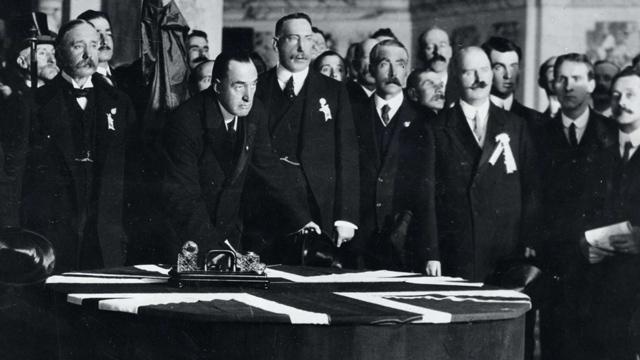
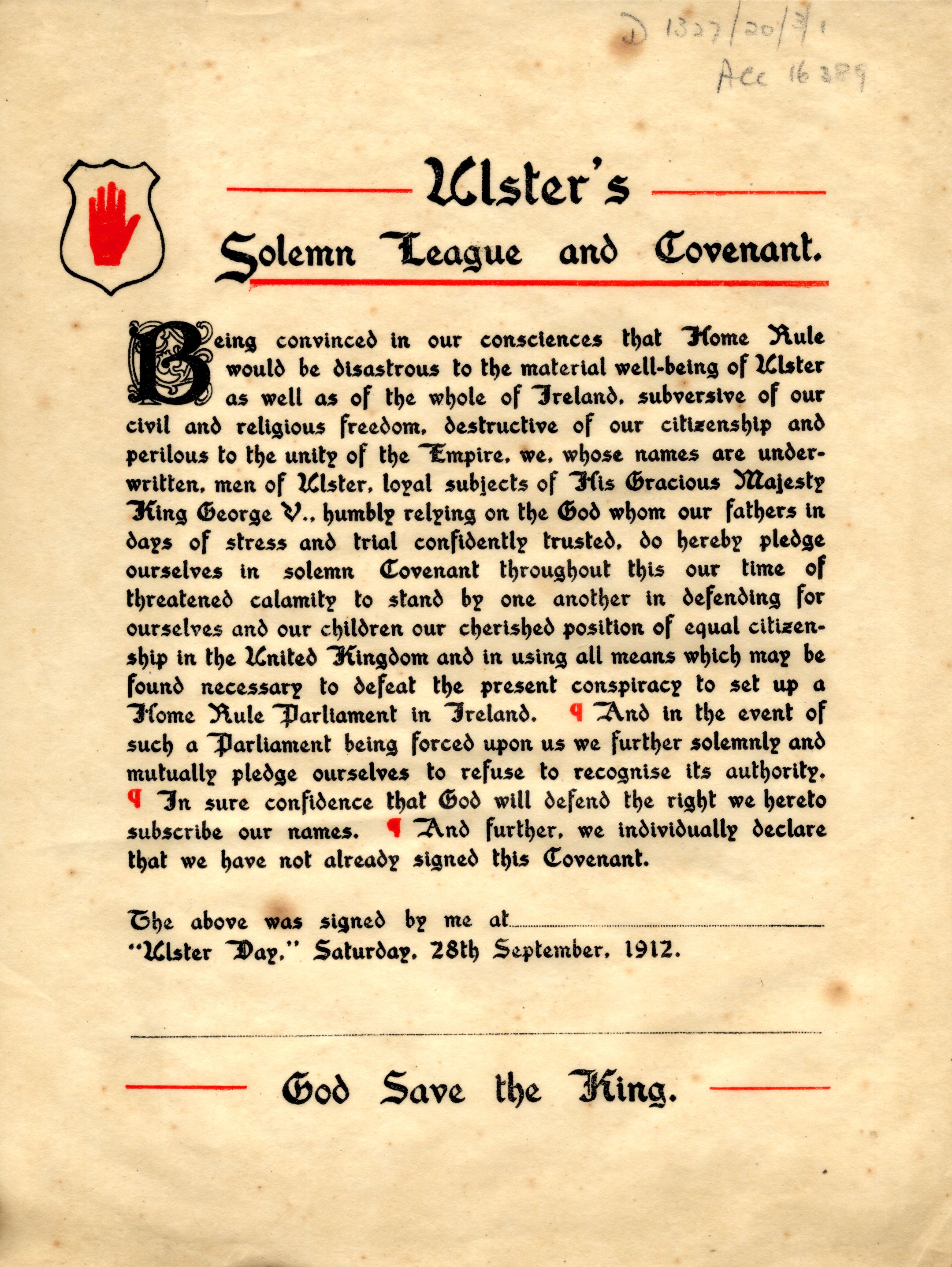
Some would say that the following passage of overblown , yet conceptually concise chest-beating ,is the very foundation -stone of “terrorism” in Ireland. From the early years of the 20th century ,It invokes God,subjection and blind obedience to an ethos which licenced those who believe it to solemnly pursue violence..
“BEING CONVINCED in our consciences that Home Rule would be disastrous to the material well-being of Ulster as well as of the whole of Ireland, subversive of our civil and religious freedom, destructive of our citizenship, and perilous to the unity of the Empire, we, whose names are underwritten, men of Ulster, loyal subjects of His Gracious Majesty King George V., humbly relying on the God whom our fathers in days of stress and trial confidently trusted, do hereby pledge ourselves in solemn Covenant, throughout this our time of threatened calamity, to stand by one another in defending, for ourselves and our children, our cherished position of equal citizenship in the United Kingdom, and in using all means which may be found necessary to defeat the present conspiracy to set up a Home Rule Parliament in Ireland. And in the event of such a Parliament being forced upon us, we further solemnly and mutually pledge ourselves to refuse to recognise its authority. In sure confidence that God will defend the right, we hereto subscribe our names.
And further, we individually declare that we have not already signed this Covenant.”
This “Ulster Covenant” evokes a time, one hundred years ago , prior to the First World War ,when such things as “empire” , “God” and “majesty” were deemed unquestionable and set in stone.It also neatly seeks permission and a blessing from that same God to pursue this course of action.Many modern people of a secular mindset, might chuckle at this blind belief in a supernatural presence, but for those who signed their name to this decaration, this “fact” was obviously a very important prerequisite.This Covenant was written against a background of sectarian violence on the streets and against the very recent unnaccountable sinking of Belfast’s protestant pride ,in ” the ship ,”the Titanic “.Their best effort yet was lying at the bottom of the ocean.
I was writing recently on our different interpretations of words.The word that came up specifically, was “terrorist”. It is one of those words which in Norneverland , Ireland can mean something completely different to what it might mean elsewhere in the world.It’s the same for the word “victim”. People search for a definitive description for that one too.
People argue here , just to whom the label “terrorist” might best apply to best. It is actually a common perception that only one section of the community invariably uses the word to denote its perceived enemies; as in the “terrorist acts ” of (…whomever… )that may have been done in the past.There is a perception too that these” terrorist “acts are almost uniquely the property of only one specific grouping. Anything that emanates from their opposite number is somehow judged “counter-terrorism” or possibly “anti-terrorism”. This causes some confusion of course.
Unionist thinking people consider that republican “terrorists” are more terrorist than unionist terrorists.Unionist terrorists at certain times preferred to describe themselves as “anti-terrorists” . Unionists believe too that the nationalist community shows greater support for “republican terrorists” than unionists would show for “unionist terrorists”(or anti-terrorists”). The idea is that unionists might sometimes prefer to disown their own terrorists while nationalists embraced theirs. I should add that republican such as those who made up the Provisional Irish Republican Army(IRA) never considered themsekves to be” terrorists” at all.As far as they were concerned they were fighting to expel a “foreign enemy” who confronted them in the streets of their own country. Add to that the fact that not all nationalists supported the “republican movement” until they disarmed themselves just before the signing of the Good Friday Agreement.That is when their representatives’ electoral prowess took off an dSinn Fein gained electoral support at the expense of the SDLP.
I know…it’s complicated.
To me “terrorism” and “terrorists” is, in its broadest sense, the use of intentionally indiscriminate violence (terror or fear) in order to achieve a political, religious, or ideological aim.It is something that exploits human fears to help achieve those goals.
There are differing views of this …for example :
“In November 2004, a Secretary-General of the United Nations report described terrorism as any act “intended to cause death or serious bodily harm to civilians or non-combatants with the purpose of intimidating a population or compelling a government or an international organization to do or abstain from doing any act”
That is obviously a very narrow view in that it proposes that governments never commit terrorist acts, which we know it is not strictly true of many governments. Governments across the world have committed terrorist acts for their own agendas over the decades. The British government is by no way unique in this respect.
I have to say that during my lifetime the British government and by association, its own forces and anyone who supported them ,have used those same tactics in communities here in Ireland .I’ve seen it on the streets and friends have seen the misuse of power happening on a first-hand basis. Of course , I know that non-government aligned groups have also used those kinds of tactics too, but my memory is that the government’s agents started that particular ball rolling in our era ,back in the late 1960s and everything else continued from there. People were batoned and eventually shot and killed at Civil Rights marches, in what I and many others ,saw as a form of “terrorism” by those representing an anti-rights agenda. You might say that the eventual reaction to those acts of ” state -terrorism ” were acts of “counter-terrorism”. It might really depend on your perspective .
As well as that I can recall a different kind of “terrorism” which was very popular here, especially among unionist politicians . It was based on an obsession with para-military display. That was usually the gathering of huge groups of their supporters on the streets or in stadiums and thereby whipping up fears in the collected grouping .The purpose was to whip these listeners up into such a state of excitement and fear that it proposed to set them off on their own homegrown terror campaigns. ….and then stand back ,basically .
This paramilitarism has an historical lineage. If we were to take only the 20th century, possibly the best place would be at the moment of the signing of that Ulster Covenant .There is a direct timeline from this moment to the partition of Ireland in 1921.
It’s worth while having a look at this recent documentary narrated by broadcaster, William Crawley to get some flavour of this and how it worked right down into the 1970s the 1980s and so on.
About half a million people , men and women,signed the “Ulster Covenant” , also known as “Ulster’s Solemn League and Covenant “on or about 28th September 1912. Why would some 500, 000 people have been mobilised to do such a thing? They were ostensibly signing a protest against the Third Home Rule Bill introduced by the British government.Sir Edward Carson and Lord Londonderry were two of the first people to sign this document. This was unionism’s protest against their government’s plan to establish a Home Rule Parliament in Dublin.Everyone who signed this document were unionists who had been somehow stirred -up and mobilised by other unionists.Far from maintaining the union of Ireland with the UK , this would be the first defiant move that would actually rent that same union asunder. It was the beginning of a sort of populist Brexit attended to only by unionists.It would eventually divide Ireland .It wasn’t really what unionism had in mind at that time.Their first preference would have been to maintain Ireland in its entirety under the dominion of Westminster.There were blood -and- thunder popular myths abounding that many signatures were actually penned in blood , but that’s exactly what they were mostly ….tall tales to colour and romanticise the story, as if to anoint it with gory glory. That’s not to say that some particular fanatics might not have done this .William Crawley mentions a certain Mr Fred Crawford who claims to have .
On the following year ,the newly established UVF(Ulster Volunteer Force) aimed to recruit a paramilitary militia using that same document to glean 100,000 recruits from its list of names, aged between 17 and 65. This was basically an illegal “anti-government ,treasonous , terrorist force”.These men vowed to resist any attempts by the British Government to establish Home Rule on Ulster.Under this threat , later that year, Irish nationalists also formed a rival militia called the Irish Volunteers(Who eventually became the original IRA in the newly formed Irish Republic), to hopefully safeguard Home Rule in Ireland.
By April 1914, the UVF , aided by the aforementioned vein-cutting , blood-spilling Crawford ,had smuggled 25,000 rifles into Ulster from Germany, on the steamships “S.S.Fanny” and then the “SS Clyde Valley”/”The Mountjoy”; the legal loophole in the law having been eventually plugged . This legal loophole in the law had previously allowed militias to arm in “defence of the empire”.Carson’s aim ,(being a lawyer and skilled in its workings) was to arm an entirely new private army to back up a provisional northern government by unionists, for unionists. In the end ,this was the first fully armed” terrorist” group to be established in Ireland .There is no doubt that the weaponry would eventually be used to threaten and terrorise both the British government and nationalists in order to gain political position. The various Protestant churches, obviously maintaining that god was on their side ,alone , aided and abetted this notion in Sunday sermons across the land.
World War one arrived just in time to defuse this particular situation and avoid the forced arrest of the conspirators as warrants for that purpose were already signed in Westminster . We all know the internicine , political machinations which produced this particular European slaughter of 35 million people,but at the time it seemed the “loyal” thing to do for many Irishmen to join in the conflagration. After the war ended there were attempts to revive this original UVF, but many of its members have been killed in the war and the eventual numbers appear to have been around 3000. They never officially disbanded ,so the exact figure is hard to determine.Many smaller armed unionist paramilitary groups continued , but the most noted was the “Ulster Imperial Guards”.Many of these armed unionist groups were given official status and cover inside the newly formed Special Constabulary (USC).These so-called “B-Specials” were an armed paramilitary grouping which spearheaded anti-Catholic violence and terrorism ,beginning in 1920 and were run as an adjunct to the police force.They operated to ethnically cleanse Catholics and expunge them from what they considered were “their areas”. These people could be seen as “terrorists” , terrorising under the cloak of officialdom.
It seems that all this terrorist activity was just fine, just as long as you believed that God was on your side.
I’m thinking here also of the formation of the UDA. the formation of Vanguard and the formation of Ulster Resistance. There were other groupings too but these will do for now. These were actually “terrorist” groups because their purpose was to instill fear and to “terrorise”.They were supported by many major unionist politicians and in fact both Ian Paisley and Peter Robinson both became First Ministers on the back of this kind of terrorising behaviour.Peter Robinson even managedto invade and terrorise a town .Paisley, of course , was a master at this kind of stimulating behaviour.
Of course , I know that many unionists can’t really conceive of themselves as “terrorists” and can’t even conceive of the British government as acting in a “terrorist “manner, but there are too many incidents of it to actually deny it..the british have used the same “terrorist” tactics elsewhere in the world and unionism has operated on an agenda of “terrorism” throughout its short hundred year existence.It’s all there in the historical record. If you want to study it more ,there is even documentary film of it….so get stuck in and learn all sorts of new things MT.The study of terror is worthwhile.
Your best piece ever Harry 🙂
Google definition or terrorism
“the unofficial or unauthorized use of violence and intimidation in the pursuit of political aims”
Unionism went against democracy, as far as breaking the law, mutiny against their state, gun running and formation of a para-military group to defy their own state in the pursuit of their unethical and undemocratic political aims.
They are almost like an Irish Taliban, almost a century ahead of Muslims in terms of the most backward ideologies in the history of mankind.
There’s more Jessica but it’s such a long story that I had to serialise it. Watch out for the Chrristmas boxset!
You haven’t been paying attention PF…http://www.judecollins.com/2016/11/psycho-killers/
When you read this, objecting to being given the gift of the right to rule your own nation.
It reminds me of Mrs Doyle and her friend offering to pay for lunch, you will not indeed, no way, absolutely not, I insist, will you put your money away.
Right. that’s it, the guns are coming out.
You will not allow us to rule ourselves. We’re not worthy…
Though some of us feel it was really all about keeping control of the wealth in Ulster away from Catholics who were a sizable minority in Ulster, and democracy would have introduced equality whereas unionism wanted a solution more comparable to apartheid in South Africa. Protestants owned 100% of businesses in Ulster even though 30% of the electorate (not population) were catholic and had 40 pounds to every one a catholic had.
It had nothing to do with the union, simply a desire for supremacy over british status in Ireland and keeping the jobs for the boys.
“Protestants owned 100% of businesses in Ulster” What?!! This is complete nonsense, as there were numerous Catholic-owned businesses in my (mainly Protestant) part of N.I.., you only have to look at the old directories to see them listed.
I would agree with that Willie.I think that you’re a little astray on that one Jessica.There were plenty of Catholic / nationalist businesses across the whole of Ireland . It’s a fact.
Thanks for keeping me right Harry, and Willie D
Sorry Willie D if I got that one wrong.
It is in my head that businesses were 100% protestant owned and wealth distribution was 1 pound to 40.
As I am unable to locate any reference to back this up, I will retract those remarks and apologise for my error.
What’s Part 2 about? The Proclamation of the Republic?
That is a little abstract PF . Put a little more meat on those bones…..
It has all the meat it needs to be chewed over.
Whether or not you can swallow your own recipe is another thing.
I think you’ll discover that there is no meat whatsoever ,PF..only fat and sinew with a little blood spilled on the side of the plate.
I’ll quote the relevant parts later, then. If you think one recipe unpalatable, then you will find the other equally, acidic, bitter and sour, and with a distinct aftertaste.
Unless you choose to ignore it, of course.
You do realise, I hope, PF that because I am not sitting inside your mind that I really have no idea what you are thinking about or actually talking about. It’s as though I’ve walked into a film you’ve been watching on your own …. half-way through.
Well, PK, seeing as you have written the first scene of the movie and I’m only pointing out how the storyline might develop, I’d have thought you would have some idea what I was hinting at.
It’s relatively clear.
But I’ll join the dots.
Cue music. Wide shot to open:
“Some would say that the following passage of overblown , yet conceptually concise chest-beating ,is the very foundation -stone of “terrorism” in Ireland.”
Slow zoom. Focus on the specific passage: Ulster’s Solemn League and Covenant.
Slow pan of text, line by line.
Cut to images of God, Nation, Empire and Titanic – Protestant ministers, shipyard workers, foreign consuls etc.
Fast flash images of ‘terrorists’: Protestant ministers, shipyard workers, foreign consuls etc.
Dream sequence: Ulster covenant blamed for break up of the Union:
“Far from maintaining the union of Ireland with the UK … this would be the first defiant move that would actually rent that same union asunder.”
Anyway, I’ll forgive all that, I’ve come to expect such a monocular view of history on this site, and it’s not half as bad as being called a bigot directly, but, PK, here’s the link:
God: ‘IRISHMEN AND IRISHWOMEN: In the name of God…”; “We place the cause of the Irish Republic under the protection of the Most High God
Nation: “we hereby proclaim the Irish Republic as a Sovereign Independent State”
Violence: “we pledge our lives and the lives of our comrades in arms to the cause of its freedom”
God and Violence: “the Most High God, Whose blessing we invoke upon our arms”
And of signing in Blood…”by the readiness of its children to sacrifice themselves”.
The parallels are a clear as crystal. And they were of a time. And to try to drive a chronological wedge of a few years, and apportion blame:
“is the very foundation -stone of “terrorism” in Ireland.”, “is the very foundation -stone of “terrorism” in Ireland.”
Without any reference to the wider (and lengthy) historical context, or to the equally religious and threatening Proclamation, is poor.
Actually, I don’t take the view that the Proclamation was a matter of threatening terror – at least those men fought largely in the open – and I don’t consider the Ulster Covenant to be threatening terror either.
Both were national and religious documents of their time (that’s why they were called ‘covenants’, for goodness sake, and both had a tendency to focus on ‘blood’ and ‘sacrifice’ – they were ‘Christian’ convents after all).
So, PK, as I said, I await Part 2 – ‘POBLACHT NA hÉIREANN and the Art of Terror’.
If I’m consistent, you can be too.
Not so fast PF.At least you explained what was on your mind, which is a lot better than trying to read the runes. That’s all I was really asking . How else would I know what you are talking about. Write your own story if you want to make yourself crystal clear. You’ve started . If you imagine that your proposed chapter in the development of terrorism merits inclusion in the series …get on with it and write it up properly .It will save me the bother of poking into every little corner. I wasn’t about to make comparisons with other versions of terrorism.i get the impression you might have wanted to turn it into a huge version of whataboutery which is a game I don’t usually play at all.i like to look at facts .To me it’s all “terrorism”…but to you that does not appear to be the case at all.
If you think that mad ,Christian blood -sacrifice is part of the root cause of terrorism, well you are simply barking up the very same tree that I am. That’s part of how terrorism developed in Ireland .The only real difference, I think ,is that I understand that it is really terrorism right across the board no matter who is doing it and you seem to believe it can be a selective thing.I would encourage you to submit a piece to Jude for everyone to read. As far as I am concerned , if we need a starting point in the break-up of Ireland and this hate- poisoned , subsequent little statelet ,that appears to now be on its last legs, you have to start somewhere. I believe Carson was dissappointed that Ireland was broken up in the end .It wasn’t something he ever really expected at all when he got involved inthe great gamble. That said the tenor of the day was “blood sacrifice” wrapped up in a belief in God with a lot of bombastic blether about righteousness.As a non- believer I can see the “Sacrifice to gods” is as old as man first made offerings to the moon or for the sun to return after Winter. That part was nothing new at all. It’s a continuation of that idea of sacrifice that had millions killed lie sheep in the WW1… but it added on the threat of violence .The men of 1912 followed that same sacrificial trend as did those men of 1916.They were all Irishmen of their time ,after all .
That said if we want to talk about the origins of “terrorism” in the 20th century in Ireland we already have our ready-made starting point with the Covenant, unless you might want to go backwards in time through some 800 years of assorted terrorism in Ireland.I don’t think either of us has the time to contemplate that here. One hundred recent years gives us plenty of scope, I think.
So yes , I see it all as “terrorism” and I like to be clear as to how it works and how it is encouraged to happen.How men and women make terrorism operate. I make no bones about that. It is fatuous to think that only some people experienced the terror of terrorism when we both should know that it happened right across the board. Sometimes i get the impression that you have some notion that i am writing as your idea of an Irish Republican ,but in that you are making assumptions which are not necessarily correct. You should never jump to conclusions.I’m looking at this subject in the round.
The next chapter for me will be about how I experienced some of that “terrorism”, not as some historical film on television or in some book ,from earlier in the century , but as news actually happening outside on the streets, in the newspapers of the days I lived through and on television, in real time, in my own life….the stuff I lived through ,if you like before we had a sort of peace .If you think that it is something other than “terrorism” , feel absolutely free to explain why you might think that is the case.
PK
First of all I already have offered a degree of explanation as to why either covenant might not be considered terrorism.
Secondly, taking the early 20th C as a starting point is merely arbitrary, and we don’t need 800 years for an alternative narrative.
Thirdly, you may not think you write as a ‘Republican’, and perhaps you do not do so intentionally, but there is an ever present undertone which I chose to highlight. It is impossible to understand either covenant without reference to the other, without reference to the preceding decades, without reference to previous covenants made in the others parts of the British Isles which had significant religious elements, without considering previous religious and national disputes including those between Scotland and England (never mind Ireland), and without relating that to the contemporary notions about conflict and the believed right to bear arms. Each and every of those circumstances are linked to early 20th C Ireland and saying you don’t have time is a cop out; you had time to write an article. In offering a one dimensional view of the Ulster Covenant, you demonstrate your ‘Republican’ influence.
Fourthly, thank you for your encouragement to write an article; however, as I have said previously, I shall decline. Responding to the presented narrative here is what interests me, whether I agree or disagree. I can do that adequately via the comments section, which also allows a wider conversation.
And yes, I understand that Carson was disappointed with Partion. He was an Irish Unionist, as am I.
I have to disagree with you if you do not think that the signing of the Covenant was not the first exhibition of an activity designed to terrorise and instill fear .You cannot threaten a government (In this case your own government) and not believe that you are in the process of an act to terrorise.You cannot import weapons if you are not in the business of terrorising . that is simply ridiculous .You can tell yourself all kinds of mad and fantastic things, but the bottom line is the “threat”. You can even say(If you believe in such things) that God says it just okay to threaten but in the end that’s just a fantastic be-ribboned excuse for your own errant behaviour.These people gathered in their thousands to threaten …just about anything if they didn’t get their way …including violent action. It doesn’t matter how you cut it it still comes out the same .For one thing it was an illegal action …it was also treasonous ,but it also frightened…”terrorised” if you like.
I have to disagree with you if you do not think that the signing of the Covenant was not the first exhibition of an activity designed to terrorise and instill fear .You cannot threaten a government (In this case your own government) and not believe that you are in the process of an act to terrorise.Later, you cannot import weapons if you are not in the business of terrorising . That is simply ridiculous .You can tell yourself all kinds of mad and fantastic things; you can pretend that you are whiter than white , but the bottom line is the “threat” of violence that you represent to the world . You can even say(If you believe in such things) that God says it is just okay to threaten or use threatening behaviour but in the end that’s just a fantastic be-ribboned excuse for your own errant behaviour. God made me do it. You might as well say that your imaginary friend made you do it.See how that one stacks up in a court of law.No ..there was the safety in numbers of signng on the dotted line just as there was the safety in numbers of breaking the law of the land.
Those people gathered in their thousands to threaten …just about anything if they didn’t get their way …including violent action. It doesn’t matter how you cut it it still comes out the same .For one thing it was an illegal action …it was also treasonous ,but it also frightened…”terrorised” if you like.The only right to bear arms at the time was in defence of the empire and this loophole was quickly plugged at Westminster . What happened was illegal and what it bred was terrorism.You can paint it any colour you like but it is still the very same thing. No ifs and no buts. If it had been anything else there would have been no reason to smuggle weapons into Ireland . Had it been legal there would have been no need to sneak them in at all.
And, PK, if you would now (for I already know you disagree with me) do as I have suggested, and apply consistency to the contemporary covenants of early 20th C Ireland, you will see that your opinion cuts both ways.
Peter, you may as well be talking another language to me, not sure about anyone else.
Could you translate that into simple explanation.
I understand what Harry is saying ok, but are you saying the threatening behaviour shown over the covenant leading to the formation of the UVF, gun running, militarisation, mutiny and threats of all out civil war are somehow less wrong because of previous covenants (which I know nothing about).
It sounds just the same simply making excuses for the wrongs of unionism that MT engages with but with a more convoluted approach.
I have been consistent; I await your, what shall I call it, ‘parity of esteem’.
Jessica
The primary comment I have made about Harry’s piece is that everything he has said about the Ulster Solemn League and Covenant can be applied directly to the Proclamation of the Irish Republic – there is no doubt about that – they are cut from the same cloth. But Harry continues to ignore that.
Following from this I am also saying that we can best understand any historical event by setting it in its historical context. In other words, asking what this or that event meant for the people then, is the first and best way of approaching history. And while that might not always be possible, it makes for bad history, and poor argument to select any given event, based on an arbitrary measure of time, take it out of context and then try to construct a reason to explain what has happened in the recent past.
If Harry wants to make his point, that’s fine, but continuing to ignore the contemporary Proclamation, reduces the credibility of his article.
And where does the rest of what I have said fit?
Quite simply, the mindset of the people of the Ulster Covenant and the Irish Proclamation has more in common with the previous 18th and 19th centuries (and perhaps the 17th C) than it has with the secular, atheist, materialistic and scientific mindset of today.
Therefore if we are to understand the Covenant and the Proclamation (be they right or wrong) we must look to the preceding centuries. And those were centuries of internal conflict between the nations of what became the UK and Eire, they were centuries of religious government, national and religiously based covenants – i.e. National promises made to God and Nation (Scotland be a prime example and the Westminster Puritan Parliament being another), and they were centuries during which people asserted the right to bear and carry arms in order to ensure their protection against the possibility of authoritarian governments, whether Parliaments or King. (The American Constitution grew out of the same ideals).
With regard then, to my supposed “making excuses for the wrongs of unionism”, that is not what I said. What I said was that given the historical context, I did not consider either the events of Covenant or Proclamation to be acts of ‘terrorism’ – can’t you see that in doing that I am lending a validity (whether I agree or disagree with it) to the 1916 Rising. Other Unionists don’t that.
Reading historical events with 21st Century eyes won’t do – it might be a useful way of justifying present events, but its bad history.
I’ll agree with one thing though – Partition was a bad outcome. Carson didn’t want it, Collins didn’t want it, but it probably seemed to both like the best worst solution.
Likewise, Stormont was a bad idea – if Partition was to happen, there should always have been direct rule which would have at least been a check and balance.
As I said above, I am an Irish Unionist: I am for Irish Unity and I am for British Unity.
I know, it puts me out on a limb.
Thank you for the clarification Peter.
I think I do see where you are coming from.
The proclamation was Irish people who wanted to be part of an Irish nation that would cherish all of its people equally and puts the primacy on the well being of humanity and focussed more on ending the political and religious differences or divisions of our people and focussing in building an Irish nation acceptable to all upon which to build.
I think you are saying the covenant is a similar call but not aimed at the Irish people, but to all of the people of the UK. Unionists feel that their best interests are served by maintaining the union and are more focussed on the material well-being of Ulster as well as of the whole of Ireland and threatened that they would fight to remain.
What isn’t clear is why you think they thought Home Rule would be disastrous?
Was it because it would lead to conflict or because they did not think we could rule ourselves? Was it just words to support their blatant anti Catholicism?
I have a feeling Scotland is afraid that it would be unable to rule itself and needs England to hold its hand.
Or perhaps something else.
Where I think the two depart, is that those who penned the proclamation were not simply making threats.
You had unionists pretending to sign in blood, I believe confirmed to be dye as blood would have degraded, so basically all mouth and no action.
The Irish people suffered more under british rule and were prepared to sacrifice themselves for their cause.
Unionism has never had such a cause nor could it demonstrate such conviction.
The covenant is also more negative. It is more of an anti proclamation, one was for peace and unity of our people, and the other for division and eternal conflict.
One was backed up by a blood sacrifice, the other bluffed in ink to impress others to do the dirty work.
In many ways not much has changed.
You have been only consistant in your opaqueness PF..Where you seem to be inadequate for our current purposes ,is in speaking with clarity and explaining exactly what you mean to say.You speak of covenants as though they are to be bowed down to ,no matter their source or their manipulatory nature….no matter their time-frame too. To me I can plainly say, so that you can understand me perfectly, they are no more than puffery of the highest order. In this case it is the excuse written in in particular purple prose ,(which would not be out of place in an old pulp magazine), of the most unctuous order,designed to the very comma to exonerate a group of people from their latent and proposed wrongdoings .
The grandiose and overblown words do not make the proposed actions any more moral. They are patently civically illegal proposals. On this God -invoking criteria , my opinion indeed cuts both ways …and every other way too. This is the highest form of populist kitsch, masquerading as eloquence . That does not appear to be your opinion of this at all , so yes I absolutely disagree on this.For me , this kind of populist manipulation is where terrorism begins….right there on the dotted line
“You have been only consistant in your opaqueness PF”
I have been perfectly clear about my objections to you ongoing refusal to acknowledge that the Ulster Covenant and Irish Proclamation are the same animal
“You speak of covenants as though they are to be bowed down to ,no matter their source or their manipulatory nature….no matter their time-frame too.”
Not at all. I have referred to the various covenants, not for reasons of justification, but for reasons of historical context. I am seeking to understand what motivated the people then, not what motivates us now. That must be the starting point of understanding history. If you keep missing that point, you will keep missing the point.
What I have said is that in that context I do not consider either to be terrorism. I haven’t made a personal moral judgement.
The rest of paragraph one is mere avoidance. Address the context of the Proclamation and I will have more respect of that you are saying.
“The grandiose and overblown words do not make the proposed actions any more moral.”
I didn’t say they did. Read what I have said.
“For me , this kind of populist manipulation is where terrorism begins….right there on the dotted line”
So, write an article on why the Proclamation of the Republic of Ireland was an exercise in terrorism, or even state that point clearly, and I will accept your opinion more readily.
It is easy to do.
Repeat after me:
The Proclamation of the Irish Republic of Ireland was immoral, unjust, born of and threatened terror, had no legitimacy then or now, should be revoked and those who signed it tried posthumously for crimes against the Empire and superstitious nonsense.
Easy.
And then read some history.
Thank you, Jessica.
At least we are able to communicate. I suspect it is because you are willing to be honest about you Republicanism. I fundamentally disagree with you on that point, but will defend your right to have your view.
I’ll pick up a couple of points.
“I think you are saying the covenant is a similar call but not aimed (solely) at the Irish people, but to all of the people of the UK.”
I wouldn’t go out of my way to disagree (although see the word I added).
” Unionists feel that their best interests are served by maintaining the union and are more focussed on the material well-being of Ulster as well as of the whole of Ireland”
That’s a reasonable way to look at it. Although I’d also say that ‘Ulster’ became the focus due to the density of the Unionist population. Again, that’s part of the wider historical context.
“What isn’t clear is why you think they thought Home Rule would be disastrous?”
I think there are a number of reasons, here are a few:
Whether we like it or not, Ireland had (has) a Protestant Catholic problem. And the ‘North was largely Protestant, and the ‘South’ largely Catholic.
I also think they were genuinely Unionist – i.e they believed that a Union was a good thing.
The Union provided a focal point for economic strength and for identity.
Belfast had much in common with other industrial cities like Glasgow and the North of England.
There were historic communal ties – especially with Scotland (which was not then Nationalist)
And so on.
“those who penned the proclamation were not simply making threats.”
Perhaps. They certainly tried to give a positive vision for an independent Ireland, but in response I’d say that the positive vision of the British Union was assumed in the Ulster Covenant. So while not explicit in the same way, is was not solely negative. You will also note that the Ulster Covenant does not call for Partition, but is concerned with the “whole of Ireland”. Partition was subsequent to the covenant and the proclamation. That is equally important in terms of context.
“basically all mouth and no action.”
Emmm. That is one of our problems!
“One was backed up by a blood sacrifice, the other bluffed in ink to impress others to do the dirty work.”
Perhaps. But the point remains (and Harry keeps ignoring it preferring to call me grandiose), is that both appropriated the language of blood sacrifice – both were religious in form – both threatened violence to one degree or other, and it is a vast over simplification to say that all modern terrorist ills flowed from the 1912 signing.
Harry’s just wrong.
Really, he’s going to have to differentiate between trying to understand history and providing contemporary justification for a past event. I’m trying to do the former, not the latter. And if he could get over his anti-religious bias, he might understand them better. I’m not asking him to convert!
I believe that in principal, there is not a real objection to having a good relationship between Ireland and Britain.
In fact I would like the relationship between these islands to be as strong as possible.
It is in all of our best economic interests and there are so many people connections between both islands that it makes sense that our relationship with Britain should be more important than that with the EU and that is the future I would like to see for our children.
Neither of us know how secure the union in britain is any longer.
What I do know, is that partition and division has poisoned all of Ireland, not only the north.
It has divided not only orange and green, but divided orange and green also.
The covenant may not have set out to partition Ireland, but it did ignore the democratic wishes of the majority of our people over many decades.
Post partition, there would have been a real opportunity to show this positive vision of the British Union you speak off, but there were 50 years of discrimination instead.
You claim it is the relationship with britain that is important to unionism, but the relationship with britain is better between the republic of Ireland than it is with the north and its economy has grown while ours stagnates.
Nationalists are still saying we would be better off ruling ourselves, perhaps Arlene would have been more careful with 400 million pounds of tax payers money had she thought it was coming out of the block grant and not from the London treasury being one example of how your union first view simply doesn’t stack up.
I want to see a sovereign 32 county Ireland outside of the political union of the EU and with a strong relationship with britiain.
There are many obstacles to achieving this, and unionism is no longer top of the list but the Dublin establishment.
That is where the real obstacle to unity lies in 2016.
Correction:
” (and Harry keeps ignoring it preferring to call me grandiose), ”
Harry wasn’t referring to me as grandiose, but the words of the documents (I think!)
Apologies.
Late last night the site would not allow me to reply…….
We’ve finally caught up .You no doubt know that some of the commentary above is out of sequence so I got your explanation after I had written an earlier response.
Let me be plain again about these covenants. I am not talking about “justification” either …or “motivation” as an actor might ask a director….Why did they do this at this particular scene and so forth.
In this case we can find out why and when they did these things. Let us say they did it out of a nebulous “fear”. That is all we really need to know of the motivation for mobilising all those people.
What i am saying is that none of that matters , because it is still the wellspring and the origin story of how “terror” got out of the box and became a public activity on a large scale in Ireland I am not arguing the pros and cons of Proclamations or Covenants.and why people signed them or who they pledged their troth to or in what God or king’s name.They might have felt justified for very diverse reasons, but let us say it was for reasons of “fear” for one reason or another .
It still comes down to the same thing . You get a bunch of people into a frame of mind and when you get them like that you can justify anything because you think you have the numbers to do just that.Historical context is actually irrelevant in that respect other than for the fact that many believed…or were told…. they were doing a” religious” activity.
Not everyone signed these covenants either .Many unionists did not sign the Ulster Covenant. The majority of Nationalists ignored or were unaware of it. They were not interested .So there is a specific grouping of very extreme people who signed it.
That doesn’t stop it being the origin story of terrorism in Ireland .This act was the focal point. That terrorism was to manifest itself on the streets in huge rallies shortly thereafter and those signatories became the UVF .Why the need to rally at all? Why buy guns?…If not to threaten.In that threat was the terror.
As for the Proclaimation of the Republic some years later , it came a little late to be the origin story ,surely.Like I said I never got around to writing about that one ,but is there any need now when you already have your own ideas about that:
“The Proclamation of the Irish Republic of Ireland was immoral, unjust, born of and threatened terror, had no legitimacy then or now, should be revoked and those who signed it tried posthumously for crimes against the Empire and superstitious nonsense.”…..
… which a unionist might claim that the republic was “treasonous to the British Empire” which those Irishmen felt for decades enforced to live within by force of might..
.I’m sure to unionists the idea of a republic right on their doorstep it eventually became a terror story for them too…. to become a chapter in their own “the art of terror in Ireland”.
Like I said earlier ,this wasn’t constructed as an exercise in whataboutery to compare unionist and nationalist mythologies. Both are suspect in that sense especially in the suicidal self-harming aspects of blood-sacrifice which I find distasteful in any kind of event.
My piece was just a statement of how i personally see and have seen again , “terrorism” evolving across Ireland , given the evidence we have …and how it works and is worked on people….how people are finally terrified by their neighbours and how their fears are constantly manipulated by men with their own agendas.We finally ended up in a tiny little statelet which was at war with itself , after all, while our neighbours afew miles south of us were barely touched by any of that terror we experienced for some seventy years.
….but if you were to ask me why the Irish Rising actually happened those few years after the Ulster Covenant, I would say that the Ulster Covenant may just have had something to do with it for inspiration and influence and there was probably a hugely romantic and sacrificial element in it too. Men have a propensity to make these kinds of gestures. It’s only in retrospect that it stimulated Ireland .The Rising was initially was a bit of a failure but it probably struck terror into unionist hearts too …the Irish , after all are quite a superstitious race …quite a lot of them still believe in God after all,enough to write letters to him in verbose ,signed statements. People really do believe some very odd things ..and probably always will.
I cant say I agree with the use of the word terrorism, but I see where you are coming from Harry. Conflict involves killing and terrorising and it is the term used by the british and unionists for republican violence. What you are doing is saying, ok, so why is Ireland plagued with terrorism?
In the 30 or more years prior to the covenant, nationalism had focussed on democratic and peaceful political means to achieve home rule, they were not seeking to leave the UK, just to have a fairer form of self governance.
As denial of this democratic will was weakening and it started to look as though peaceful politics and democracy would win the day, this covenant appears along with threats of war, street rally’s, the formation of the UVF, gun running, even mutiny at the curragh.
Clearly this was the use and threat of violence to achieve political aims, in this case preventing the democratically expressed wishes of the majority population. I think you are absolutely spot on Harry that this was indeed the focal point of the introduction of terrorism if they choose to call it this.
It was designed to instil fear and entrench division and was successful.
Perhaps that is why so many unionists were happy to speak Irish, the UUP carried flags of Erin go brath prior to this covenant yet after it unionisms acceptance of Irish left them and animosity of Irishness is still strong in unionism today..
In fact Ian Paisley used similar tactics to bring out mass rally’s onto the streets which resulted in chaos and led to the troubles.
This covenant is indeed the cornerstone of modern day terrorism.
Excellent observation Harry.
I don’t think enough of us truly understand our past, I certainly struggle with it.
That’s about it .My point is that “terrorism” is something that everyone felt.Why people are so easily manipulated is a bigger question but i think at a basic level ,people are very easily led.There is no doubt in my mind that the Ulster Covenant was a threat of violence to Westminster and the rest of Ireland too,..a catalyst that set the ball rolling. I think it was misjudged and i believe we all ended up with a very poor deal that doesn’t really work very well (Everyone in Ireland and in Britain are worse off from its outworkings)…at the end of it, …..but it is an action that has attempted to repeat itself over and over like a rat running in a maze. I’ll have more to say presently.
“Let us say they did it out of a nebulous “fear”. ”
Why say that? It was more complex than that, and your use of the word nebulous is of no help to this discussion.
“That is all we really need to know of the motivation for mobilising all those people.”
Not only have you not established it was “nebulous”, we need to know much more than that. You are only serving your own narrow agenda of pinning all ills on the Ulster Covenant if you take that approach. As I keep saying it’s evidence of bad history.
”What i am saying is that none of that matters , because it is still the wellspring and the origin story of how “terror” got out of the box and became a public activity on a large scale in Ireland”
Of course it matters. You obviously don’t grasp the point I’m making about history.
And you have established nothing about the Ulster Covenant being the wellspring of terror. Of course if you keep ignoring the rest of history I can see why you would think that.
“They might have felt justified for very diverse reasons, but let us say it was for reasons of “fear” for one reason or another .”
‘Let us say’, is no basis for making historical judgements.
”It still comes down to the same thing”
No. it doesn’t.
“Historical context is actually irrelevant”
That’s nonsense.
“So there is a specific grouping of very extreme people who signed it.”
So, if you say they are extreme, they were extreme? You’re lost in a circular argument.
”That doesn’t stop it being the origin story of terrorism in Ireland .This act was the focal point.”
Whether it was or was not, has not been established by your article. You have merely asserted that it was by ignoring context.
”As for the Proclaimation of the Republic some years later , it came a little late to be the origin story ,surely.”
I’ve already addressed this. Without historical context, the chronology you have chosen is arbitrary. But you can’t, or won’t see this.
“when you already have your own ideas about that. “The Proclamation of the Irish Republic of Ireland was immoral, unjust, born of and threatened terror, had no legitimacy then or now, should be revoked and those who signed it tried posthumously for crimes against the Empire and superstitious nonsense.”…..
Harry, read what I said. I didn’t offer that as *my* opinion, indeed I have already offered my alternative opinion which lends a validity to the Proclamation. I used that from of words to illustrate how both ‘covenants’ might be compared.
”Like I said earlier ,this wasn’t constructed as an exercise in whataboutery”
But without context and a broader view, it reads as not only whataboutery, but as apportioning a singular blame.
Which might be your opinion, but it isn’t good history.
“So, if you say they are extreme, they were extreme? You’re lost in a circular argument.”
Ok Peter, so why were they extreme?
Am I wrong to think that nationalism had been pursuing home rule peacefully for decades in the late 1800s and into the 1900s.
As England was hinting at allowing home rule or even accepted it, this extreme opposition pops up threatening to use violence and war?
Why was their opposition so strong, why were they prepared to go to such lengths and how is this not a turning point and the start of terrorism in Ireland?
Let’s get down to basics here PF. You are having your own private discussion about “history”.It is an agenda that appears to have been inside your head since your first utterings on this page ,even though most readers were unaware of your oblique agenda.Thankfully you focused. You’ve since clarified several of the points so that there was some coherence .I appreciate that and I’m also glad that you no longer speak in non-sequiturs like some continue to do and pretend it is conversation. None of us writing here would be writing at all unless there was some sense of self-opinionation. so call me self-opinionated and I’ll wear that as a badge.I’d say you are fairly self-opinionated yourself or you wouldn’t bother at all.
This article is called “The Art Of Terrorism”. it is about the bare facts of “terror” entirely from my personal perspective. and it attempts to address how those facts are accepted out in the world ,from that oddly unique perspective . It is not a unionist perspective and it is not a nationalist perspective. it is oddly my own personal perspective ..as is everything else I write.. it is not to necessarily condemn unionists or nationalists in the 20th century .It is to study how they have done things to themselves and each other. Some of the later examples I have lived through.
It is attempting to explain how “terror” affects a society across those who use it as an exercise and those who are the recipients of its outworkings. It is about what drives people to terrorist acts..In that respect you can set it in a temporal context.It doesn’t change the facts of those “terrorist” actions or seek to excuse them. ..You keep returning to the Proclamation which you introduced into the conversation.” Did those people terrorise too ” , you might want to ask?” Of course they did”, would be my reply. Are you trying to tell me or imply that there is a difference between a unionist living on the border feeling fear and feeling terrorised and some nationalised fearing being shot or burned out of their home on a Belfast street? The terrorism experienced by each family is the same terror to my mind. Both are/would be terrorist acts.
For all of that , if a story has to be told ,the story has to have a beginning within a time -frame or it would end up as a very long read.We could say “Long, long ago in a land faraway….etc” …but you’ll agree that changing the time frame would mean leap-frogging back through centuries of incidents to the time of the 12th century to see how we got incrementally to a present point. Yes there is history written by diverse hands before the events of the last century and in this present century the story still continues but it is not possible to finesse every detail .I’ve already told you .If you have your own story to tell get stuck in and write it from your own perspective.It will possibly a different story to mine .You might think that some are neatly bracketed as terrorists and some are not. You might think that amassing a large illegal army is not a terrorising act, for example and you might not believe that a lot of people were not terrorised by it at all. I still do not believe that you understand the importance of what “terrorism” is or means to each of us living here in Ireland . Maybe you have your own self-opinionated description of “terrorism”that might shed more light on this subject, but I really think i’ve said enough until the next chapter. …and please do not think of it as “historia”…it’s only “my story” ..i don’t believe it is written in stone..
It’s only your story. Yes!
Which is exactly the point I have been making.
And it is your story repeated without context.
And this is far from my private discussion or oblique. You can try to deny my argument if you wish but it is clear, public and coherent.
Clearly you are not interested in discussion. I should have learned that from before. Every challenge to your articles is dismissed as you writing merely an opinion or a joke or by not taking it too seriously or whatever other excuse.
PK, you accused the people of the Ulster Covenant of being the wellspring of terrorism in Ireland, while at the same time refusing to take context into account.
That is a serious accusation ( and yet more of the unsubstantiated anti unionist rhetoric which adorns this site).
I should have known.
It is indeed a serious accusation Peter, and one that has been backed up with facts as well as opinions.
It is not unsubstantiated anti unionist rhetoric at all.
Perhaps the reality is that unionism is wrong and always has been wrong.
Wrong in that it was anti democratic, that minority control is no different in Ireland that it was in South Africa with Apartheid.
It led to the same sort of discrimination and abuse of power did it not?
Perhaps british rule in Ireland is not what is in our best interests.
We wont know because unionism still refuses to accept that we would be better off running our own affairs and wont even contemplate it.
Unionism is almost entirely founded on rhetoric and perhaps it all stems from this covenant and Harry has hit the nail on the head.
If you don’t agree then explain why and how?
In the decades prior to it, had nationalism been pursuing home rule peacefully in the late 1800s and into the 1900s.
As England was moving towards granting it, why did such extreme opposition ride out of unionism, why did they turn to terrorism and threaten to use violence and war?
Why was their opposition so strong, why were they prepared to go to such lengths and how is this not a turning point and the start of terrorism in Ireland?
And neither will I be offering a version of history.
I am one of those odd people who still believe that a study of history can lead to knowledge and facts rather than mere myth.
Maybe that is the greatest gulf between us.
I am not a relativist.
Stop throwing tantrums PF. If you can prove to me that the signers of the Ulster Covenant had not got terrorism in mind , you might be onto something but it is a historical fact that they threatened the government with treasonous behaviour and armed themselves for war and insurrection with smuggled weapons.If you can’t see that it was an act of terrorism, you ‘d be better watching that documentary again instead of blaming everyone else and me included.
As for discussion and “unsubstantiated unionist rhetoric that which adorns this site” .I’ve already told you that it is not unsubstantiated anti-unionist rhetoric” …nor is it” nationalist rhetoric “, come to that. It is the simple plain truth that happened right out there on our streets in front of the world’s eyes and ears…not just mine . Do you think the likes of Winston Churchill saw it as anything else when the warrants for the arrest of the perpetrators were being issued? Stick to the facts and don’t worry your little head as to whether the perps were unionists or nationalists. It didn’t seem to matter to the government of the time what they were..
Tantrums?
Oh for goodness sake.
Harry
One more time.
I haven’t denied that the Ulster Covenant threatened violence, I’ve asked you to look at it in the round.
I’m still waiting.
What do you mean by in the round though Peter?
I don’t think it is an adequate defence for anyone to simply say, it was the done thing at the time or that there were revolutions every other century as gio suggested.
Nationalism had pursued peaceful means of achieving home rule right through 1880s, 1890s and into the 1900s so the precedent was the peaceful pursuit of democracy.
It was the result of unionisms refusal to accept the democratic wishes of the Irish people expressed in many elections over many decades that brought violence into the last century.
Same with the recent troubles, there were 50 years of relative peace before Paisley decided there were too many Catholics about the place and started a pogrom leading to mayhem and conflict.
It seems to be that the harsh reality of this is finally dawning on many unionists.
Right oh PF …looking at it in the round , it looks like terrorism to me .It walks like a duck, quacks like a duck …etc …So which part of terrorism interests you most?how does it differ fromother terrorist acts?
PK
“f you can prove to me that the signers of the Ulster Covenant had not got terrorism in mind…”
Do you realise how ridiculous that statement is?
Even if we could *prove* it, we could only do so by… wait for it… considering the wider historical context.
Do you really believe, because it looks like you do, do you really believe that picking a single event, at an arbitrarily chosen point on the timeline, taking it out of its historical context and refusing to consider *any* idea other than you own opinion of it is credible?
“Right oh PF …looking at it in the round , it looks like terrorism to me .It walks like a duck, quacks like a duck …etc …So which part of terrorism interests you most?how does it differ fromother terrorist acts?”
Yep! PK that just about sums up your approach to logical argument and history: if you say it is so, it must be so. On that basis you can say whatever you like without fear of being challenged.
The only answer to that can be and must be – whatever.
Jessica
“What do you mean by in the round though Peter?”
I mean, historical context.
Why have I said all I have said about worldview, God, religion, covenants, nation, empire, Proclamation and so on? To try (although I have failed miserably) to try and encourage PK that if he is going to pin the blame for Irish terrorism on a single event and a single people then at the very least he ought to cast a sideways glance at the historical influences of the time.
How else are we going to try to understand those people, the people of the 1916 Rising, Partition, Irish Unity or much anything else if we refuse to look at contemporary context?
Harry has refused to do that.
“I don’t think it is an adequate defence for anyone to simply say, it was the done thing at the time or that there were revolutions every other century ”
You are correct, it isn’t. And if you have read me carefully, I have not done that. By that means we could justify anything.
Jessica, what you have written in the past suggests you are capable of understanding the complexity of Ireland. There is no one single event that any of us can point to which says, “There, that’s what started this or that or the other.”
Each are interrelated and complex. Loyalties ebbed and flowed and shifted over time. People made good decisions and bad decisions. Some pursued peace, some threatened violence – no where have I said that was right. What I have said is that some of it might be understandable – some of it might be justified – I’ve even, as you know, granted validity to the 1916 Rising.
But the monocular viewpoint of this website is monotonous. Surely you can see that?
Yes I can and I agree with you Peter.
Ireland has one of the most complex histories on this planet.
Religion and monarchy mixed, allegiances changed, Catholics were the unionists one day, protestants the next.
We are a fighting nation, it is in our blood. We are a passionate and god fearing people, we are very patriotic, whether it be towards our national dead over pursuit of freedom and an Irish nation, or our loyalty to something greater, the association of empire, king and country.
If we could remove the divided loyalties and find a way of bringing protestant, catholic and dissenter back around the table to find a way of living together as one nation on this island with a sufficient connection to britain that would satisfy the majority of our people.
Unfortunately we are not yet mature enough politically to advance to that next level and probably wont be until unionism loses its minority and finally realises that it has nothing to fear from a nationalist Ireland.
Jessica
“Unionism is almost entirely founded on rhetoric and perhaps it all stems from this covenant and Harry has hit the nail on the head.”
Perhaps?
Perhaps Harry has hit the nail on the head? Has he, really?
Was there unionism before the Ulster Covenant?
Was there violence in Ireland prior to the 20th C?
Were Presbyterians once as discriminated against as Catholics?
Was it ‘Unionists’ who discriminated against the Presbyterians?
Was Wolfe Tone a Protestant? Was he influenced by the French Revolution? Was he influence by Thomas Paine?
Was popular republican revolution part of the European landscape in the preceding century?
Were Presbyterians part of the United Irishmen?
Did those alliances fall apart due to shifting loyalties and sectarian tensions?
Was there previous agrarian aggression in Ireland?
Was there sectarianism before 1912?
Was the Ulster Covenant really the wellspring of Irish terrorism? (even if we grant it was ‘terrorism’?)
Come on, you know the answers to those questions.
Yes there was unionism before the Ulster Covenant and of course there was violence in Ireland prior to the 20th C.
“Were Presbyterians once as discriminated against as Catholics?”
Yes, I am aware that the penal laws discriminated against Presbyterians almost as much as Catholics.
“Was it ‘Unionists’ who discriminated against the Presbyterians?”
After the ascension of James 2, Catholics were appointed into positions of control over the protestant planters.
After the battle of the Boyne most Irish land was confiscated by the Crown and sold to English soldiers and traders who became the Protestant Ascendancy who ruled over the native Irish nationalist and Ulster-Scots unionists.
It was they who discriminated against both Catholics and the Presbyterians and implemented the penal laws which led to protestants like Wolfe Tone to give up their entitlements to support independence from England and to unite Protestant, Catholic and Presbyterian Dissenter in an Irish Republic.
Wolfe Tone and many Irish were very influenced by the French Revolution and England also was very wary of it.
“Were Presbyterians part of the United Irishmen?”
“Did those alliances fall apart due to shifting loyalties and sectarian tensions?”
“Was there previous agrarian aggression in Ireland?”
Yes to the above.
“Was there sectarianism before 1912?”
As far as I am aware, the historical context around the signing of the covenant was that nationalists had been pursuing home rule within the UK through peaceful democratic means and had demonstrated majority support many times over the previous decades but it was continuously denied. People ke Daniel OConnell had moved nationalism away from violence and towards peaceful democracy.
As england was about to allow home rule, ulster unionists decided to use violence and the threat of further violence to prevent it.
Are you saying this was justified because of previous century rebellions or sectarian and agrarian acts of aggression.
“Was the Ulster Covenant really the wellspring of Irish terrorism? (even if we grant it was ‘terrorism’?)”
It was the defining moment of the last century that inspired the conflict and terrorism that followed yes.
There may well have been something else had it not happened but the fact remains, this did happen and it did lead to division, conflict and indeed terrorism.
It moved the conflicts in Ireland that came before to a new place based on attrition and in many ways defined the paramiitarism that was to follow.
Jessica
Thank you for your reply.
As you have agreed there has been much violence in Ireland. That is the context we are working with, and it predates 1912. Maybe that’s why it’s call Ire-land!
Now to the Covenant.
“Are you saying this was justified because of previous century rebellions or sectarian and agrarian acts of aggression.”
No, but I am saying that it was very much influenced by that history. And we must first try to understand what the people then thought.
As I keep saying, the people of the Ulster Covenant and the Republican Proclamation have more in common with the mindsets of The French and American Revolutions, the 1798 Revolution, the Scots English disputes, Europe’s Protestant Catholic disputes, the English Civil War, The Williamite Settlement and so on, so unless PK is going to write all of those events off as terrorism, and then consider practically every other war as terrorism, the only conclusion I can come to is that he has picked up the events of the Ulster Covenant in order to make a not very convincing point.
If you want my personal answer to the justification question, I can say this:
I wouldn’t sign a similar document now.
At the time I’m not sure what I would have done, but I don’t think it any less justified than the United Irishmen or the 1916 Rising.
So let me ask you a question.
Do you think the 1916 Rising was terrorism, because in my view it wasn’t.
I do get this Peter.
I have refused to condemn loyalists for their actions against my community.
I understand it was conflict, that a young unionist/protestant seeing their people attacked would react the same way as a young nationalist/catholic would and the same would apply in every county of this island.
I have also said in the past, that I would rather live among the working class loyalists than their political elite who have used them or the hypocrites and traitors in the Dublin establishment or their supporters for that matter
But until our representatives are prepared to bridge these differences which are significant and stop trying to vilify one another then it is all pointless.
A major issue will be the opposition towards the british state who whether you believe it or not, are responsible for some of the worst atrocities and acts of the conflict. Not least the Dublin Monaghan bombings which Fine Gael not only knew about but refused the offer from Harold Wilson to have the bombers handed over and have sat on and covered up ever since.
They have to get involved in the healing process.
There was a substantial RC bourgeoisie in Ulster at the turn of the last (19th / 20th) century. Most of them were Unionist for the same reason as their Protestant counterparts, the Empire was a big, BIG market.
We’re talking mill-owners, and people who ran businesses connected with linen and the manufacture of cloth (there was one very large cotton mill leftover from Belfast’s first foray into cloth weaving in the 1780s. There was also a very large wool mill).
There was too, the selling of the cloth, and the machinery. That went to eastern Europe (including Russia) and to places like Latin America, where stuffy (arrogant) Ulster Prods felt uneasy.
The Catholic lower middle class, teachers, shopkeepers, pub-owners were the backbone of the Nationalist movement, having comparatively little to lose if ‘Imperial Preference’ was closed to them.
Why the Republican movement and Sinn Féin (officially dual-monarchist until the 1917 Convention / Ard Fheis) attracted so many Ulster Protestant intellectuals is a mystery. But only if you project backwards the ‘Ulster identity’ worked up by the Unionists after partition.
It’s not that there wasn’t such a thing, but it was deemed on a par with Connacht’s special characteristics.
That is all true true Sean.as you say, there were businesses across the board… Families were sometimes large and aspired to have shopkeepers,lawyers, teachers, pub-owners and there might even be room for a priestly son. Mothers delighted in that kind of thing! Also ,the building trade was another big avenue. One of my grandfathers was a contractor in the 1920s running a business with a fleet of lorries.The family joke was that he couldn’t drive and had to be chauffer-driven…apparently the very worst back-seat driver, if the legend is true! So business was by no means unique to only a particular side of the whole community.
Not sure where I read this Harry, obviously inaccurate.
I also have it in my head that wealth distribution in Ulster was a protestant had 40 pounds to every 1 a catholic had.
Not sure if that rings true with you either.
I also had it down to the reason for opposing home rule in ulster was mainly down to this jobs and wealth distribution.
Ulster was the wealthiest part of Ireland at the time with its shipbuilding industry and home rule would have meant ulster contributing more to the poorer south.
There was also objections to Catholics owning homes and those that worked hard, saved and managed to were not popular with unionist thinking at the time.
Is all of this inaccurate do you think?
If it is I would rather know the truth.
I like to know exactly what I am writing about, Jessica, so usually I try to read about a subject and weigh up whether or not it rings true. I might not get it right every time but I try. There is so much nonsense believed in without any evidence, criticism or thought(That goes for most things , come to think of it!)… and so much “history” is written to fulfill a specific bias or mindset by the writer.There is also ,always an anecdotal, hidden history, left unwritten that passes down as gossip .
I haven’t got that information which you mention but that doesn’t mean it isn’t partially true.I just haven’t come across it. Maybe some else has.There is much anecdotal evidence about the selling of land , for example .I know of some instances where business properties had to be bought by proxy so that a Unionist -seller was unaware that the sale was to a Nationalist instead of a Unionist. It’s a fact that there were many cross-community business-friendships which made this kind of thing possible. As for the opposition to Home Rule itself, I think the William Crawley narrated documentary which I’ve featured answers some of those questions pretty well.Some of the interviewees are at times too diplomatic as to what was actually happening but the bare facts are there.
I like to hear from people memories and first hand experiences.
Has there been a process to capture as much memories from the general public as possible.
I think we need a troubles museum here, where the whole story of our troubled past is told warts and all from a variety of points of view.
The multi faceted approach is essential as the same events can have completely different interpretations depending on what side of the fence you are on.
It should be verified as much as possible and in no way glorifying violence but to show how easy it is for divisions to lead to conflict, how utterly unpredictable and uncontrollable it is and hopefully how it was successfully over come.
If it were built around the Maze hospital then it would easily be the biggest tourist attraction on this island and help make Ulster the wealthiest part of Ireland once again.
That might be a good idea, Jessica. Many diverse opinions and memories. It has been attempted in books and there have been television series such as “Reeling In the Years” which used a musical soundtrack alongside events of the day.I think there were a couple of series like that or with that format . .It appears that the Titanic centre is a leading world attraction, so if they can do an exhibition centre themed around a big boat that sank , anything is possible, eh?
The problem with memory is that it is a sly thief.People do not remember with any kind of accuracy . The mind very obviously edits and hones snippets of stories and episodes from lives and recreates them gradually .People do this constantly so I imagine that there’ll be a lot of conflicting stories….never mind conflicting politics. I can remember ten years ago, playing an old blues song on guitar for an aunt ,on the death of my uncle…the kind of thing he might have enjoyed ,(now both sadly dead)…..where she “remembered” and reminisced about me standing beside Coventry Cathedral ,aged eighteen , back in 1970 , with long hippy hair and a guitar slung across my back. I was there okay.The guitar bit was wrong because I didn’t learn to play it for another seventeen years…… memory, eh?
I don’t quite understand the arbitrary selection of dates here.
Why start with the beginning of the 20th century?
We are all aware of the many armed groups that have formed over the centuries in Ireland with the idea of using force of arms to achieve their objectives.
From the Fenian Brotherhood invading Canada through the United Irishmen back to the peep o’ day boys they could all be made to fit the bill regarding terrorism.
The formation and dissolution of factions in each era plays its part in the development of factions to follow.
Perhaps we choose the starting point that best suits our narrative.
There were decades of peaceful political persuasion by nationalists to achieve home rule without even leaving the UK, all turned on its head by the actions of a minority to pursue terrorism to achieve its political ends, and this document is a defining moment in that decision.
In the context of modern Ireland, can you think of a better starting place?
Well gio ..As i mentioned elsewhere ,this story could go on forever and could start almost anywhere within this past 800 years , but seeing as how the last century recently turned and some of us have had some first-hand and personal experience of how things developed at first -hand during at least the latter half of that time and hope that we never have to experience anything remotely like it ever again….why not start at the beginning of the century with the biggest turnout of terror the Government had ever confronted on its doorstep.The start of an illegal army terrorised ’em alright.That seemed like an excellent starting point to me. Talking about getting the show started with a bang.
Cant wait for part 2 Harry, you are trying to build suspense? 🙂
Part 2?
Let me guess. I saw bad things happen. Unionists did it. The wellspring was a unionist Covenant.
Unionists are bad.
So they are.
I think you are letting your paranoia get the better of you, PF . It’s not always about poor little me, except when it actually is.Let every terrorist have its day.
Goodness, PK. I misread you last statement.
You wrote:
“I think you are letting your paranoia get the better of you, PF . It’s not always about poor little me, except when it actually is.Let every terrorist have its day.”
And I thought you had written:
“I think you are letting your paranoia get the better of you, PF . It’s not always about poor little Unionists, except when it actually is.Let every terrorist have its day.”
What I actually mean PF, is that all the little terrorists throughout the last century will eventually get their day in the spotlight and get their chance to shine .I don’t play favourites here.If they can terrorise that’s good enough for me.
Then, PK, if that’s the case, an article on your take on Republican terrorism would make for an interesting read.
Assuming there are any.
ou haven’t been paying attention PF…http://www.judecollins.com/2016/11/psycho-killers/
You haven’t been paying attention PF…http://www.judecollins.com/2016/11/psycho-killers/
You think so?
Don’t forget about the great Land Theft when the English Monarch granted the stolen Irish lands to his mercenaries. Let’s discuss, using that as a starting point of terror. Let’s discuss the moral/legal rights that the Britishers have to be here at all. I know we’re only allowed to go back to 1969 but who cares? Thieves are thieves are thieves and thieves mean theft.
Get stuck in by all means, fiosrach.Start scribbling that story.I’d read it! For my own part, I explained that there really has to be a starting point from which to construct a tale…., which we, who lived through terror ,can relate to ,from within our own personal lives.Otherwise there are too many stories and not enough time for one man to tell them all. I’ve been trying to encourage PF to write something original , for example …of his very own…too, to get another personal perspective . to get an idea h ow he has arrived at a position or a belief -system. He seems like a guy who might have at least one story.
I would like to hear another view through someone else’s eyes. The historical record of dry history books which we have all trawled through has been much too edited and mostly lacks the personal touch.On the other hand , I thought William Crawley had a right stab with his documentary above.
What PF and his fellow travelers want to do is to discuss-all this from an academic point of view. To stand to one side and comment as observers. It doesn’t really concern them. They have been thrown in among tribal warfare and age old squabbles which they would prefer to forget. Let’s all mature and forget all the bad old days – as long as theminns admit we’re right. Happy enough to debate the pedantics but unwilling to face the morality of the Empire.
Well fiosrach,PF does seem at times to want me to write something from a more “republican ” perspective or from a more “unionist” perspective maybe , but as an observer I’m not always best -equipped to do that, as you might already know.
This isn’t academic either . it’s creative writing and in that I can say whatever I like as long as I don’t libel anyone.I’m not even sure whether some of the discussion is even on an academic level either. It’s never as rigid as that .Some points are not answered with enough clarity to be considered remotely academic.There is sometimes too much extrapolation and assumption of meaning based on a cursory misinterpretation of a single word or an isolated phrase, while the meat of the idea is simply ignored.
There’s a tendency to read another agenda into what is actually being said or that the agenda being discussed is a simple a green/orange one with an inbuilt bias in favour of one view or the other. The truth is not always so black and white..As you know I can write stuff that nobody will agree with and sometimes do!
Really? Academic?
Why don’t you ask Jessica about the content of the conversations I’ve had with her.
Academic is one thing, and my writing is certainty not academic, balanced is another. And on that point, could you please direct me to the comments I have made which have been “unwilling to face the morality of the Empire.”
I am certainly no Academic.
Further more I have no interest in academics.
I value much more real life experiences and peoples opinions whatever they may be.
There are no right or wrong opinions here.
I get totally what you said Peter, historic actions can seem wrong or right depending on points of view, time and context.
To some, the rising was wrong and shouldn’t have happened. To me it was a great event and proud people took a stand for something they felt passionately about.
The covenant could be seen much the same way.
The problem is they are polar views and we want the opposite things.
To me the only solution is compromise and agreement, the alternative is conflict and for one side to lose.
I have always said, my preference is to reach agreement when unionism is strong, as I believe when the tables are turned and nationalism is in a majority, we will fare no better than unionism which will fade into irrelevance.
There will still be the north south division though. What Fine Gael and Fianna Fail have done has not been realised yet. But it will.
It wont be unionism or the british that provides the greatest stumbling block to unification, it will be the very real animosity that has been nurtured between nationalism north and south via these despicable parties.
Fianna Fail don’t even know what they have done yet.
The next division will not be along the 6 county border. This division will run through all 32 counties.
Jessica
Thank you for your persistent willingness to converse.
This is interesting:
“The next division will not be along the 6 county border. This division will run through all 32 counties.
But, as was once said, ’twas ever thus.
Ireland has always been a melting point of various points of view, warring factions, competing nationalisms, class division, religious divisions, and so on.
And while I can certainly agree that the (political – for it continued to be united in other ways) partition of the island was an example of a pretty fundamental division, is was not and has not been the only division in Ireland.
Nor was it the most bitter division Peter.
Sinn Fein and the DUP can form a coalition government, Fine Gael and Fianna Fail almost a century on still could not.
Although they seem to be joined at the hip at the moment in their fear of Sinn Fein.
Perhaps we are in for a civil war part 2.
Jessica
And despite all the rhetoric, don’t you think that, for whatever reason it has happened, that the DUPSF government speaks of the significant change which has taken place in Northern Ireland?
“Perhaps we are in for a civil war part 2.”
Now, please, Jessica; whatever are you suggesting? A united DUPSF Northern Front (extending, perhaps, as far south as the McAleese bridge, and and including the western counties as far as Kerry) against the Eastern counties of the Pale?
I must add an exclamation mark!
Peter, Sinn Fein is the only party on this island that is making any effort at reconciliation and putting it before party politics.
The DUP are in coalition with Sinn Fein because they have no other choice.
Unionism is not going to change ever so that is a non starter.
What I am saying is that the animosity that the civil war parties that are the Dublin establishment are dredging up could well have consequences.
I expect Fianna Fail could well split.
The animosity between them and Fine Gael is as strong now as it was half a century ago.
Who on this island is putting peace first?
I can tell you that unification is further away than ever before because of the actions of these two parties.
Don’t get me wrong,PF. I didn’t mean academic in the sense of intellectual. I meant ‘as divorced from reality ‘. Do you accept the Empire’s right to be here?
fiosrach
Ahhh the sagacity of dear Peter Cushing. I read somewhere that his feet were giving him gyp when this was filmed….
fiosrach?
Apparently Jessica and I are capable of having a conversation.
I can have a meaningful conversation with my dog. Sometimes I lose and then I use force. Just like the Empire.
Sweet sufferin’ Sassafra wht thehekk Have i unleashed on a Saturday night?
PK
I’m not really sure, but it’s definitely your fault!
Laugh of the night, however, goes to Jessica, who, on another thread wrote:
“…takes it upon himself to use it to attack Sinn Fein in the pathetic little brit assembly called Dail Eireann but without all of the facts and without researching it making a tit of himself and a farce out of the Dail.”
BTW, it’s Friday night!
Once again, you don’t give enough clarity of your thinking for me to understand which part you find amusing Peter, so I will go through the line bit by it and perhaps you can point our why you find this amusing.
First of all, Mr Farrell was given scant information from Fianna Fail which led to him making false accusations against Sinn Fein members who were able to verify the accusations were false immediately on the floor. Hence, my assertion that he did not have all of the facts and made no effort to research it before standing up in the Dail to make his little outburst.
I think it is safe to assume, his motivation therefore was purely to publically attack Sinn Fein and no different to what the unionist MPs have been doing in Westminster where they can use dail privilege to say whatever they want even if it is a pack of lies or libellous, hence my referring to it as the little brit assembly.
You do know that the current Dail remains a setup based on the Westminster model. All we need to hear is the Ta’s to the left have it, the Ta’s to the left have it and it would hardly sicken me any less than it does already.
People like Ian Paisley have abused this exact same privilege in the past. When it was put to Mr Farrell did he recall what happened when Douglas Hogg used the same privilege in 1989 and was he comfortable with the decision to go straight to the floor with these accusations, he didn’t even know who Douglas Hogg was or what was being referred to.
In that case, elements within the RUC passed on information which led to the home office minister to link solicitors to the IRA, just a few weeks before Pat Finucane was murdered which involved elements within the same RUC and security forces, go figure.
I am claiming that Mr Farrell was used now by Fianna Fail in much the same way but with the intent to inflict political damage rather than physical.
I would say this is hardly a laughing matter Peter.
Honestly, Jessica, it was just your turn of phrase; after one of those stuffy old days that we all have to face from time to time, the words, ‘making a tit of himself and a farce of the Dail’ was a touch of the down to earth Ulster that both of our tribes are so good at.
It made me laugh, that was all.
Indeed Peter, they could do with a bit of ulster wit in the Dail.
The truth is, the thought of it frightens the very life out of both Fine Gael and Fianna Fail.
They know they have done the dirt on nationalists north of the border. They have been so caught up in their own civil war animosities with one another, they missed the recent conflict and have been more focussed on reliving the previous one.
Now Sinn Fein are trying to build lasting peace in Ireland and they are prepared to wreck it all over self preservation of the pathetic republic of Ireland.
What they need to realise, is Ireland is not theirs and they are in for a fight they cannot win.
You’ll undrstand that I now live in a perpetual weekend of retirement , PF, where time has little meaning anymore… and the wine had just kicked in…ha ha!
Perpetual weekend, PK; I do envy you.