
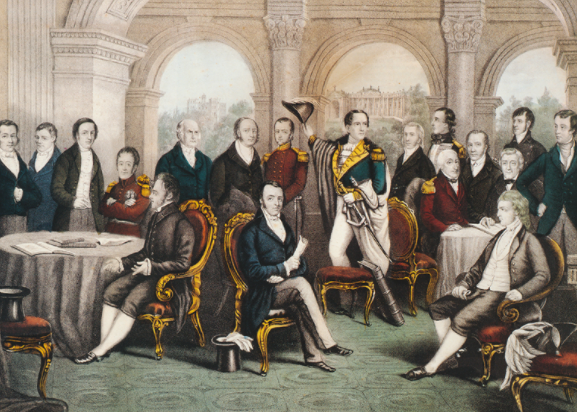
Fr James Quigley was born in the townland of Castleraw near Loughgall, in County Armagh in August 1761, the second son of James Quigley and Louisa Donnelly. He went to grammar school in Dundalk, was ordained a priest in 1784, at the age of 23 years. In 1785 he was sent to the College of the Lombards in Paris where he got into trouble with the Superior a Fr Walsh.
When the French revolution began in 1789, he fled the city and eventually arrived in Brighton in England, and from there he travelled back to his home in Armagh in bad health.
At that time in Armagh there had been an upsurge of violence between the Peep o’Day Boys and the Defenders. O Coigligh tried to unite people against this kind of sectarian strife. He spent 3 years in the parish of Dundalk until 1794.
The United Irishmen had been formed in Belfast in 1791. During 1795 there was a lot of sectarian strife where his parents lived. Their home was attacked and wrecked by the Peep o’Day Boys who had the backing of the Magistrates. The wrecking of his father’s home led him to join the United Irishmen in Dublin in May/June 1796. He lived in Dundalk until April 1797. He was involved with others in trying to incorporate the Defenders into the United Irishmen.
Already the government were on his trail. He went on the run to Liverpool, then to Manchester and on to London. There he met up with other members of the United Irishmen. He and four others were sent to Paris where another group of United Irish were planning an insurrection in Ireland. This group was divided between those who were with Wolfe Tone and those with Napper Tandy. It is reported that Tone did not like O’Coigligh and so O Coigligh supported Tandy.
In December 1797 O’Coigligh returned to Dublin but he was being followed. By February 11th 1798, he was back in London and was on his way to Paris again. He went to a dinner which was attended by an informer. On 11th February he and four others set out for Paris. He was travelling in disguise. He was arrested in Margate before boarding the ferry for France. He and the others were charged with treason and brought back first to London on 11 April and then to Maidstone for the trial in May 1798.He was badly represented at his trial. The others were acquitted by Judge Bullen but O Coigley was found guilty and sentenced to be hanged drawn and quartered, which was the sentence for treason in those days.
While he was kept in the condemned cell awaiting execution, a priest called Fr Griffiths, who was a government agent, was sent to him.
Fr O Coigligh was executed on June 7th 1798 in Maidstone, Kent. There is a monument to him in the Church of St Francis of Assisi in Maidstone: “Pray for the soul of Red James O Coigligh, a native of Ireland, who was put to death on Pennenden Heath, June 7th 1798″. Wolfe Tone proposed the erection of a monument to him when freedom was secured but it was never put up. (A close family relative, Fr Tom Quigley, is a priest today in the Clogher diocese. I met another descendant of his in London some years ago who gave me some of this information.)
Sorry I see a mistake. The United Irish were formed in 1791 NOT 1891!
O’Coigligh reputedly peeled and ate an orange on the scaffold while awaiting execution. There are still loads of Quigley/OCoigligh”s round South. Armagh North Louth/ Monaghan.