
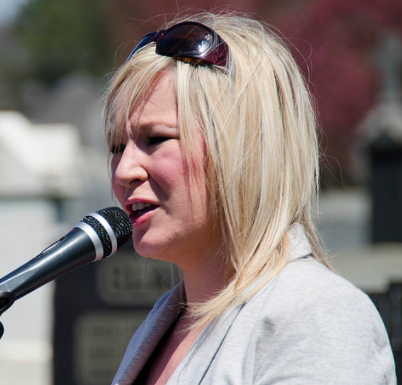
When I was still a teenager and during my first year at university, studying for a psychology degree, I was always advocating for improved mental health services to deal with the scourge of depression which dampened the hopes of many in my generation. I was asked by a dedicated local mental health campaigner to come with him to Stormont to raise awareness of the issue. I didn’t really know what to expect, so I just put on my Sunday best and went up to meet the “folks on the hill” on behalf of a suicide prevention group. When I got in the car, I was told we would be meeting with the recently appointed Sinn Fein Agriculture Minister, Michelle O’Neill.
Of course I thought that the Health Minister might seem more in line with this remit but what a lot of our own data showed was that suicide is becoming increasingly common in rural and farming areas. I didn’t really know what to expect – I had grown up meeting politicians, with my grandfather having been a well regarded local Councillor, so I’ve always had a sense of confidence when it comes to gracing people’s presence for the first time (at least I hope!). When we went in to meet with Michelle, she took the time to shake everyone’s hand, offer us tea and right away it became clear she had a person-centred approach to her. Of course it was a sensitive issue which we were discussing but she was very disarming, and what struck me was she already knew the exact statistics for suicide rates in both rural and urban areas off the top of her head. She has an eye for detail. But it also became apparent that this was someone with young children, including a daughter around my age, who has an obvious stake in young people doing and feeling well in life. It was a very productive meeting and she endeavoured to help as much as possible in tackling suicide via funding preventative training in the areas we highlighted. I never at all got the impression that this was someone motivated by a political office; but rather by a clear-cut set of ideas and conscience.
Wherever you look, women are taking centre stage politically in what was always a man’s world. Barriers are being broken and stereotypes eradicated. There’s a lot to do in achieving absolute equality and an understanding in men that women do have much tougher struggles to overcome than they do in life. Don’t get me wrong, women have held powerful roles in world politics for years – but I wouldn’t exactly call Thatcher or Golda Meir great feminists. I think it’s important for women, particularly young girls, to be able to have a role model in public life in a top job, who actually believes not just in ideas per se, but specifically in the principle that women can do any job every bit as well (if not better) than men can. And to see them apply it accordingly, in a progressive way, advocating an ethic which encourages other women accordingly.
Many of these women who attain senior jobs, whether it’s Merkel in Germany or May in the UK, don’t really seem to believe in equality or parity of esteem. They get to govern because they govern like conservative-minded men would. So I don’t think anyone should be in any doubt that there will be a very sharp distinction between the clash of left and right-wing ideas when it comes to Michelle O’Neill and Arlene Foster. They actually are polar opposites, as opposed to differences so often pretended by politicos.
I like the idea that she is a mother and that one child is of a similar age to me. She therefore has a real interest in helping to ensure we have a growing economy which offers people jobs and opportunities, with a quality of life that capitalises on the peace divided which her and my parent’s generation didn’t really have the advantage of when growing up. She understands the future while not being constrained by the past. And I think it’s abundantly clear that while many politicians can put on a facade of being “nice”, she genuinely is the real thing.
I bumped into her in an airport a few months back when we were heading on our annual family holiday to Spain. And true to form, she was just as polite and friendly. But the teenage boy she first met had a beard and a Belfast Telegraph under his arm. I’ve changed a bit, but she’s still her same approachable and courteous self. My grandmother commented afterwards, “She’s a lovely we girl. She says what she means and means what she says, and you can’t ask for much more than that.” Which I think is a pretty good analysis from one strong woman of another.
Be careful, a Dhómhnall, that she doesn’t turn into one of these ‘dissidents’ that you have nightmares about.