
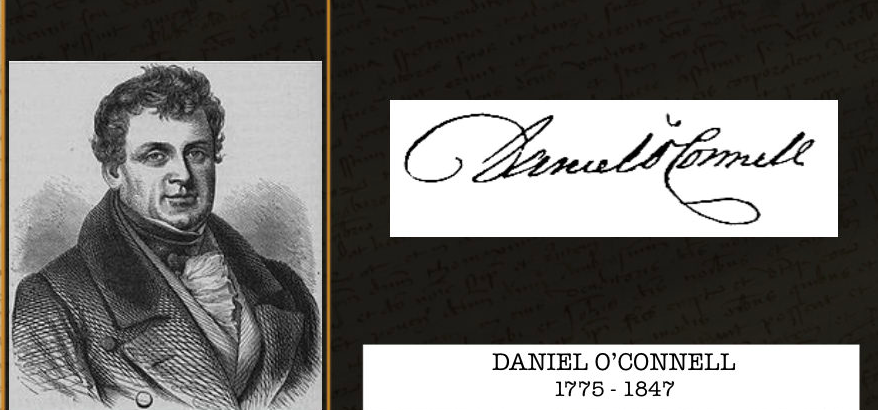
Whenever I read damned fool commentary on Daniel O’Connell I sigh for the time when every gentleman worthy of the name kept at least one brace of duelling pistols. But alas, I’m no gentleman, nor even a scholar, and must rely on my laptop to secure satisfaction.
Some years back Fintan O’Toole wrote in The Irish Times that O’Connell had been written out of Irish history. Some time later that newspaper sought suggestions for naming a new bridge over the Liffey, so, inspired by O’Toole’s complaint I wrote to his Editor suggesting it be dedicated to his forgotten hero.But my suggestion wasn’t published.
Of course, Dublin has long had an O’Connell Bridge, spanning the Liffey, an impressive Boulevard leading to it, named after O’Connell, which has hosted an O’Connell monument carrying his likeness.
Dublin’s main cemetery in Glasnevin contains, together with the remains of hundreds of thousands of other decent people, those of great numbers of outstanding persons in many walks of life. Dwarfing all memorials is a Round Tower, built over O’Connell’s tomb. Other Irish cities and towns have streets, squares and other public places dedicated to O’Connell’s memory.
For the best part of two hundred years a major school in Dublin, O’Connell Schools, has flourished. It is the Alma Mater of at least two Taoisigh, John A. Costello and Sean Lemass, the renowned comedian Jimmy O’Dea, and, for a time, not often acknowledged, James Joyce. The school was recently the scene of one of the silliest, if not infamous commemorations in world history.
O’Connell, who once killed a man in a duel, and whose family for over a century smuggled young men to France to fight in its Irish Brigade, is reputed to have said that the freedom of Ireland was not worth the shedding of a drop of blood. O’Connell said a lot of things in his long career, in the Courts, in Parliament, in private meetings and in public, even “Monster ” meetings, in Irish (his native language) and in English. He tailored his speeches to his aims and audiences and organised masses of common people on an unprecedented scale. Like Parnell and de Valera and Gerry Adams in later years, he earned the hatred of The Times. No greater compliment is possible.
But erstwhile supporters whom he derided as “Young Ireland” after the “Young Italy” , split with him. Amongst them Thomas Francis Meagher, whose speech on “The Sword” is an eloquent and principled defence of its use in a good cause. Meagher played a hero’s part in the Union Army during the American Civil War.
But back to Dublin’s O’Connell Schools, where there was recently unveiled a plaque commemorating an ex-pupil killed serving with the British Air Force in the Second World War. The late British historian A.J.P. Taylor maintained that the Air Force was founded as a terrorist body. The British magazine History Today, founded by the renegade Irishman Brendan Bracken, carries, in its June 2013 issue, a 1923 photograph of a burning Iraqi city following an RAF raid and says it was the custom of their pilots to machine-gun women and children during their “policing” of that country, This was some fourteen years before the Luftwaffe bombed Guernica and the genius of Picasso ensured that later atrocity was not forgotten.
(Incidentally, Brendan Bracken denied that he himself had been at O’Connell Schools. General Emmet Dalton who had fought in Flanders with the Dublin Fusiliers, in Dublin with the IRA’s Dublin Brigade, and in the Civil War with the “pro’-Treaty” side would have smelt mud, blood, sweat and tears but still remembered the smell of Bracken’s corduroy breeches at Sgoil Ui Chonaill. But Bracken denied it.)
Anyhow the ex-pupil honoured by O’Connell Schools was Brendan Finucane, known to his RAF comrades as “Paddy Finucane”, and referred to, in his end of war speech as “Paddy Finoocane” by Winston Churchill, and held up by him as a “good” Irishman to differentiate him from the “naughty” Irish who served their own country.
The O’Connell Schools event was organised by an ex-pupil, a dentist, not, as one might imagine, some pig-ignorant oaf. His oration praised Finucane’s blowing numerous Germans to Kingdom Come, and said he had thus served Ireland’s freedom. I read the report in the Irish Times which did not appear to note the irony. I can think of a genuine Patrick Finucane, a more deserving subject for Irish commemoration and international respect.
In praise of a speech by Enda Kenny, which I’d be surprised if the Taoiseach himself wrote, Irish Times’ Political Correspondent, Stephen Collins, invoked, you guessed it, Daniel O’Connell. It was a speech where O’Connell praises the separation of Church and State. O’Connell had been hailed as “The Liberator” , not in the derisive way he had himself christened “The Young Irelanders”, but in earnest. The title had been bestowed on Simon Bolivar, who had used The Sword to wrest territories from Imperial Spain and had shed blood with the same instrument. O’Connell had used no sword, shed no blood nor wrested a square inch of territory from Imperial Britain. The oath which O’Connell took to enter Parliament did not require him to abandon his Catholicism, but did require him to uphold the Protestant Succession, and to grass on anyone trying to upset it.
O’Connell died on a pilgrimage to Rome, where the Pope held not only the Keys of Saint Peter, but Temporal Power over a significant swathe of the Italian Peninsula. While most of O’Connell’s mortal remains lie in Dublin’s Glasnevin Cemetery, his heart remains in Rome in accordance with his wishes.
In Ireland great oceans of blood, and other matter, were shed, not in warfare in “Famine”, as “the Bloody Flux”, as Dysentery was then called, laid waste to the nation, and agricultural produce which would have prevented the catastrophe was taken to the docks for export, escorted by the bayonets, swords, and other weapons of Britain’s Imperial Troops.
Donal Kennedy.2013
This first appeared in “Church & State” – An Irish History Magazine and Cultural Review of Ireland and The World. Published by Athol Books. Last Quarter 2013.
I’ve always viewed O’Connell as having more than a touch of Stockholm Syndrome about him, like so many Irishmen siren the years. A fierce opponent of violence by his fellow natives, he was willing to join the militia to fight the United Irishmen. For all his passionate struggles for the rights of the people, the excruciating story of him kissing Victoria’s feet as she alighted on Irish soil is hard to get by. Any idea if that was actually true, Donal?
O’CS
Best known as the corner boy’s Belvedere
Its crest features the head of an old deer
Ciall agus Neart
Strong n’ Smart
Close ink-stained links of late with Lincolnshire.