
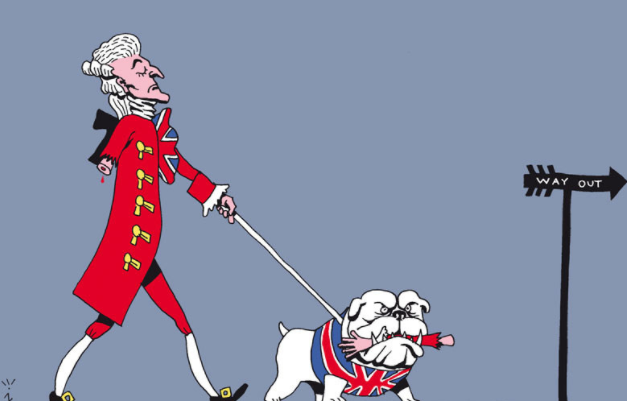
According to Theresa May ‘Brexit means Brexit’. To many people living in border areas in Ireland those words are a cause for great concern. We were just beginning to forget that there was a border but Brexit has made sure that we will not forget and former First Minister, Arlene Foster, is pleased and excited.
If the British Prime Minister, Theresa May, intends to pursue ‘a hard Brexit’ in order to keep unwanted immigrants from entering the UK there will need to be some kind of checkpoints along the border in Ireland. To the majority in the north who voted against leaving the European Union (EU) and to those especially who live close to the border that means an end to freedom to travel. If Theresa May’s government chooses to leave the Customs union that will mean an end to freedom to trade and a return to customs posts along the border to collect tariffs. The restoration of a border of any kind on this small island is nonsensical and will be disastrous for the economy of the whole island of Ireland.
The Dublin government and the EC have a serious responsibility to defend the rights of the Irish citizens in the north who are also European citizens from any attempt to create a border with Customs checkpoints from Newry to Derry. Are they up for it? I am not sure. I would not like to be relying on Charlie Flanagan to defend the interests of the people who voted Remain.
As far as Ireland is concerned when Brexit is implemented the people and businesses will have to deal with levies, duties and tariffs of all kinds. There is no escaping them. How they are paid is open to speculation. The twenty-six counties will be staying in the EU and will have to charge and pay levies to non -EU countries which now includes the UK. The UK will be out of the EU and imposing their own tariffs on goods being imported. It is going to be an unbelievable mess.
The former first Minister, Arlene Foster, in an article in the Guardian (October 24th) claims that the economic and social benefits from being part of the UK are more important than being in the EU. What about the Single Farm Payment? What about access for farmers to the European market, without tariffs? And what does her comment mean in a situation where the purchasing power of any such benefits are dramatically eroded by inflation, as is already happening, even if she does not seem to have noticed.
She claimed that “…trade with the EU won’t stop when we’re out of it, any more than it does for those who have never been in it…” But is she happy to pay the levies, duties and other requirements imposed on such countries in order to be allowed to trade with the EU? More importantly are Northern businesses happy to do so? That won’t affect her income, but it will affect that of hundreds of thousands of owners and workers in businesses.
Arlene also states: “There are real and exciting new prospects for the UK outside of the EU”. Where are they? If she considers the economic position of most commonwealth countries, she will not find many there; so where are they? They are not obvious to most business people, even if the Ulster farmers Union have been saying that, though they did not convince all of their members to vote for Brexit. The farmers are shrewder than most politicians.
Farmers will discover over the coming years that this is a bad decision. Already we see the damage being done to the major Agri – food business in recent weeks, which was precipitated by Brexit. Worse has yet to come –unless politicians and business people north and south get their act together and demand a special status for the north in the long term interests of peace and stability.
you started off well recognising the main point of stopping unwanted immigrants coming into the north.this is where the whole brexit business stemmed from,so people should direct their protests towards dublin to change their open door policy that they themselves know is the biggest danger ireland has faced in decades,
Direct EU payments to farmers represent 87% of annual farm income in the north
http://www.thedetail.tv/articles/the-eu-s-common-agricultural-policy-should-we-stay-or-should-we-go
If farmers here genuinely believe that Westminster is going to subsidise them to the same extent, they’re in for quite a shock.
Councils across England are having fire sales at the moment with a number of them (including Liverpool, Newcastle and Lancashire) warning that they will be unable to provide the services they are legally obliged to by 2020. Pardon my French, but there’s a shitstorm heading this way.
Farmers in the north tend to be of a Unionist persuasion, and have a fair amount of influence within political circles. When farm income drops off the side of a cliff, is blaming Sinn Féin really going to work? Farmers are nothing if not pragmatic, and when those in the north shortly learn the meaning of ‘Perfidious Albion’ all hell will break loose. Unionist Unity you say?
“Farmers in the north tend to be of a Unionist persuasion, and have a fair amount of influence within political circles”
Sorry to break the stereotype of the countryside being full of some kind of Protestant landed gentry, but it’s simply not true. 55% of farmers are Protestant and 44% are Catholic.
https://www.daera-ni.gov.uk/sites/default/files/publications/dard/farmers-and-farm-families-in-northern-ireland.pdf
Religious belief
There were distinct differences in the community background of farmers by type and
size of farm. These reflect the geographical distribution of farms and indicate that the
prime distinction is by Less Favoured Area status. Farmers in the Severely
Disadvantaged Area (SDA) were predominantly Catholic, those in the Disadvantaged
Areas broadly 50:50 and in the Lowland predominantly Protestant. The proportions
of Dairy and Other Types of farms in the SDA are low, 24% and 16% respectively,
and hence farms of these types and sizes were predominantly Protestant.
How now Brown Cow?
It is commonly agreed that the vast majority of ‘Big’ farmers are of the Protestant Unionist persuasion and that they hold the biggest influence in terms of decision making for the farming community as a whole. Let’s not even go into the reasons for this, old wounds etc.
“Theresa May, intends to pursue ‘a hard Brexit’ in order to keep unwanted immigrants from entering the UK there will need to be some kind of checkpoints along the border in Ireland.”
It seems very unlikely that the EU will restrict freedom of.movement for UK citizens.or vice versa, so I don’t expect there will.be any need for such checkpoints.
“To the majority in the north who voted against leaving the European Union (EU) and to those especially who live close to the border that means an end to freedom to travel.”
Even if it did, checkpoints wouldn’t mean an end.to freedom of travel. We’ll still be green to travel to Southern Ireland and vice versa.
“If Theresa May’s government chooses to leave the Customs union that will mean an end to freedom to trade and a return to customs posts along the border to collect tariffs.”
Only if the EU decides.to.impose.tariffs and vice versa.
“We’ll still be green to travel to Southern Ireland and vice versa” – is that a Freudian slip, MT, or are you just glad to be with us??
“The Dublin government and the EC have a serious responsibility to defend the rights of the Irish citizens in the north who are also European citizens from any attempt to create a border with Customs checkpoints from Newry to Derry.”
There are no such rights therefore there can’t be any responsibility to defend such non-existent rights.
Have you received your Irish passport yet MT? The day we achieve a United Ireland I would like to meet you personally and thereupon, shake your hand and give you a big Irish hug.
The EU confers no rights on its citizens. The truncated Irish state confers no rights on its citizens. Is this what you’re saying, MT?
“The EU confers no rights on its citizens. The truncated Irish state confers no rights on its citizens. Is this what you’re saying, MT?”
No.
Funnily, as I watching the English chancellor deliver his budget the other day, I felt a strong sense of irrelevance. Since the election and the genuine talk of a reunited Ireland I find britishness and its tenuous place here drifting away, like a swimmer waving out at sea.
Not waving but drowning?
Yep, maybe so Jude.