
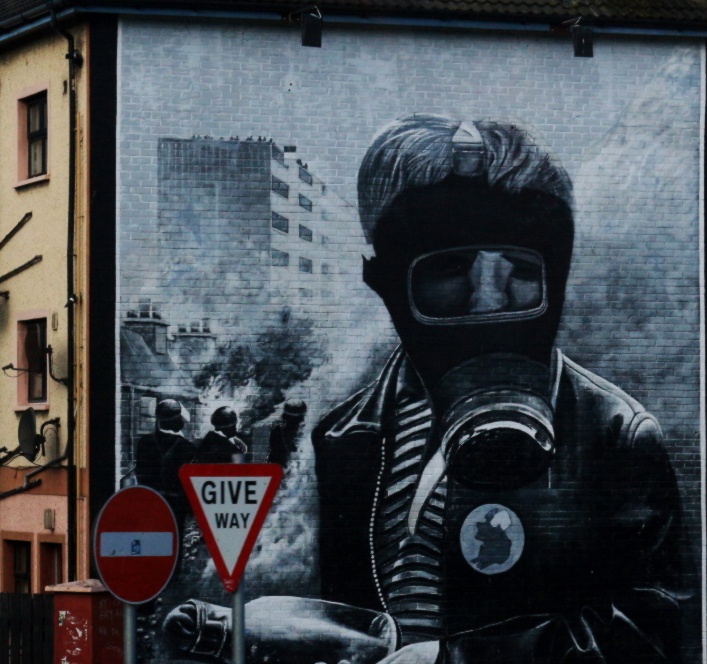
Yesterday I did a Skype interview with a young Hungarian woman who is studying for her Master’s in Budapest. She’s doing a study of political violence and wanted some background information about the situation in our NE Nest. I’ll list her questions and my response to each. I’d be interested in whether you think I’ve misled her/left out something crucial.
Question 1: According to you, what lies at the heart of the conflict in Northern Ireland and what are the main identities competing within the communities?
Answer 1: The main identities are the Irish nationalist/republican identity and the unionist/British identity. Nationalists/republicans argue for an end to partition – the division of the NE of Ireland from the rest of Ireland – and the Irish people governing themselves, without interference from England. The unionist identity argues for continuation of the link between the NE of Ireland with Britain – that Northern Ireland should remain part of the UK
Question 2: Is being Irish more important than being Protestant, Catholic or even British? How were these identities formed?
Answer 2: I believe, certainly in political terms, that being Irish is more important than one’s religious identity, even though for historical reasons, Catholics tend to be nationalists/republicans and Protestants tend to be unionist.
These identities were originally formed in the seventeenth century, when, to consolidate its position in Ireland, England brought over English and Scottish Protestants, who were given land throughout Ireland but particularly in Ulster (much of which eventually became Northern Ireland). These Scottish and English settlers were colonists, pro-England and anti-Irish, and that division remains to this day
Question 3: What are the main differences in the perspectives of the various actors involved and how did they influence the conflict? By these actors I mean the governments of Ireland, of the UK, of Northern Ireland, the IRA, the RUC, and other paramilitary organizations.
Answer 3: Nationalists/republicans seek Irish reunification, in a new and better Ireland, arguing that partition was bad for the south of Ireland as well as the north. Unionists are reluctant to accept their Irishness, and look to maintain the link with our more powerful and cosmopolitan neighbour, England.
The government of the South of Ireland say they believe in Irish reunification, but many in the NE believe this is lip-service.
The UK government – which established partition – says it supports the status quo, but that ultimately it is a matter for the people of NE Ireland/Northern Ireland, and that a referendum on Irish unity should be held when it appears a majority want constitutional change.
The IRA was a republican paramilitary group which believed violence only would persuade Britain to stop meddling in Irish matters.
The Royal Ulster Constabulary (RUC) was the police force in Northern Ireland. It has now been abolished, being seen as too pro-unionist and violent in its suppression of the nationalist/republican drive for civil rights and ultimately re-unification.
Question 4: What was the official attitude of the Republic of Ireland towards Northern Irish citizens?
Answer 4: The official line of the southern Irish government is that they favour reunification; but their main concern is to keep the southern state intact, untouched by violence or northern influence. Sinn Féin are making that difficult for them, by being a major party in the north and a growing political power in the south.
Question 5: Could you tell us more about the promotion of Irish culture through less obvious channels, such as sports or culture?
Answer 5: Unionist culture shows most obviously in marhing bands to celebrate the victory in 1690 of King William III, the Protestant English (Dutch) King over King James II (the Catholic English King). There are some 4,000 marches annually, and traditionally these are seen by nationalists/republicans as triumphalist, mocking nationalists as the defeated ones.
Irish culture is maintained by Irish music, dancing, Gaelic/Irish sports and the Irish language.
Question 6: Was this attitude any different when it came to other Irish diasporas outside the Republic of Ireland?
Answer 6: The attitude to Ireland is seen most clearly in the Irish diaspora in the United States. There has been strong support for nationalists and republicans from Irish-Americans living there, many of whom have a race memory of An Gorta Mor – The Great Hunger or the Irish Famine. That support is less pronounced today.
Irish-Americans played a crucial role in the period of armed conflict, when they supplied money for the dependents of republican prisoners (and, in some cases, financial support for the IRA). The US also played a major role in encouraging the end of conflict and the signing of the Good Friday Agreement in 1998.
Question 7: According to you, what were the most important factors that led to the radicalization of the society and to the legitimization of the use of political violence by the IRA?
Answer 7: Undoubtedly the reaction of the Northern Ireland government and of the RUC, police auxiliaries and extreme unionist elements played a major role in reaction to the nationalist drive for civil rights in the late 1960s. The civil rights marchers wanted an end to discrimination in housing and jobs, an end to constituency gerrymander. In short, they wanted the same rights as citizens in other parts of the UK. The peaceful marches of civil rights activists were met with violence, from the RUC and from unionist extremists.
Eventually, the RUC was seen as being unable to cope and the British army was brought in. Before long, the British army was seen, not as a neutral peace-keeper, but as a support for unionism. Events such as the Ballymurphy Massacre, when the British Parachute Regiment shot dead eleven innocent Catholics, including a priest, and Bloody Sunday in Derry, when the same regiment shot dead fourteen people, confirmed the belief that the British Army was a support for unionism in Northern Ireland rather than a fair-minded referee.
Question 8: Could you please tell us some of your personal experiences that could reveal more about the patterns of radicalization?
Answer 8: I’d been living in Canada during most of the 1970s. I came back 1979. The hunger strikes – ten IRA men died in prison, rather than accept classification as common criminals – changed my thinking. I began to see that this was essentially a colonial problem. As part of the middle classes, I was largely protected from the direct impact of the Troubles, which were largely fought out in working-class areas; but to pretend that republican paramilitaries were just a bunch of criminals seemed to me unsustainable.
Question 9: How would you evaluate the current peace settlement, and in your opinion what are the outlooks for a re-unified Ireland, with the possibility of a Scottish independence and with Brexit in the background?
Answer 9: I believe that the peace settlement will hold. With a few exceptions, there is not an appetite for the terrible violence that was the Troubles.
I believe a united Ireland will come perhaps within 10 years, perhaps longer. The changing pattern of demographics will play a major part. Northern Ireland was set up in such a way that it was believed there would be a guaranteed majority of Protestants/unionists. What started as a two-thirds unionist majority has, over the decades, changed. The nationalist/republican population in NE Ireland is swelling, the unionist population shrinking. This was seen vividly in our recent election, with Sinn Féin, the republican party, coming within one seat of the DUP, the unionist party. A lead which had been ten seats shrank to one seat. I believe the call for a border poll will eventually be granted and won by those favouring a united Ireland. Importantly, arrangements will have to be made for a new kind of Ireland – one perhaps with a federal element, with the seat of government in Dublin but a devolved Assembly in Belfast.
Were Scotland to win independece, it would be seen as a signal that the UK was fragmenting. Most people in NE Ireland voted to stay in the EU, as did Scotland. If Scotland left the UK and re-joined the EU, there would be a strong drive for NE Ireland to do the same. The economic benefits of being in the EU, along with the changing demographis in NE Ireland, would offer a compelling case for ending the union with Britain. I think in those circumstances most unionists would accept a united Ireland where they were convinced their civil rights, their cultural identity, even their British passport would remain.
Do you believe,Jude, that Sinn Féin really want Stormont to work? Or do you agree with Seamus Mallon, the Grande Dame of Irish nationalism, that they are lying? He actually did say they were liars. I wonder did your . I wonder did your Hungarian friend go to a unionist source to check your answers?
What a sad old man is Seamus Mallon. All his political life overshadowed by John Hume. Seamus always believed Sinn Fein spoke with forked tongue.
Why would SF not want to see the Assembly working.
SF are on the crest of a wave in both the Six Counties and the 26 Counties!!!!
Better still…were the same questions put to any unionist commentator to see how they might interpret the past, present and possible future…
Yes I do think SF want Stormont to work. (i) Their consistent policy has been to transport as many powers as possible from Westminster to Stormont – Irish control not English control; (ii)A successful Stormont shows that they can exercise power successfully – good ad for southern progress. I’ve no idea if she went to a unionist source. She talked about using the interview as a podcast in her work, so she may have done the same with other sources. Do you think I’ve said something that would need a counter-version?
Not at all Jude.i’m just curious as to how those same questions might be answered by our visionary unionist friends…if at all……also…who might you consider a good source to ask on the opposing team and how do you think those same questions might be answered….
Is there such a thing as a visionary unionist?
Maybe you could name one.
When you think that the DUP leader and former first minister seems to have lived all of her life without knowing anything, or learning anything of the Irish language and culture, and up until now having been so adamant that she wouldn’t, you might have to look outside the DUP!
Irony tends to get lost in cold print , sherdy
My irony gets a bit rusty at times!
As a totally unbiased person, no!
Excellent Q&A session Well done Jude
Grma, Jim…
Jude
You have given her an honest view from your perspective so it could hardly be misleading in that sense.
The interesting one is Q7
” what were the most important factors that led to the radicalization of the society and to the legitimization of the use of political violence by the IRA?”
There is an assumption inherent in the question that IRA violence had been legitimised, an assumption you do not challenge.
Does this mean you are clearly saying it is your view that the IRA campaign was legitimate?
It is something you have been a bit unclear about in the past,other than saying that they (the IRA ) believed it to be legitimate,which is fairly obvious.
The Irish nationalist people legitimised it same as the unionists did for ‘their boys’. Any fool can see that. The dictionary says it means ‘made lawful’. Who made the serial rape of this country lawful by the English conquistadores?
fiosrach
The Irish nationalist people legitimised it did they?
When did that happen?
In any case I was more interested in Jude’s apparent acceptance of the term ‘legitimised’ .
It’s always difficult to explain our conflict to people not within the NI bubble. Let’s be honest most of us struggle with the reasoning behind it never mind people on the outside.
All in all you answered her questions fairly well from your own perspective and didn’t let your own prejudices (which we all have of course) affect your attempt to give the girl a balanced answer. I may have answered things slightly differently but I suppose we all would have.
I remember once driving a English friend back to the airport and she finally plucked up the courage to ask me what the Troubles were all about. I wanted to give her as unbiased a view as possible and only had 15 minutes till we got to the airport.
I told her that when you boiled it down to its most basic level the NI conflict is no different from conflicts all over the world and throughout the centuries. There are two tribes here and it’s a battle to decide who controls the land.
“Let’s be honest most of us struggle with the reasoning behind it never mind people on the outside”………Sherdy, I’m not one bit confused, I don’t struggle at all with understanding how this shit hole came to be and the resulting slaughter of all of our citizens. When you assume, you make an ‘ass’ out of ‘you’ and ‘me’.
you never explained the ruc very well.saying it was seen as too pro unionist.maybe she will go away with the idea things have changed.when its only the name was changed.
That will teach you to consult all your readers before you do any more interviews,jude 🙂
Your answers were all fair and honest.
Very balanced answers, to be honest you would need a novel to explain the complexities and it is difficult to pick out what needs to be said to give a basic understanding. You have done a better job than I could. I do like to point out that England played the religious card around 1798-1815 to drive a wedge between radical Protestants and Catholics. A card played again by Ascendancy Unionists in the early 1900s. Essentially the first republicans were Protestants. But again that confuses even the people who have lived here all their lives.