
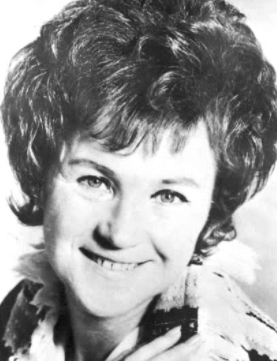
At first glance one might fancy that the names of Dame Margaret Rutherford and Tony Benn do not belong in the one sentence, even a suspended one.
Not because both had greatness trust upon them while being great already, but on account of the factoid that whereas the great actress added a Dame as a prefix to her name the great politician deleted a Sir as same to his.
But belong in the same sentence they indubitably do.
For, not only did they contribute to the greatness of England, if not Britain but, unlikely as it might seem, they were actually related one to the other; in a word, cousins. If not exactly of the kissing variety. Or, in another word, cousinTs, as the word is pronounced in such relatively, oops, exclusively rusTic suburbs of Dublin, as Crumlin, Drimnagh and Ballyfermot, Cabra, Finglas, Sallynoggin, Kilbarrack etc.
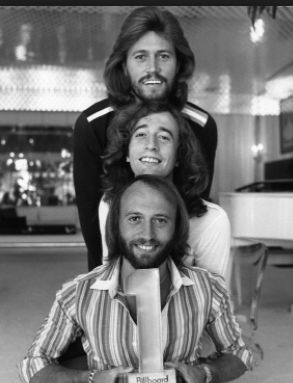
So also with B.G. and the Bee Gees who also belong in the same sentence.
Both Bridie Gallagher (for it is indeed, she !) and the Bee Gees, despite their teeming with transparent talent, have each been treated shabbily by television.
It was one of Bride’s biggest disappointments that she was never offered her own show by RTE while on one infamous occasion a ghost-written Chat Show host, consumed with his own self-insignificance, name of Clive Anderson (?) , effected to mock the Bee Gees who were his guests. In what was one of THE great moments of live television EVER, the cringe-worthy one truly got his comeuppence when the Brothers Gibb, surfeited with their host’s conceit, duly discarded their clip-on mikes and trekked off.
It is not only wisdom which cries out in the streets and no man regards it.
Likewise, while B.G. and Billy Fury would appear at first hearing to belong to the opposite (diametric, indeed) extremes of the popular music spectrum nonetheless, both also belong in the same sentence.
For in October 1959 the Father and Brother of all iffy showbiz hulabaloos rocked Dublin-sur-Liffey to its very alsatians. This happened when the management of the Theatre Royal brought the curtain (if not the house) down on the pop singer Billy Fury on account of his ‘lewd acts’ with his microphone, which is long for ‘mike’.
Nobody in Drimnagh (see above) talked about anything else for the following month of Sundays. Indeed, at every road corner spontaneous competitions ensued between local Jacks the Lad even as they vied with each other to act out what they imagined the ‘lewd acts’ of Billy Fury might have been.
In so doing, their re-creations left nothing to the imaginations of their younger audiences which consisted in the main of snotty-nosed gurriers in short pants. Who were left, as it were, halfway to paradise trying to figure out just exactly and into what kind of shapes the aged teenagers were contorting themselves.
Meanwhile, in the neigbouring parish of Crumlin a (gulp) one year old Fintan O’Toole was giving voice, according to urban (very) legend, to his very first word:
– Chickengick.
How incalcuably far the future Horse Manure Magnate has travelled since that local vocal day !
One mentions this latter detail of local colourlessness because many of the above gurriers returned to their homes to listen to the first vinyl LPs on the fambily’s first record players. In one house at least, the r.p. came accompanied by two LPs, both with a Belfast provenace:
-The Songs of Bridie Gallagher and the Irish Airs of David Curry.
The point here being that even short-britchered bowsies could effortlessly juggle two contrasting (allegedly) types of music, the rural and the urban , despite the One of such a swinging surname later encountering ginormous diffificulty with the simple concept of a, erm, dichotomy.
The (yawn, stretch, trouser cough) dictum of O’Toole being: one cannot be simulataneously rural/ urban: or synchronically juggle the English with the Irish: one must be a cultural mongolot or not.
B.G., indeed, was top of the bill that fateful night in the Theatre Royal when the boom was lowered on Billy Fury.
-After rehearsals earlier in the day, Billy had come up to her dressing room and presented her with a beauiful box of lace hankies embroidred with red roses. She was very touched by his kindness and thoughfulness, especially from such a young man.
This is the kind of devilish detail which so enriches this biography of Bridie Gallagher to such a delightful degree. The biographer of Bridie is her son, Jim Livingstone, a musician and a psychologist. And as it’s a musical biography one could do far worse than to borrow the catchphrase of another musical legend, Laurence Welk of orchestral fame, to describe the book:
-Wunnerful, wunnerful, wunnerful.
Some things come in cycles: one is reminded of how Stephen Roche and Sean Kelly came a-peddling along at the same time. So also in spokesong: Bridie Gallagher, the Girl from Donegal and Ruby Murray, the Girl from Donegall Road. Not forgetting the serenly efferfescent Eileen Donaghy: can any one with half an ear honestly listen to ‘The Old Lammas Fair’ without tasting either dulce or Yellow Man?
Ah, yes, the grim, grey Fifties that the late-arriving Fair-minded Fintan O’Toole is so fond of ruling as (gulp) inadmissable.
The Theatre Royal, coincidentally, was the same venue where Judy Garland had appeared some eight years beforehand, 1951, when she unwittingly took on the mantle of the Ultimate Innocent Abroad by insisting on singing ‘A Pretty Girl Milking her Cow’ in (gulp) the original Irish in (gasp) deference to the linguistic sensibilities of the locals.
As it happened, Bride Gallagher was in the audience that memorable night, having travelled down from Belfast to see one of her heroines. It had a major impact on the Girl from Donegal.
-For Bridie made the then bold step of using a handheld microphone, just like Judy. This meant moving about the stage using hand gestures to emphasise lyrics in an artistic manner and thus communicating even better with all parts of the audience.
In later years, Bridie took to attending Irish classes in Belfast. The Perkin’s inner phisher likes to fancy that the performance of Judy Garland might well have also influenced Bridie in this latter regard. Thus, making Judy G. not merely a gay icon, but a Gaelic one as well.
And then, there was that unique musical instrument of Bridie’s: that voice. Once heard, never forgotten. Utterly unique, remorselessly musical, always in tune. Here is how her son and biographer describes it :
-At an early stage in her career it was often commented on that she had a ‘break’ in her voice. This was a feature that could best be described musically as a trick of the voice where she would sing a note in a pure tone and then falsetto, an octave higher. It was described as sounding like she had ‘a tear in her voice;, particularly appropriate perhaps for one who sang so many songs that were sad.
So which singer most struck a chord in this songbird’s heart?
-Undoubtedly the singer whose albums she brought time and again, and played almsot daily, was the American coutnry and western star Jim Reeves. She adored his smooth voice and once described it as ‘chocolately’. She would relax and listen to possibly two or three albums in succession either in her lounge or in her garden listening through an open window. She regarded him as not only the best country and western singer in the world but the best ballad singer in the world’.
It takes one class act to recognise another: aithníonn pirogue amháin pirogue eile.
A contemporary phrase which might be regarded as the companion piece of ‘anytime soon’ is:
-back in the day.
Actually, it may also have been contemporary in the era of Bridie Gallagher, an caillín ó Chraos Loch, if not long before:
I spoke to the captain – he’ll not turn her round
And if I swam back I’d be apt to be drowned
So I’ll stay where I am and the diet is great
The best of combustibles piled on me plate.
But though it is ‘Sumpchus’ I’d swap the whole lot
For the old wooden spoon an’ the stirabout pot
An’ Katey forninst me a wettin’ the tay
Where they’re cuttin’ the corn in Creeshla the day.
One rarely if ever hears such wit in the lyrics of contemporary radioland; one never hears the glorious glór of the Girl from Donegal, who remains as contemporary as tomorrow.
Why, pray, should this musical equiv of that template of spivs, Section 31, prevail?
The Perkin tends to put it down to that plague of the monominded media on Liffyeside:
-Organized Chime.
It was to heard as recently as last Monday, May Day, when the time-honoured tones of that eminent son of Glasgow whose mother hailed from Portadown, Canon Sydney McEwan once again ‘brought flowers of the rarest’ in his effortlessly splendid way.
Bong !
Went the Organised Chime.
-Separate Church and State, it’s nevet too late !
Bong !
Went the Organised Chime.
-Contact Cardinal Colm O’Gorman, of the Higher Narky Hierarchy aka Amnesty Ireland.
Bong !
Bong!
Bong!
To conclude: not the least fascinating detail in this minutiae-rich biography is the argument which ensued one night between two members of the Bridie Gallagher Show as to which of them could write the better song for an upcoming LP album the singer was planning to record.
In one corner was Pat McGuigan, a genius on the harmonica and composer of ‘The Men behind the Wire’ and in the other, Eamon O’Shea, whose most famous composition was ‘Come Down the Moutntain, Katie Daly’. In the heel of the hunt, Bridie recorded the two songs which emerged from this tonic solfa contest:
‘The Castlebar Fair’ by Pat McGuigan and’ Heaven around Galway Bay’ by Eamon O’Shea.
Now, here’s a thing: Bridie never referred to the latter as Eamon but always by his original name, Herman. Which was his actual name, having been born in Deutschland. Yes, indeed, Herman was a German. He wisely assumed an Irish identity on coming to Ireland in the middle of a world war.
Thus, one cannot help but wonder if there is a German version of ‘Katie Daly’?. Say:
– ‘Kommen sie den Berg hinunter, Katie Daly?’.
The Perkin often puzzled how an O’Shea fetched up in Bundoran: now he knows. This is the sort of chapter and verse which makes this biography worth the price of edition alone.
Just a detail – Tony Benn was never knighted. He renounced the inherited peerage of his father – Viscount Stansgate. I think I read somewhere that one of Tony’s sons – not Hilary – is reclaiming then title.
@ Perkin.
As an afficionado of the trivial, you can maybe solve this puzzle – is there any truth in the claim that Cockney Rhyming slang for a curry is “Ruby Murray” as a cap-doff to The Village girl?
Perkin – I looove it – you have surpassed yourself again – ‘ Kommen sie den Berg hinunter, Katie Daly?’ !!!!!!
I have heard that Kevin. Remember, until the advent of the Beatles in a much more affluent age Ruby was the only artiste ever to have 5 records in yhe top 20 at once, something Vera Lynn, Anne Shelton, Alma Cogan,Lonnie Donegan Dickie Valentine or no other solo artiste of her era ever achieved. So she would have been on everyone’s lips at that time.
With regard to Bridie Gallagher the first record I ever bought was a 45 record by Bridie under the green and white Beltona label. I think it was ‘Moonlight in Mayo’. Even as a boy of thirteen I was on love with her sensuous almost bluesy voice. To me she was an Irish Piaf. While Irish purists,pop aficionados and rock ‘n’ rollers alike sneered at Delia Murphy, Maggie Barry, Bridie, Theresa Duffy, Eileen Donaghy and their male counterparts, Brendan O’Dowda and Peter Tomelty, even Charlie Magee, it most be remembered that these singers kept Irish music and song popular in the arid post war years up to the folk revival of the sixties. My own personal favourites of Bridie’s songs are “The Moon Behind the Hills’ and ‘The Boys from the County Mayo. I never rated Eileen Donaghy till I heard her sing “Slieve Gallion Braes”. It made the hair stand on the back of my head. Delia and Maggie deserve chapters on their own another time. Go raibh maith agat Perkin.
1. You would be on the Jenson there, kc.
It is also a historical factoid that Ruby Murray and David Curry (of the Ulster Light Orchestra) rhymed bigly one with the other on the turn tables of Liffeyside during the (allegedly) grim Fifites.
2. Tagaim go hiomlán leat, BP.
Thank you for the kind comments about my mum and my biography of her life.
For anyone interested, they may find this link interesting. https://m.facebook.com/TheGirlFromDonegal/