
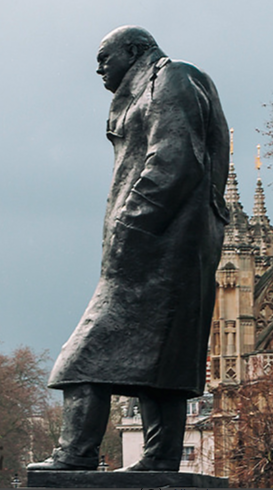
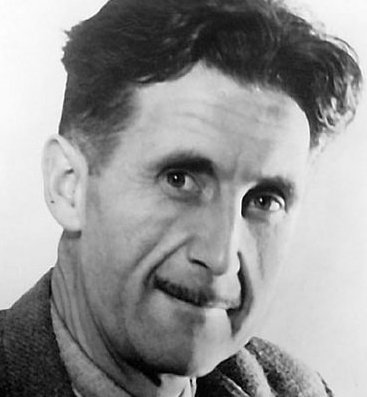
An American Military Historian, Thomas E. Ricks, has written a book (what else?) called “CHURCHILL AND ORWELL :THE FIGHT FOR FREEDOM” and it’s been reviewed by Andrew Roberts “a visiting professor of war studies at King’s College, London” in the London Evening Standard of May 25th.
That paper is free. I paid no money for it. In its altruistic spirit you can have my comment free, gratis and for nothing.
I quote – ” On the day Britain declared war on Germany in September 1939, Churchill sought to define it as a struggle far removed from the mere territorial issues of Poland and German aggression in Eastern Europe. ‘It is a war, viewed in its inherent quality’ he told the House of Commons, ‘ to establish on impregnable rocks, the rights of the individual, and it is a war to establish and revive the stature of man’. “
I quote – ” On the day Britain declared war on Germany in September 1939, Churchill sought to define it as a struggle far removed from the mere territorial issues of Poland and German aggression in Eastern Europe. ‘It is a war, viewed in its inherent quality’ he told the House of Commons, ‘ to establish on impregnable rocks, the rights of the individual, and it is a war to establish and revive the stature of man’. “
Hi-falutin’ rhetoric. No sooner was the ink dry on the 1918 Armistice than Churchill was planning to co-opt the abdicated Kaiser’s forces in a war on Russia and hijack a million unwilling British soldiers, who had signed up only for the war on Germany. And no sooner had Hitler blown his brains out in 1945 than Churchill planned precisely the same cunning stunt, co-opting Hitler’s surviving warriors in a war of aggression on Russia. The British electorate in 1945, better acquainted with Churchill’s character than is today’s generation, booted Churchill out of office at the first opportunity, postponing World War III by nearly 72 years, so far. In fact, during his long career that electorate only once sent Churchill to power at the head of a winning party. That was in 1951 when the Conservatives won more seats than Labour, but with less votes. In 1939 a Franco-British-Soviet alliance was there for the taking, but Chamberlain, like other British statespersons from November 1917 until the present (post-Soviet) day, have schemed against Russia.
As for Poland – from September 1939 to May 1940 the French and British twiddled their thumbs behind the Maginot Line. Then France surrendered and the British went home in a hurry. Neither country liberated a square millimetre of Poland from the Nazis during the following years. Nor, in 1941 did either country pose a threat to the Third Reich. Hitler was not utterly nuts in discounting Churchill’s rhetoric, nor Britain’s military capabilities, when he unleashed his legions on the Soviet Union. (He was, however ignorant of the forces which the Soviets had in reserve. Those forces sacrificed most before they became the determining factor in Hitler’s downfall.).
Churchill was a wonderful champion of the individual named Winston Churchill. But for the masses in Britain, India and Africa he was a bullying liar. During the 1926 General Strike, whilst a Cabinet Minister he edited a paper claiming that miners had gone back to work in a mine which its owners had closed down long before. Hardly the most damning of his lies, but a valid example. He caused the deaths of millions of deaths in Bengal in 1942 and 1943, and gloried in his villainy. That helps establish the stature of the man. In 1948 it seems that Churchill discovered ethics of a sort. I quote from “THE DARK VALLEY – A Panorama Of The 1930s ” by Piers Brendon, recently deceased Keeper of the Churchill Archives and a Fellow of Churchill College, Cambridge , and a biographer of Churchill. – “Not until 1948 did Churchill acknowledge that, ‘Mussolini’s designs on Abyssinia were unsuited to the ethics of the twentieth century. They belonged to those dark ages when white men felt themselves entitled to conquer yellow, brown, black or red men, and subjugate them by superior strength and weapons. ”
I can just imagine Kikuyu prisoners in Kenya when Churchill came back to power appreciating his conversion to twentieth century ethics. I can commend “The Dark Valley” and believe Piers Brendon was an honest historian. Too often that expression is an oxymoron.
Churchill and Orwell never met, nor did they correspond nor write in the same papers. Churchill sailed under Conservative, then Liberal, then Conservative colours whilst Orwell described himself as a Socialist.
Many, many years ago, in a reasoned critique of Orwell’s writing, Conor Cruise O’Brien described it as conservative. Young as I was then, and certainly no radical, I had thought so. I had read Animal Farm, and 1984 ( which struck me as as much a critique of Catholicism, which I knew about, as of Communism, which I’d only read about by its foes) and a few other pieces. I tried reading “BURMESE DAYS” but seemed to detect a contempt for the natives. It had been one of Orwell ‘s duties as a policeman to escort a prisoner to his hanging. And in the 1940s it was one of his hobbies to report on Communists or “fellow-travellers” to the Special Branch and the Spooks of MI5 and MI6. Just the sort of “FREEDOM FIGHTER” to commend himself to an American Military Historian and a Visiting Professor of War Studies at King’s College, London?

|
10:50 (3 hours ago)
 |
|
||
|
||||

> I can just imagine Kikuyu prisoners in Kenya when Churchill came back to power appreciating his conversion to twentieth century ethics. I can commend “The Dark Valley” and believe Piers Brendon was an honest historian. Too often that expression is an oxymoron. Churchill and Orwell never met, nor did they correspond nor write in the same papers. Churchill sailed under Conservative, then Liberal, then Conservative colours whilst Orwell described himself as a Socialist. Many, many years ago, in a reasoned critique of Orwell’s writing, Conor Cruise O’Brien described it as conservative. Young as I was then, and certainly no radical, I had thought so. I had read Animal Farm, and 1984 ( which struck me as as much of a critique of Catholicism, which I knew about, as of Communism, which I’d only had read about by its foes) and a few other pieces. I tried reading “BURMESE DAYS” but seemed to detect a contempt for the natives. It had been one of Orwell ‘s duties as a policeman to escort a prisoner to his hanging. And in the 1940s it was one of his hobbies to report on Communists or “fellow-travellers” to the Special Branch and the Spooks of MI5 and MI6. Just the sort of “FREEDOM FIGHTER” to commend himself to an American Military Historian and a Visiting Professor of War Studies at King’s College, London? Yours faithfully
Comments are closed.