
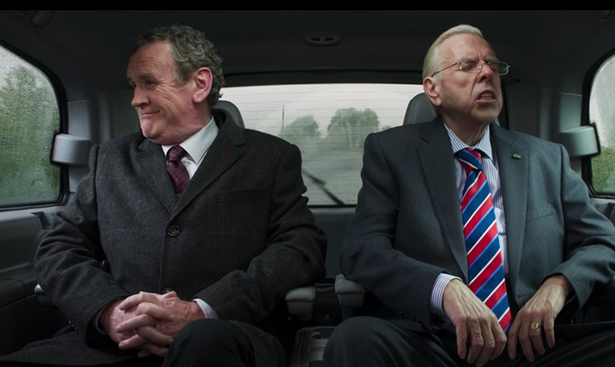
Now before I start I have to declare that I haven’t seen nor do I have any intention of going to see the film ‘The Journey’ the fictionalised account of the interaction between Martin McGuinness and Ian Paisley. There is a point that you should never criticise something until you have at least watched it but I will ignore that for now. I have seen clips from the film and from what I can gather, and I know all about artistic licence and all that, not only is it a fictionalised account of their meeting but it is even a fictionalised account of what they believed in.
Watching the Arts show the other night they were featuring the film and it showed some of the exchanges between the two main protagonists. Now if you are making a film of this nature the least you can do is try and make sure that the characters are as true to life as possible. In the clips shown Martin McGuinness’ character is shown vehemently arguing with the Paisley character and shouting: “We were fighting a civil war.” No republican least of all Martin McGuinness would ever make a statement like that. In fact such a statement smacks of a pro-British perspective on the conflict here that bears no relation to the views held by republicans.
Now you can disagree with republicans, you can believe that what they did was wrong, you can be vehemently opposed to everything they believe in, but no one has the right to misconstrue republican beliefs in that way.,
Republicans believed that they were waging a war against the British state. The British state was always their main enemy and the conflict was designed to hit the British state in any way they could. Republicans would never have said they were fighting a civil war because in their eyes they were fighting the British. The fact that the British chose to involve loyalism and unionism to help bolster their position does not change the central fact that the conflict was at heart between Irish republicans and the British.
This sort of revisionism plays directly into the hands of the British government who throughout the conflict here tried in vain to portray it as a conflict between two sides, republicans and loyalists, with the British being some sort of good guys being stuck in the middle trying to keep both sides apart. That was never the case. The British were the main protagonist in the conflict here from the very start through to the very end. Maybe it doesn’t suit British audiences to be reminded that they were involved in a war here but that is how it was. And we will never resolve the so called legacy issues until the British are prepared to admit that they were a party to the conflict.
The problem in films like this is that film is a very powerful medium and people tend to take a lot of their history from celluloid. So people ignorant of the true situation here in years to come will be quoting from films like this as if they were fact and so the British view of themselves as being stuck in the middle of a nasty civil war gains credence. You can fictionalise situations for drama’s sake but you have no right to completely misconstrue what someone believed in until the end of their life.
I havn’t seen the film either, Eamon , but I could have guessed there were would be a lot of revisionism to the fore. The republican struggle was against the british imperial jurisdiction in Ireland. Having said that, some of their military actions,whether premeditated or genuine mistakes, would certainly have fomented sectarian tensions. There certainly now is a concerted ,orchestrated attempt by unionism and the british military and political systems to sanitise their involvement, and present themselves as honest brokers and victims.
In fairness to the producers of the film any time I have heard them speaking about it, either on the radio or TV they have made it clear that it is simply a work of fiction only based loosely on events.
It should be taken as it was intended which is as a piece of drama.
Yes Scott, obviously a scurrilous piece of drama designed to embed a narrative that suits the British frame of mind regarding the ‘Troubles’
you’d be pretty weak of mind Gerard if you couldn’t see the difference between drama and a factual documentary. I think most people are intelligent enough to understand that this is a piece of fiction.
Out of curiosity though do you think that other films are trying to embed “narratives” as you put it? Films for example as Micheal Collins starring our own Liam Neeson (a great show I add) or perhaps The wind that shakes the barley?
I would proffer the suggestion that not everyone is as intelligent or discerning as yourself, Scott….. actors have been attacked in the street for the roles they have played in British soaps…. some people can’t separate fact from fiction……that’s how propaganda works …..and having discussed this visual diahorrea with several others,our unanimous conclusion was … a poorly made , trite , crass and stereotypical propaganda piece , meritless and undeserving of further mention.
Thank you for the compliment Eolach but I’m no more intelligent than the next man. In fact I don’t think there is such a thing as intelligence as we understand it as a sliding scale, but that’s a different subject altogether.
The examples you mention regarding actors being attacked are extreme examples and I would argue certainly not the norm. I they were we would have actors being attacked across the country.
I haven’t seen the film so I can’t comment on the quality the show or acting, but I’m sure its not as bad as you make out and you probably shouldn’t get so worked up about it.
I’ll put the same question I asked Gerard to you though. Do you think the films Michael Collins and The wind that shakes the barley also pieces of propaganda?
I think Eamonn is correct that McGuinness would probably not have used the term ‘civil war’.
I can not remember anyone from physical force republicanism using that term although they certainly do talk about a war, albeit one in which the combatants are held to different standards.
Some people do consider it a war but a lot of people do not. That is up to each individual.
I would say in this instance it is probably just a bit of careless writing by Colin Bateman or whoever edited the script, rather than part of some revisionist conspiracy.
I am pretty sure that Colm Meaney a supporter of SF would not have taken part had he felt it to be unfaithful to McGuinness.
“I am pretty sure that Colm Meaney a supporter of SF would not have taken part had he felt it to be unfaithful to McGuinness.” I find your faith in his SF commitment touching, gio. I also know that Colin Bateman in his fiction has never portrayed the Troubles as other than a bunch of crazies killing each other. Whether intentional or not is pretty well beside the point. As Eolach points out, a fair number of people take their history from movies. As to ‘Michael Collins’ and ‘The Wind that Shakes the Barley’ – do you think they present the conflict involved in each film inaccurately, to the point where they remove one combatant and substitute them with another?
Jude
Whether it was intentional or not is pertinent in establishing if it was a piece of revisionist propaganda or just a slightly poorly written docudrama.
Not everything has to be a conspiracy.
Meaney is on record as being very positive towards McGuinness and SF. He has said:
I think what Martin McGuinness and Gerry Adams and Sinn Féin have achieved in Ireland in the last 10 years is tremendous.
They’re the only all-Ireland party. They’re moving towards bringing the island of Ireland together which I think is a laudable goal.”
He supported McGuinness’s bid for the presidency.
He joined SF as a young man.
Have you some reason to think he would willingly undermine McGuinness?
I made no mention of either of those other two works of fiction ‘Michael Collins’ or ‘The Wind that Shakes the Barley’
“to the point where they remove one combatant and substitute them with another?”
I’m afraid you’ve lost me on this bit Jude. Not sure what you mean by this but it may be just because I haven’t seen the film in question.
I do remember a scene in The wind that shakes the barley were they marched a informer to a very scenic secluded spot and before executing him (with tears in their eyes of course) they said something like ” now Sean have you said your prayers” in genuine concern that he should make his peace with god before they killed him.
Do you think this was propaganda to present the old IRA as honorable chaps? I dont I just think its a drama full stop.
However if you have the ability to tell the difference between drama and fact then why do you think others dont and are not as enlightened as your good self?
I remember in a history class (as a mature student) we had one class mate who would go of on a rant regarding how the media had brain washed everyone, to which the teacher replied “including yourself”. The man replied “Well everyone except me” the teacher simply smiled and said “of course not” and carried on the lesson.
Of course historical films are often a form of propoganda. Michael Collins was. TWTSTB was. (There is a propoganda element in all of Loach’s, films) Because they are constrained by time they are often unable to convey nuances and subtleties. The more subtly and unobtrusively an author or producer manages to get his message across the better the art. That is why in Loach’s case Kes is a magnificent film, TWTSTB mediocre, and Jimmy’s Hall awful.
NIO propaganda was a constant in the north throughout the troubles. Even , indeed especially, children were not immune. The awful Joan Lingard novels of the early seventies portraying the young lovers as Romeo and Juliet and the rest of us as crazed psychopathic tribal gangs, suited Britain’s agenda so well it is hard to believe they were not ghost-written by an MI5 agent. They were compulsory, but not compulsive, reading for post primary children. Banal by any literary socialogical or historical criteria. (PS I am not sure what Scott means by ‘Our own’ Liam Neeson. Not mine!)
Ah, Joan Lingard and her barbed wire novels. I remember how for anyone to be critical of those novels was obviously a card-carrying Provo. Now that’s what I call effective propaganda…
You really think the goal of the movies in question Brian were to influence politically and not just as entertainment?
On Liam I simply meant he was from NI or Ireland if you prefer. Has Liam upset you somehow?
Ha haaa – very good , Scott. I like your boyhood memories. I’m well aware of my own stupidity and am happy to attest to it at any point. I’m also aware of the ways in which the media can project a version of events big and small. But don’t take my word for it – check with Noam Chomsky. A single example from recently – a positive one in this case: had TV commentators and journalists not picked up on it in a critical way, I for one would have swallowed Theresa May’s claim that nothing had changed in the Tories’ social care policy as presented in their manifesto. Less positively, I have no doubt that many people saw Jeremy Corbyn as a hopeless leader because the media kept telling them so. I also believe the version of the Troubles sold by the mainstream media – wicked IRA embarks on slaughter, are finally checked and peace and harmony restored – is one that a lot of people have bought, including quite a few nationalists. I’d suggest that history will place the Troubles in a wider context than that. So I don’t think people accept everything the media offer all of the time, but quite a few do some if not all of the time. As to movies and history – it just strikes me as outstandingly blatant that the McGuinness- Paisley movie should have McG presenting the Troubles as a civil war. That really is a perversion of what happened. And that kind of thing does have impact – I remember cowboys and injuns, and who the good guys were; I remember Queen Elizabeth in Pathé News visiting Kenya in the 1950s, where Britain was bringing civilization to some very savage natives; and I remember all the b and w war movies like ‘Dam Busters’ where we were taught to cheer on the gallant RAF who always dropped their bombs wisely and without killing people.
Well Jude big difference between the news/journalism and movies for starters. One claims to be facts the other only seeks to entertain.
If you do think that movies are somehow an attempt to influence people politically then who do you reckon is directing this deception? Is it a top down thing or more of a spontaneous effort?
You may be a riding the “Civil War” quote a bit hard, it’s one quote in a whole movie. Do you think there could be a chance that your taking the whole thing far to seriously? Far more seriously than the movie was ever intended to be which (according to its makers) is as a bit of entertainment.
Scott
Don’t you realise there is no need to produce evidence for this being deliberate propaganda.
All that is required is a willingness to believe.
The eye sees what it wishes Gio.
It’s tiresome and not to mention boring though when something, and it does seem to be in any sphere of life, comes along that doesn’t fit someone’s viewpoint the standard reply is “It’s propaganda”
Anybody who thinks Ken Loach’s films are not propoganda does not know Loach. He is perfectly upfront about his views. Scott, I have never subscribed to the idea that because someone is born in Ireland they are “one of our own”. Otherwise we could talk of “0ur very own William Joyce, Martin Cahill etc. I have never liked Neeson as an actor. In fact I think he is awful.Neither did he endear himself me when, after playing Collins he accepted a British gong. Other than that he seems like a nice guy. In mainstream films there does not have to be overt propoganda. You start with the idea that there are “goodies and baddies”. Challenge that and you are a weirdo. I suggest you read ” Manufactured Consent” by Chomsky. And the other guy
I’ll bow to your knowledge about Loach Brian can’t say I know much about the guy but I’m surprised that a movie producer admits to making movies to clearly promote a political ideology, warping narratives to suit etc.
Not quite sure it’s fair to use a fascist and a criminal in the comparison with Liam Neeson but there you go if you don’t like Liam you don’t like him.
We all like the idea of goodies and baddies in our films, nothing like a hero beating a bad guy but again this is in the sphere of entertainment.
I think everyone understands in the Irish context, and life in general, no ones whiter than white and everyone has dirty hands somewhere.
Spoiler Alert. The driver of the car is actually an MI5 undercover agent, taking instructions via a Bluetooth earpiece from his boss (played by the late John Hurt) on ways to get the pair to loosen up.
I in no way mean to compare Neeson with Joyce and Cahill. Neeson is clearly a decent person. But in my opinion a bad actor. Others in their millions disagree. I was making the point that sharing nationality with someone is a dubious endorsement.
Every fim producer uses poetic licence ie bends the truth a little for entertainment. Loach is no different. It is his perspective just as historians have their own perspective. That is a far cry from warping. He is an honest socialist just as Wayne was an honest redneck right-winger. And, at his best a great director
Your tone has softened Brian we have went from movies being propaganda to now just from a persons perspective.
The term propaganda which is used by the writer of this piece and yourself in a earlier post implies something a lot more insidious. Perhaps it’s the wrong term to use?
Perhaps you can explain the difference to me of expressing a opinion and propaganda when someone chooses to express themselves publicly through say a blog, newspaper article, tv program etc.
Interestingly the physical force republicans killed far more Irish (or Northern Irish) people than they did British forces from outside.
Some might say that is a good argument for calling it a civil war.
Of course most of those Irish people they killed (or liberated perhaps) were civilians so I don’t know if that counts or not.
Same goes for the Irish war of independence Gio, as the RIC was by far the largest victim of IRA activity.
Irishman killing Irishman.
Scott
An inconvenient truth.
Britain’s dirty hands delved into Ireland affairs, our fore father’s fought to rid our nation of the invader/planter and anyone who aided them was a legitimate target.
Gearoíd
Indeed. And what a lot of legitimate targets there were.
Census takers, teachers, lawyers, shopkeepers, builders, children etc etc.
Good old IRA eh!
I respect both the main actors for their decent attempts at portraying Martin and Ian, Spall is quite spookily Paisleyesque. On a general note I don’t see the point of made up stories featuring real life characters. The Brian Clough film The Damned United suffers from the same artistic licence. (It wouldn’t surprise me to see Don Revie turn up.) As for films set during the conflict, I remember Harry’s Game way back in 1982. Not only did your man from the Flora advert play said Harry, one memorable scene featured an IRA army council meeting at which one of the leaders of the freedom struggle said it was time to ‘bomb the mainland.’ Lord help us.