
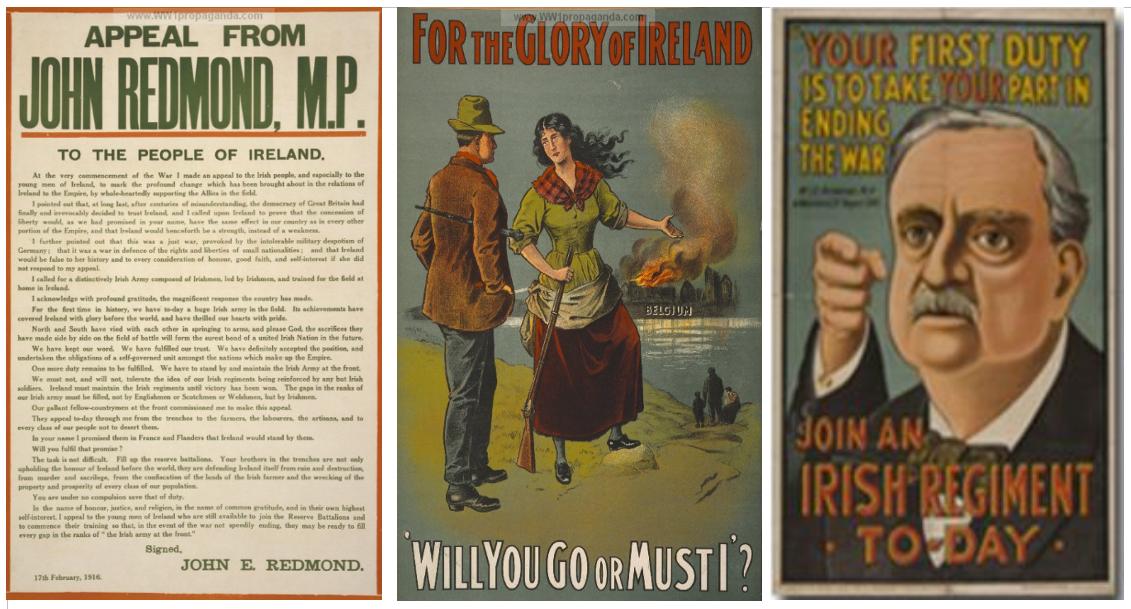
Re-writing history is wrong. It’s wrong even if motivated by a desire to reconcile differences and to heal divisions: history is what it happened, not a reinvention of events and motives. We can and must learn to understand our differences. We must, when necessary, learn to forgive wrongdoing against us and to let the past remain a mere truthful record of our history.
Firstly, it’s a lie to contend World War One was some noble quest to defend small nations against tyranny. In truth, that bloody war was a land-grab quarrel between malevolent royal families who could have sat around a conference table and decided their evil imperial carve-up of the globe.Secondly, we know that native Irishmen and British Unionists in Ireland fought in World War One for every differing reasons. Integrity dictates, we accurately portray the relevant plain factual truths.
Irishmen fought and died in WW1 in pursuit of the Irish nation’s quest to help break a link in the chain of British colonial bondage over Ireland. In particular, they fought in the hope the British empire would honour its 1912 Home Rule Bill that loosened its evil colonial grip on Ireland.
British Unionists in Ireland fought and died for their own selfish and dishonourable campaign. Namely, they hoped that by fighting for the British empire it would reward them by not honouring its already approved 1912 Home Rule Bill for Ireland promised to the majority native Irish nation.Ireland was known as ‘the land of Saints and Scholars‘ in the centuries preceding British occupation. In the subsequent centuries, British evils transformed the Irish nation into a virtual peasant people. Consequently, the Irish nation many times rebelled against our evil foreign occupier. Research the relevant Irish history: the reign of Queen “bloody” Mary I; Oliver “the butcher” Cromwell; Arthur “the enslaver” Chichester; Charles “the genocidal” Trevelyan; plus the Risings of 1534, 1569, 1579, 1594, 1608, 1641, 1798, 1803, 1804, 1848, 1867, 1912, 1916, 1918 and others.
Our small Irish nation evidently lacked the resources to oust the mighty British empire from our native homeland. After so much brutality, denigration and many failed rebellions our people felt obliged to try securing our freedom in stages when eventually given limited access to a gerrymandered colonial parliamentary system. This curates egg option of last resort has belatedly been portrayed by British Unionists as suggestive of we Irish embracing foreign British colonial rule. This sickening attempt to warp history must end, as must attempts to portray our 1916 rebellion was some aberrant endeavour. A majority of Ireland always opposed foreign British colonial rule and NI colony British Unionists must learn to live with that reality.
World War One concluded with the British state increasing the size of its empire and it signing the Treaty of Versailles in 1919. This Treaty contained 14 principles agreed by the British state and the other major powers. Two of those principles pertained directly to the predicament of small nations such as Ireland. Namely:
5) A free, open-minded, and absolutely impartial adjustment of all colonial claims, based upon a strict observance of the principle that in determining all such questions of sovereignty the interests of the populations concerned must have equal weight with the equitable claims of the government whose title is to be determined.
14) A general association of nations must be formed under specific covenants for the purpose of affording mutual guarantees of political independence and territorial integrity to great and small states alike…
Unsurprisingly, the British state not only refused to honour its own 1912 Home Rule Bill but also the above provisions of the 1919 Versailles Treaty that ought to have prevented it from partitioning Ireland at gunpoint in 1921.
A genuinely civilised people would insist their state conducts commemorations that remember the many civilian victims of their bloody wars fought in their name: see by way of example the 1916 war memorials at Glasnevin cemetery in Dublin, Ireland.
In closing, I contend that purely militaristic commemorations serve only the interests of war-mongering states. Like too many states, the British state uses these glorification events to perpetuate the lie that to “fight and die for your country” are heroic and honourable deeds. Lest we citizens of the world forget, those forever glorified military dead murdered millions of innocent civilians under the guise of fighting in our name.
Ruaidrí, what has the below narrative from your article, and Greenwich Mean Time in common?
‘ Unsurprisingly, the British state not only refused to honour its own 1912 Home Rule Bill but also the above provisions of the 1919 Versailles Treaty that ought to have prevented it from partitioning Ireland at gunpoint in 1921.’
Long ago, in a land, not so, far, far away, the brit’s came to an agreement with the europeans that, in return for the location of mean time in London, they would adopt the metric system rather than their ‘imperial’ system of weights and measures.
It is hardly surprising therefore that they, again, reneged on their undertakings in a european treaty.
The people who fought in the war of the cousins, in particular those who failed to return home, were just lower classes, of no concern to the two german cousins responsible for the disagreement, the Paddy’s were of even less concern to the two hun cousins, whether supplanted or indigenous.
Thankfully, my family fought for the freedom of small nations in their own small nation
Irish people are welcome to join in these pointless and hypocritical glorifications of political violence because those being commemorated died fighting for Britain. That is the only qualification.