
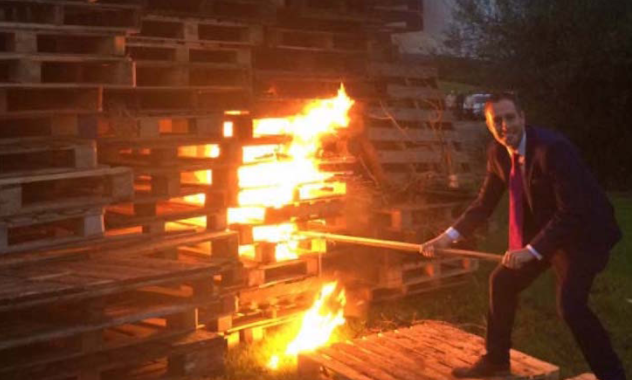
Are bonfires a cultural activity? That seems to be the persistent defence offered by unionists. Annually, at least half a million pounds is spent cleaning up the mess created by the Eleventh night bonfires. That is on top of the cost of the emergency services, as the PSNI and Ambulance Service tend to be busy, while the Fire Service typically get 45-55 calls outs due to bonfires. If that was being billed, someone would be getting a £40-50,000 bill for the Fire Service alone. However, no-one admits ownership or responsibility for the bonfires, not the Loyal Orders, not the DUP or UUP, nor are there any groups with a formal or legal standing that manage the bonfires. Even where grants are allocated for bonfire management, they are effectively grants to community groups to manage the public space that gets used for a bonfire within their district.
That’s just part of the financial cost. The majority of bonfires are constructed of pallets, stockpiled for a period of weeks or months in advance of the Eleventh night at the intended bonfire location. Although this is usually a public space, it gets increasingly obstructed by the start of July. Supply chain companies, like Chep, have identified their property among the wood dumped at such locations but been unable to retrieve it, even when local councils have removed, stored, then returned the material to the bonfire site. The ridiculousness of siting bonfires where they knowingly destroy road surfaces, play parks, damage houses is painfully obvious.
The broader public failing here is extraordinary. Since no-one officially claims ownership of bonfires or their management, basically, no-one can be held accountable for them. To some extent this amounts to having perpetrator-less crimes (certainly the relevant regulatory authorities, such as the PSNI, Fire Service and local councils take this approach). If the limitation on the problems at bonfires was confined to environmental problems, stolen property and some other public order issues, this sense of perpetrator-less crimes would just represent a failing of civic governance, albeit a significant one. However, the visible political dimension to the bonfires transforms that anonymity into something much more sinister. This is perhaps the most contentious aspect of bonfires. Typically, flags are burnt on the bonfires, mainly Irish tricolours although occasionally other flags have been added, often of those countries whose immigrants have been on the receiving end of racially-motivated attacks. Election posters are a favourite, mainly Sinn Féin, but sometimes including SDLP and Alliance posters. Other things added to bonfires in recent years are banners with messages and slogans (some racist, some sectarian), stolen religious statues, effigies, and, soccer and GAA flags, shirts and symbols. If you unfamiliar with these, there is more on this in a longer post here – https://storify.com/jjconeill/a-quick-reprise-bonfires16.
Some people are quick to diminish the symbolism of all this or its potential impact. People Before Profit’s Eamonn McCann has dismissed burning similar material on bonfires as an ‘act of defiance’. But the main defence given is that this is unionist culture and assume that somehow by designating it as ‘culture’, it should now therefore be beyond any reproach. In fact, paradoxically, the implication is often that to criticise this ‘culture’ is somehow, in itself, a dreadfully revealing act of prejudice.
There shouldn’t really be an issue with anyone who wants to define this as ‘culture’. Trainspotting can be described as a culture. Heroin use, and the activities connected to it, can be described as a culture. So can the antisocial behaviours around joyriding. Basically, any set of shared activities and values can be defined as a culture. That doesn’t tell us much about the culture itself. That comes from looking at the activities and values evidenced by that culture.
But there are clear echoes here with other activities that are offered a blanket defence of representing unionist (and often misrepresented as ‘Protestant’) culture, such as Loyal Order marches. Many of the issues around Loyal Order marches can be identified with bands or crowds watching the parade, and the Loyal Orders repeatedly deny any responsibility for the behaviour of either (echoing the refusal by anyone to take ownership of bonfires). The semantics here are important. What is intended to be communicated is that bonfires, like much of the activity around Loyal Order parades, is not subject to normal laws, rules or regulations. Hence the vitriol directed at the Parades Commission.
This sends a clear message. Those whose symbols, property or facilities are being deliberately and publicly destroyed at bonfires are not to be considered, in the eyes of society or the law, as equal to those responsible for that destruction. Much in the same way it is insisted that legal and social norms should not be applied to Loyal Order parades. This seems to be a defining element of bonfires (and to some extent Loyal Order marches) – to not just be above the law, but to very publicly display that supremacy.
As long as the Law Enforcement Agencies Stand Idly By and Do a Ponius Pilate, Whether they Feel that their Hands are Tied, OR Members of the Law enforcers support Said KKKulture, The Issue Of Bonfires will never Be resolved. Dear PSNI GROW A PAIR….
Exactly. This is neanderthal behaviour.The P.S.N.I need to man up and put a stop to this bullshit. “Orangefest”? More like hatefest. All bonfires need to be monitored and regulated. Fine those who are illegally building them. I read the other day that last years fire service costs alone were £666,000 and today they say they were called out twice as much. This obviously does not cover the cleanup costs, damage to parks, private property, ambulance service cost or other costs associated with these outdated practices. My friend’s daughter a beautiful gentle girl who is part-time model was setup on and assaulted at Craigyhill bonfire in Larne by several men. She is currently recovering in Antrim Area Hospital from a broken jaw and severe bruising. This is not culture. This is barbarism.Excellent piece of writing John O’ Neill.
Superb post John, should be required reading for all those who are in ‘authority’ in the wee six. I will not hold my breath on anything being done. I think that the official attitude is ‘let’s get the next couple of weeks over with’, just ignore all the damage being done to the environment, burning of tyres and other hazardous materials. Could it happen anywhere else in the civilised world? Not a chance, its ar Kulture. You could not make it up.
Brilliant post John and thanks for posting it Jude. Would this be the “cultural supremacy” Arlene Foster was talking about? Obviously not, but it should be!
Protestant/unionist culture is people gathering up a year’s rubbish and burning it in a public place – moronic or what!
As far as ownership or responsibility is concerned, we read this week of one UDA gang stealing previously stolen pallets from another UDA gang, so surely that is an indication of claimed ownership, even if it is of stolen property.
How come none of this stolen property is never returned to its rightful owners?
Of course, we still have a Protestant police for a Protestant people!
How do we ever reach any sort of compromise or understanding with these people….These are not the law abiding , God fearing people they would like us to believe they are , these are lawless , gangster type people , driven by an almost satanic hatred of their fellow Irishmen……and I’m not just talking about their armed paramilitaries , I’m talking about the whole caboodle….ok , there are good Protestant people but they seem to be a voiceless minority unconcerned by this willful criminality . Unionism/ Loyalism still have their own police force , living within their community and unable to abide by the laws they are meant to enact……they , day and daily , refuse to police….passing the buck onto the nearest available scapegoat. Their heavily armed paramilitary thugs murder with impunity , sit at the top table and direct their politicians like subservient sheep ….. all apparently acceptable in Dublin and London. We can refuse to resurrect Stormont but that’s not enough….we need to make this a law-abiding society with the consequences of non compliance clearly demonstrated. We may have to withdraw support for the “police”if they’re not up to the task….we’ve compromised enough ….no fecking more !!
great article john –
in reply to eolach who wrote ” How do we ever reach any sort of compromise or understanding with these people….These are not the law abiding , God fearing people they would like us to believe they are , these are lawless , gangster type people , driven by an almost satanic hatred of their fellow Irishmen”
Evidence in support of what you say about lawlessness and disregard of even law-abiding unionist people comes from the mouth of one of the bonefire klacters and makers
https://eurofree3.wordpress.com/2015/06/23/11th-night-bonfires-in-northern-ireland/
Eolach, eloquently put and I agree 100%
Tip of the day: anyone interested in politics here should read Tom McGurk’s column in today’s Sunday Business Post. I haven’t got a copy but have managed to read it. It tells us things we might not want to hear but every word rings with resounding truth. If anyone does get a copy and can email the column to me, I’d be grateful and will put it up. End of tip of the day…
After a long day travelling the first thing I done when I got home tonight was to open the Business Post. Then after that I logged on to Jude’s blog and see the mention of Tom McGurk’s article that had also stuck out for me.
The heading of Tom’s article is ‘Hostility to Irish exposes true nature of unionism’. He ends the article by saying “To attempt to explain away this crisis as mere Sinn Fein political posturing would be to gravely underestimate how serious it is”. This is exactly what we get from FG and FF politicians and the majority of the southern media.
Tom also refers to Jim Allister’s claim that Irish language legislation was a long standing objective of the IRA Army Council. He follows with a nice comment that Jim is hugely useful in these matters, as he’s always there to remind us how things used to be. So true Tom
thanks for your info nuacht
any chance of you posting a copy and paste or an archive version of Ton mc gurk’s article?
many thanks for whatever you can do
Jude, many thanks for a well constructed and balanced article. What struck me about the dissertation was the fact that I have seldom questioned many of the aspects of the bonfire ritual – including both the financial loss and social fall-out.
The reason for the apparent diffidence of people like myself is that is that we lived in a disputed section of inner city Belfast in the 70s and the bonfire was regarded as a “national” celebratory event such as a street party to honour a monarch’s jubilee.
Up until very recently (perhaps still the case), the main Ulster TV channels would show the 12th parades live and then a later highlights show a la Match of the Day!
When we were eventually forced out in 1976, we left in a hurry, discovering later that many family heirlooms (including a huge bible with all if the family births, baptisms and confirmations recorded within) were planted on the 11th night “boney”.
I would appreciate a copy of the Tom McGurk article.
Thank you,
Steve
A dangerous vacuum has opened in the north.
After the RHI crisis was allowed (maybe created) to destroy the GFA institutions there is now no local agreed authority & the Brits are adopting a (on the face of it) hands off approach.
The PSNI are badly under-resourced & lack political support to take a firm line with any lawlessness.
We are back where we were 20 years ago except this time there is no political will to reach agreement locally or internationally.
Where this will go is anyone’s guess, but a vacuum and a degree of manufactured anarchy has been created.
I believe this is a deliberate political tool by the Brits who no doubt have an endgame in mind.
Rest assured the agreed institutions have been got rid of for a reason which unsurprisingly isn’t to the advantage of ordinary Irish people.