
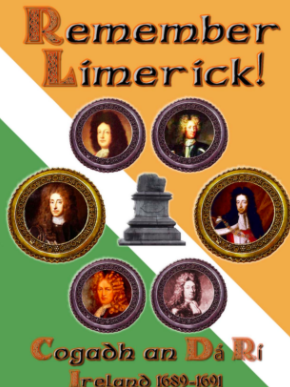
“CUIMHNIGH AR LUIMNEACH!” were probably the last words heard by the uncomprehending crack troops of King George II’s Coldstream Guards on 11th May 1745 before perishing on the thrusting bayonets of Irish Brigadesmen in the service of King Louis XV of France. Some might even have heard “CUIMHNIGH AR LUIMNEACH AGUS AR FHEALL NA SASANAIGH” which, to those who could comprehend it, might explain the ferocity of the Irish onslaught. The scene of the encounter was Fontenoy, near Tournai, and King George II of England and King Louis XV of France were on opposite sides of a war on the succession to the throne of Spain. Fifty three thousand men, British, Dutch, Hanoverian and Austrian, faced about 48,000 in the service of France.
The Duke of Cumberland, who was to be the victor of Culloden in 1746 and Butcher of the Highlands, led the British. King Louis XV was at the battle and Marshal Saxe had overall command of the French forces. The British withstood the French attacks and appeared to be on the brink of victory until the Irish Brigade turned the tide, with great losses to themselves , captured the colours of the Coldstream Guards and many British Guns. There followed soon after a quick BREXIT, as British troops quit Europe-not quite as quickly as the 1940 rout at Dunkirk, but hard enough. The Young Irelander Thomas Davis told the story of Fontenoy in verse, rather more inspiring than Ireland’so Call, and A.M.Sulivan in 1898 devoted chapter to it in “”The Story of Ireland.” Both can be Googled.
“Remember Limerick and the Perfidy of the Saxons” was the ilburden of the Irish Brigade’s War Cry and “Semper et ubique fidelis” – “Always and Everywhere Faithful” its motto.
The Brigade had been founded in 1690 when some Irishmen in the Service of James II in Ireland had been swapped for Frenchmen sent to strengthen the Jacobite cause in Ireland. The Brigade had been greatly augmented following the 1691 Treaty of Limerick when they were allowed to take passage with arms and colours to France, and guarantees regarding the practice of Catholicism and the property rights of Catholics in Ireland were given them. (In 1691 William of Orange and the Pope were allies in the League of Augsburg and perhaps neither wanted to antagonise the other. A couple of years later the Papacy switched its support to James II, and Catholics in Ireland lost all civil, property, and religious rights as The Irish Parliament – an Anglican Monopoly, which had risen to eminence on confiscated Irish property under the Tudors, Stuarts, Commonwealth and Stuart Restoration proceeded to complete the process.
Anyhow,the Wild Geese reckoned Ireland had been well and truly plucked by the Perfidious English and that revenge was sweet. To this day, on a bridge over the Shannon, stands the Treaty Stone on which the Dutch General Ginkel and Ireland’s Patrick Sarsfield, Earl of Lucan, rested the papers on which they signed the document fatal to Ireland’s hopes for some generations.
On the same Bridge, or another in Limerick, in April 1919 stood a cumberous ironclad terrestrial gunboat, called a “TANK” to deceive enemy intelligence. Its development was inspired by Winston Churchill, whose devotion to violence,great though it was, was at least equalled by his enthusiasm for deceit. The intention was to shock and awe the people of Limerick when the British Government declared the city and part of the County a Special Military Area and decreed that everyone passing in and out of the city have a military permit.
A Limerick citizen, Robert J Byrne , an active Trade Unionist, member of the City’s Trades Council and an Officer in the IRA,had been arrested and sentenced by a British military court to twelve months imprisonment for possession of a revolver and ammunition. With other Republican prisoners he had demanded political status but been denied even some facilities given criminal ones. He had gone on hunger strike and had to be taken to hospital. His comrades, in rescuing him had fired on the RIC holding him.Two RIC men were killed as was Robert Byrne.
Many thousands attended his funeral and he was described as a self-effacing patriot. As the British imposition of restrictions on access into and out of Limerick affected supplies and trade the Trades Council established a Soviet, organising supplies, establishing its own bakery,controlling prices and printing currency.It lasted for twelve days and its currency was redeemed at par with sterling. It was covered nationally and internationally in the print and film media as can be checked on Google. When remembering Limerick, the self-effacing patriot Robert J. Byrne should not be forgotten.
Neither should Joseph O’Donoghue, who taught Irish In Limerick, an activity which presented such a threat to British “authorities” that the Royal Irish Constabulary shot him dead in his home just after midnight on March 7 1921.The usual British Army Curfew patrol was withdrawn that night when, coincidentally RIC squads shot the ex-Lord Mayor Michael O’Callaghan and the Lord Mayor, George Clancy, dead in their homes.
Clancy had been a friend of James Joyce and features in “Portrait of the Artist as a Young Man” under the name “Davin.”. I realise that some commentators would reckon that stroppy Trade Unionists, Teachers of Irish and Sinn Fein Lords Mayor merit capital punishment for the post-traumatic stress disorder they inflict on the the commentariat.
Come to think of it, Ireland’s best-known pacifist, Frank Skeffington, was also a friend of Joyce and features in “A Portrait” as “McCann”. Skeffington, too, was murdered by a British Officer, who pleaded PDSD, decades before its time, and got away with the crime.
My stream of consciousness,fed by the lordly Shannon arises from a report in the London-based IRISH POST that a statue, cast in bronze, commissioned by Limerick County Council and executed by Rory Breslin, immortalising Sir Terry Wogan, has been unveiled in Limerick where it stands on the banks of the Shannon.A spokesman for the Council said that Wogan was ” a Limerick person who succeeded on the international stage but never forgot his roots.”
While he may never have forgotten where he came FROM it seems that he never lost sight of what he came to England FOR. Some years ago PRIVATE EYE claimed that when persuading watchers of “CHILDREN IN NEED” to part with their money he insisted on trousering £10,000 each time for his altruism. He became a regular brick in the BBC when those murdered by the Paratroop Regiment were still warm in their graves and before the ink was dry on the wretched Widgery Report. He wittered and twittered the most inconsequential nonsense on the principle – “whatever you say, say nothin’ ” and no framed prisoners, no question of fair play such as health and safety of workers in dangerous occupations attracted his attention or commitment.
Whilst most Irish men and women in the British media maintained a civil demeanour Wogan adopted a servile one, betraying passion only when Eurovision juries refused to give all their votes to the British entries and appeared to favour their near neighbours. Irish juries, for whatever reason, were generally fairly supportive of British entries (probably because of their long exposure to the BBC ) but Wogan out-bullshitted the most jingoistic Britisher over that trashy issue.
He was literate and intelligent but thought “ta se mahogany gas pipe” a worthy joke. Blankety-Blank” perhaps best sums up his service to his fellow men and women and engraved on his memorial might be adapted from inscription on the plinth under the statue of Ozymandias – “Look on my works, ye mortals -and throw up!”
THE TIMES of London, in an Editorial, acclaimed Wogan as one of their own,and a memorial service for that Cradle Catholic was held in Westminster Abbey, the resting place for the bones of England’s monarchs.
Is doigh liom nac bhfheicfir a leithead aris.
He plumbed the nadir of self-abasement when he attended Thatcher’s funeral. As did the great socialist Ruarí Quinn.
The BBC have tried to airbrush the fact that he was the only person involved in the children in need night who insisted on being paid a fee. He was the archetypal” don’t offend anyone” “full of blarney” oirish man who the British Establisment love.