
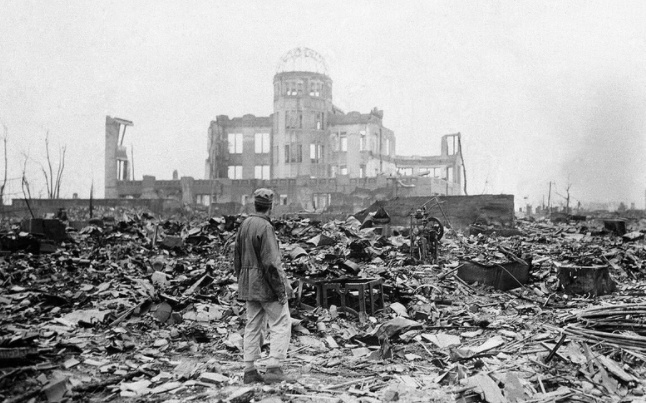
The bombing by US air force planes of Hiroshima and Nagasaki on 6th and 9th August 1945 resulted in 129,000 people being killed and thousands more injured. When Germany surrendered in May 1945 the Japanese refused to surrender. On 2nd September the Japanese signed the Instrument of Surrender thus ending World War II.
There had been numerous bombings of Japan by the US air force in the years previous to 1945 but when Japan refused to surrender along with the Germans, USPresident Harry S Truman ordered the bombing of large cities in south Japan in order to force the Japanese to surrender. For Truman the end justified the means. For war mongers the end always justifies the means. For pacifists the end never justifies the means if they involve the use of violence and killing.
The US had entered the Second World War after the Japanese bombed the US naval base at Pearl Harbour in Hawaii on 7th December 1941 killing almost 2,500 US soldiers and navy and injuring another 1000. The following day President Franklin D. Roosevelt asked Congress to declare war on Japan which they duly did. Only one person, Jeannette Rankin voted against. She was a pacifist and stated, ‘As a woman I cannot go to war and I refuse to send anyone else.’ It was then that Germany declared war on the USA. America had now become embroiled in the Second World War.
One man who witnessed the bombing of Hiroshima was a Superior General of the Jesuits, Pedro Arrupe S.J. who became the Superior of the Jesuits in 1965. Fr Arrupe, a native of the Basque region, was the Rector of the Jesuit house on the outskirts of Hiroshima and recounts his memory of that terrible day:
“I was in my room talking with another priest at 8.15 when suddenly we saw a blinding light, like a flash of magnesium. Naturally we were surprised and jumped up to see what was happening. AS I opened the door which faced the city, we heard a formidable explosion similar to the blast of a hurricane. At the same time doors, windows and walls fell upon us in smithereens.
We threw ourselves or were thrown onto the floor. I say were thrown because a German priest who weighed more than 90 kilos and had been resting against the widow sill of his room, found himself sitting in the hall several meters away with a book in his hand. The shower of roof tiles, bricks and glass rained upon us…Three or four seconds seemed an eternity because when one fears a beam is about to crash down and flatten one’s skull, time is incredibly prolonged.
When we were able to stand we went running through the house. I had the responsibility for thirty-five young men who were under my direction. I found none of them had even a scratch. We went out into the garden to see where the bomb had fallen since none of us doubted that that is what had happened…After about fifteen minutes we noticed that in the direction of the city dense smoke arose. Soon we could see enormous flames.
We climbed a hill to get a better view. From there we could see a ruined city: before us a decimated Hiroshima.”
The city was reduced to ashes. Throngs of survivors were fleeing with great difficulty, unable to run owing to the horrible injuries they had sustained.
“I shall never forget my first sight of what was the result of the atomic bomb: a group of young women eighteen or twenty years old clinging to one another as they dragged themselves along the road. One had a blister that almost covered her chest; she had burns across half of her face, and a cut in her scalp caused probably by a falling tile, while great quantities of blood coursed freely down her face. On and on they came, a steady procession numbering some 150,000. This gives some idea of the scene of horror that was Hiroshima.”
Fr Arrupe SJ devoted the rest of his life to working for peace and an end to nuclear weapons. It is a work we should all be involved in.
Joe, i lived in Japan for afew years and visited Hiroshima and to see how an atomic bomb eradicates people, leaving them as mere shadows on a pavement is certainly one of the ost horrendous and frightening things i have ever seen.