
 A couple of years ago I found on Youtube a ten-minute colour film taken in an unspoiled beauty spot praised in Irish verse by Saint Colmcille upwards of fourteen hundred years ago and celebrated in rapturous retrospect by Molly Bloom in the last lines of James Joyce’s Ulysses.
The beauty of the film was enhanced by the soundtrack added to it recently. But adding to its interest was that it depicted a regatta, an atypical phenomenon at the time , in most countries, for much of the world was at war in 1942. I was seven months old at the time, and five months earlier, my uncle Leo, who had been enjoying undemanding garrison duties as a regular soldier in Britain’s impregnable fortress Singapore, died when the Japanese infiltrated it from the “impassable” jungle to its rear, and the Japanese Navy and Air Forces sank some of Britain’s most prestigious battleships in its vicinity.
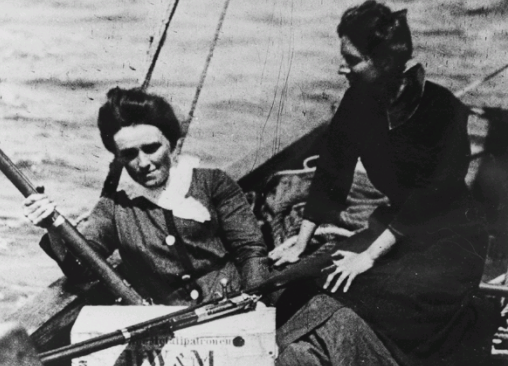
I came recently upon some black and white newsreel shot in Howth some nineteen years after the regatta film,which helps explain why peace reigned in Howth and in most of Ireland when most of the world’s powers were at each others’ throats. For, on Sunday, 30 July 1961 there sailed into Howth the 51 foot long yacht ASGARD whose only previous visit there had been on Sunday 26 July 1914 carrying a cargo of single-shot Mauser rifles manufactured in 1870, a weapon which had helped Prussia vanquish France and proclaim the German Empire in the Palace of the Sun King in Versailles.
This handful of obsolete weapons in the hands of resolute but partially trained Irishmen, women and boys ,held better armed and more numerous British forces at bay for nearly a week in 1916 and set in train a series of events which forced the evacuation of British Government from most of Ireland within eight years,not to mention India and most of Britain’s Empire within a few decades.
Amongst the many benign consequences of the landing of rifles in Howth was that not man or woman living in Ireland, Nationalist or Unionist was conscripted by any Government in the one hundred and three years that have since elapsed. Neither my father nor my siblings nor I were forced to wear any uniform, swear any oath or carry any weapon.
But I had the honour and privilege to wear the uniform of Oglaigh na hEireann , Second Line Reserve (FCA) that July Sunday in Howth as, with one hundred comrades I was part of Guard of Honour for Ireland’s President, who himself had helped unload the rifles 47 years earlier.The newsreel, shot by Gael Linn’s Amharc Eireann , as shown on an RTE archive is of poor quality, and while I can identify one or two comrades I can’t see my own younger self. RTE Television was not inaugurated until December 1961, five months later..
‘In 1980 after I’d had a couple of articles and many letters published in THE IRISH POST, its Editor, Breandan McLua treated me to a meal in Wheeler’s , a posh Kensington restaurant, after which we crossed the road for cigars and brandy at an equally posh hotel. There was a band playing there and we got talking to one of the bandsmen, an Irishman who told me he’d been to Howth just the once, as an Army Bandsman to welcome the Asgard back. I remarked we’d featured on the Gael Linn newsreel and Breandan MacLua told us he’d been part of the newsreel team. But for the landing of the rifles in 1914 they’d have been liable for conscription in the 1950s in a British ruled Ireland for dirty work in Kenya or Egypt or Cyprus.
History is complex and full of irony. Erskine Childers, who sailed his ASGARD into Howth was a reserve officer in the British Army and returned to their colours where he distinguished himself. Another of the gunrunners was also a British Officer and became the youngest Brigadier General in their Army and was killed in the War. Childers later conversion to Republicanism and his strict adherence to its principles earned him the hatred of some of those who supported the “Treaty” who saw to it that he was shot by a firing squad after a Court martial which had reached a verdict before it sat.
My Uncle Ned, who, as a member of the Republican Boy Scouts Fianna Eireann helped unload rifles in Howth, got diverted into the British army by the pied pipers of JohnRedmond’ party fought in Flanders and was lucky to be nursed back to life by his family after he was sent home to die from the effects of poison gas. He was in and out of hospital from its effects before dying in 1963, still in his mid 60s. |
Comments are closed.