
Letter to the Editor
IRISH POST
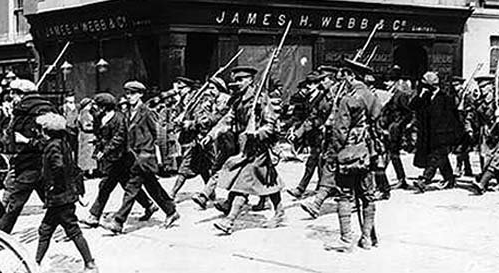
A pity Dr Ivan Gibbons (July 2) is so blinkered that he asserts that it is “an inescapable fact” that the 1916 Rising “was a total failure.” Unblinkered he might have recognised the first chapter in THE DECLINE AND FALL OF THE BRITISH EMPIRE.
In May 1916 the Insurgent Leaders were shot dead on the orders of GENERAL SIR JOHN MAXWELL who in June 1916 wrote –
“There is a growing feeling that out of the Rebellion more has been got than by Constitutional Methods……if there was a General Election, very few, if any, existing M.P.s would be re-elected.
There is a danger that Mr Redmond’s party would be replaced by others less amenable to reason.”
(FATAL PATH by Ronan Fanning, Faber and Faber 2013)
In Zurich, about the same time, Lenin commented – “A blow against the British in Ireland..has a hundred times more political significance than a blow of equal weight would have in Asia or Africa”
(Quoted by Conor Cruise O’Brien, in his essay “The Embers of Easter” in the IRIH TIMES 9 April 1966)
On a purely military level, the insurgents held central Dublin for six days when they were strongly outnumbered by much better-armed British troops who did not over-run a single insurgent position.
The insurgents were willing to fight longer but obeyed orders of their own commander to surrender, In order to save civilian lives, not their own. Not exactly a total failure. The leaders had calculated
that in any Peace Conference their achievement would win Ireland a voice. (They hadn’t factored in the cynicism of the “champions of small nations”)
On July 14 1917 IVOR CHURCHILL, Lord Wimborne, Lord Lieutenant of Ireland wrote to the British Cabinet –
“ The Sinn Fein victory in East Clare is a fact of cardinal significance…it marks the definite failure of the policy to rehabilitate constitutional nationalism or defeat Sinn Fein defiance of English rule…in a remarkably well conducted political contest sustained by excellent candidates on both sides, the electorate, on a singularly frank issue of self-Government within the Empire versus an Independent Republic, have overwhelmingly pronounced for the latter.”
(Changing Times – Ireland since 1898 as seen by Edward Mac Lysaght (1887-1986) published by Colin Smythe,Gerrards Cross 1978)
The Lord Lieutenant’s letter remained secret for 50 years until lodged in the UK’s Public Record Office in Kew in 1967.By that time Ivor Churchill, Lord Wimborne was long forgotten, but –
Eamon de Valera, the victor in East Clare, had headed 10 Irish Governments, been President of the General Assembly of the League of Nations, President of the Council of Ministers of
the League of Nations, and was in his second year of his second seven year term as President of Ireland. He had, incidentally, appointed the loser in the East Clare By-Election as Attorney
General in the 1930s, who helped him draft Bunreacht na hEireann, the Constitution of the sovereign Irish State.
In 1948 de Valera, 1916’s senior surviving insurgent leader found himself temporarily out of political office.. He visited newly-Independent India – the most populous democracy on Earth. There he was feted as a hero, a reception unlikely to be give Winston Churchill, nor, indeed, Clement Attlee, had either dared to set foot there.
Donal Kennedy
LONDON
Comments are closed.