
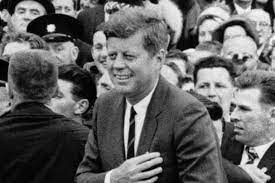
I was 14 years old. I had just completed my first year in secondary school and was now enjoying the novelty and the luxury of a three-month school holiday. Predictably, the weather was dreadful. Just a week before, there had been a torrential downpour unlike anything that anyone had ever seen in Dublin. The road outside our flat in Churchtown turned into a river, and in Dundrum, where the former railway bridge had been removed a short time before, the water flowing downhill along the disused railway line fromStillorgan cascaded onto the main street, creating a spectacle that was as close to Niagara Falls as any of us had ever seen. I was old enough to think that it would be cool to assume an attitude of ostentatious disinterest towards the presidential visit. This was largely inspired by and in inverse proportion to my older sister’s enthusiasm. She worked in Cassidys’ Silks in O’Connell Street, which was on the route that the presidential motorcade would take on its way from Dublin Airport to the Phoenix Park. She and her workmates had helped to decorate the shop window with American flags and posters of JFK, along with many yards of Cassidys’ silks in red, white and blue. The posters were supplied by the American Embassy to anyone who requested them, and there were thousands on display in windows all over Dublin, in shops and in homes. They showed JFK behind his desk in the Oval Office. My sister had brought home one of these which was surplus to requirements and, whenever no-one was around, I would suspend my disinterest, unroll the poster, and have a surreptitious peek at JFK .
In the days leading up to the visit, my sister would come home with exciting stories about the preparations. She had seen the TV presenter, Gay Byrne, in a sheepskin coat on a platform near the O’Connell Monument, rehearsing his part of the planned outside broadcast. Even if JFK had cancelled his visit, this alone would have made her year.
On the day of the arrival, I maintained my attitude of disinterest, but still managed to place myself in front of the television for the entire event. In itself, this would not have been noteworthy. At that time, those of our family who were in a position to do so (me and my mother) would position ourselves in front of the television from the moment the UTV symbol appeared on it at 4.40pm (UTV being the first of the networks to come on air each day, to be followed by BBC (NI) and Telefis Eireann in the hour following) and would stay there for the rest of the evening, watching anything that came on the screen. I suppose my mother must have broken off at some stage to prepare our “tea”, which in fact was our dinner (our “dinner” being what posher people called their “lunch”), but she would soon resume her post and would be joined by my father and sister as they arrived in from work.
I remember that we were all mortified that DeValera began his address of welcome by speaking to Kennedy in Irish, and that he then rubbed salt into the wound with a laborious explanation of what he had just said. “Tá sé mahogany gaspipes” would have been my mother’s comment on this, summing up her attitude, and the attitude of most working-class Dubliners, to the Irish language and the political establishment. The contrast, when Kennedy spoke, was electrifying. We watched as the motorcade made its way through Dublin. The most astonishing spectacle was presented by the US bodyguards who accompanied Kennedy. They wore sunglasses and raincoats and were standing on the running boards of the limousines. True, we were mortified by the predictable bad weather, which we would have bracketed alongside DeValera and the Irish language for their embarrassment potential, but we had never seen anyone wearing sunglasses and a raincoat at the same time and, besides, what did they imagine they were protecting the president from? Who would want to harm him? It seemed like madness.
The following morning my mother and I were positioned in front of the television again to watch the visit to Wexford, New Ross and Dunganstown. Once again we were mortified, this time by the antics of Andy Minihan, the local political boss in New Ross, as he struggled with the public address system. “Can you hear me now?” he asked. The crowd roared back in reply “No!”. “Janey Mack”, my mother said “they’re making a laughing stock of us in front of the whole world”. “We’re in real trouble now”, said Minihan. We buried our heads in our hands.
By Friday I had suspended my official stance of ostentatious disinterest and decided that I had to see JFK. I like to think that the historian in me recognised that these were historic events and that I needed to witness them. If so, the same instinct was sadly missing several months later when I decided not to bother going to see the Beatles in the Adelphi on the basis that if they lasted they’d be back, and if they didn’t, then I’d be wasting my pocket money. Besides, I would have had to camp out all night in front of the Adelphi if I were to get tickets anywhere near the front, and I wouldn’t have been allowed to do that..
That Friday JFK was due to address the Dáil and Seanad in Leinster House. I found a spot on Nassau Street by the railings of Trinity College, across the road from Fred Hanna’s Bookshop. Waiting for the motorcade, I scanned the buildings opposite, thinking how easy it would be for a sniper to shoot the President, unlikely and all as that would be. Then the motorcade passed by. Kennedy was seated and was shielded by a Perspex cover to protect him from the rain, presumably, rather than from assassins. The most striking thing about him was his colour. He was not just tanned, he was brown. This was probably symptomatic of a medical condition, a reaction to cortisone medication. At the time it seemed exotic. He smiled and waved, and his teeth shone brilliantly against his tanned skin. I had never seen anyone like this before. After the motorcade had passed, no-one moved. No one wanted to let go of the moment. Kennedy was due to return along the same route on his way from Leinster House to Dublin Castle to be conferred with honorary degrees from TCD and NUI and to receive the Freedom of the City of Dublin. Everyone decided that they had to see the president again, just to confirm that they had seen him in the first place. Sure enough, the motorcade passed by again, travelling in the opposite direction, and everything was as before. There was that impossible tan, those white teeth, and that charisma that seemed to represent a world so far removed from ours as to be almost unimaginable.
It took some time that day for the city to revert to normal, and for the buses to resume their service. When I eventually boarded a 14 bus to Churchtown, I met a former friend from primary school who had been waiting outside Dublin Castle to see President Kennedy. ‘It was great’ he said. ‘All the people outside the Castle were singing “Kennedy’s Bread”.’ At that time there was an advertisement on television for Kennedy’s Bread. It had a jingle that went “K for Kennedy, E for energy, N for nice and nourishing, E for enjoyment, D for delicious, YS means you’re satisfied”. This was what the people outside the Castle had been singing!
The following day, being a Saturday, I was joined by both my parents in front of the television and we watched as Kennedy departed from Shannon. There was a huge sense of sadness. The magic had been removed from our world and we fell back to earth in boring old Ireland.
Later that summer, we holidayed in a hut in Shankill. We had borrowed a transistor radio from one of my sister’s friends as there was no electricity in the hut and we listened to the commentary, as Ireland won the Aga Khan trophy in show-jumping at the RDS. We also heard the sad news of the death of Patrick Kennedy, the new-born baby of JFK and Jackie.
Three months later we were seated in front of the television as usual, watching the Donna Reed Show, when there was newsflash, something we had never seen before. The news reader, Charles Mitchell, announced “There has been an attempt on the life of President Kennedy.” At the mention of the word “President”, my first thought was that the attack had been on De Valera. Then the bulletin recounted the facts as they were then known. The president had been visiting Dallas, and shots had been fired at the motorcade. It was believed that the president had been struck, but it was not known how seriously he had been injured. About fifteen minutes later there was a second newsflash. This time a tearful Charles Mitchell struggled to deliver the news “John F. Kennedy, the 35th President of the United States has died”. It was the first time in my life that I was conscious of hearing news on the television or radio that I wished I had not heard. It would be another 34 years before I experienced the same feeling, in a very different setting. Thinking back from a distance of more than fifty years, it seems to me that nothing was ever the same again. It was an end of innocence; it was an end to optimism.
Mr Murphy your attitude remains that og a mahogany gobshite.
See my next Blog.