
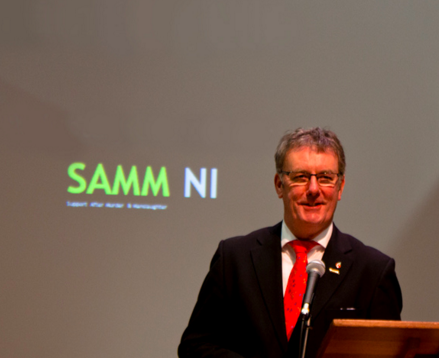
Yesterday on Talkback, Mike Nesbitt, leader of the UUP stated that the Easter Rising gave rise to the partition of Ireland. This revisionist mentality air-brushes the facts and context of the times – it’s a massive over simplification that is ignorant and oblivious to the truth. I have blogged on this before and the fact is, this is historically inaccurate. But I feel to repeat for clarity would be beneficial for Mike. Ok Mike, sit up …. Sit up, I said, a bit of focus, please, and pay attention. You might learn something here …
To simplify and embellish the Rising as the single cause of partition is a failure to fathom the wider historical ambience of the time. Partition should not be seen in isolation and attributed solely to one event – partition, as a potential solution to the 1912-14 crisis, was well in existence before the Easter Rising planning, never mind the commencement of the event.
The Liberal Government under Prime Minister Herbert Asquith introduced a 3rd Home Rule Bill for Ireland, not because they wanted to, but because they had to, largely the product of parliamentary arithmetic, to survive in power. The constitutional crisis from 1909, precipitated by the anti-Irish House of Lords, enabled John Redmond’s Irish Party to hold the balance of power, offering support to a Liberal Government and in turn an inadvertent “commitment” to Home Rule was reciprocated. Asquith was not an enthusiastic proponent of Home Rule and his attitude to the Bill throughout the 1912-14 illustrates this. Before a Home Rule Bill was even introduced, elements within the Liberal Party were already considering partition (exclusion) for Ulster, namely Winston Churchill and David Lloyd George, who feared a Unionist backlash in Ulster, the “Ulster will fight, and Ulster will be right” mentality that had already publicly opposed two previous Home Rule Bills. Augustine Birrell, Irish Chief Secretary, had even stated that some form of partition would ensure that there would be no Civil War. Asquith’s response: “We are not going to be frightened by the menace of Civil War.” How Asquith was to eat these words!
The Bill that introduced into the House of Commons on 11th April 1912, was Home Rule for all-Ireland. No provision for Ulster was made, although the Bill stated “If fresh evidence or facts or the pressure of British opinion dictates, this may take the form of special treatment for Ulster” . This would mean special provision for Ulster – in essence, partition. Even at an early stage, this became a reality for the Government. According to Professor Michael Laffan, a partitionist amendment to the Bill could have settled the Ulster question, before it came back to haunt him. Patricia Jalland believes failure to concede on Ulster was a “fatal error” and may have “prevented a dangerous growth in Ulster Unionist militancy.” By August 1912, Churchill in a letter to Lloyd George was ready for partition, when he stated “The time has come for action about Ulster to be settled.”
The Ulster Unionist campaign that emanated during this period was to force the Liberal Government into a rethink, into a compromise partitionist disposition. The embryonic Unionist objective was to destroy the Bill in its entirety – Unionists akin to Nationalists believed Ireland must be treated as an indivisible unit; Carson’s mythology was to “use Ulster as a weapon to break Home Rule.” As the crisis developed, this was to change, political pragmatism took preference. The verbal menace and often treasonous, contemptuous and inflammatory speeches of Edward Carson and Andrew Bonar Law radicalised Irish society. The intensification of the crisis took on a militant image with the formation of the Ulster Volunteers Force. By September 1913, Asquith’s “wait and see” strategy was abandoned as compromise talks proceeded, in the form of a partitionist settlement. Edward Carson’s own view had moved to a compromise, partitionist mind-set. Carson had been long threatening to establish a Provisional Government in Ulster, that would be cut off from a Dublin Home Rule Parliament: “The morning Home Rule passes, ourselves to become responsible for the government of the Protestant province of Ulster.” In September 1913, in a letter to Bonar Law, Carson stated “The minimum would be six plantation counties.” Bonar Law had been moving towards a partitionist settlement. Asquith was now willing to move on this, even at the risk of provoking Redmond.
When the Liberal Government offered concessions to Unionist resistance, it seemed that their extreme measures had been vindicated. By 1914, Asquith had presented Redmond and Carson with partitionist proposals. Redmond accepted partition albeit in the words of Asquith, “Redmond shivered visibly and was a great deal perturbed.” Acceptance of compromise now put Redmond in a weak position, and as Gandhi said, “Any compromise on mere fundamentals is a surrender.” Did Redmond have a choice? Carson rejected the proposal, wanting permanent partition as opposed to temporary, stating “We do not want a sentence of death with a stay of execution for 6 years.” Subsequent events such as the Curragh Mutiny and the landing of 25000 rifles at Larne undermined Home Rule to the extent that the Unionist ultimatum, partition, was unavoidable.
The Home Rule Act reached the statue books with Royal assent in 1914, but its implementation was suspended due to the commencement of WW1. A proviso within the Act included an amendment clause for Ulster counties to remain under London administration for a time, yet to be agreed. Partition was already an inevitability before the Rising began! Redmond, the leader of Irish nationalism, fought tenaciously against partition, had accepted this concession as a compromise to pacify Ulster Unionists and avoid Civil War. Carson and Unionists, backed by a Lords’ recommendation, supported the governments Amending Bill in the House of Lords on 8th July 1914 to temporarily partition Ulster from the workings of a future Act. Respective leaders Carson and Redmond had accepted Partition, though vehemently opposed to the concept when the crisis began.
There’s no doubting the impact of the Easter Rising on post- Rising Ireland. The sea change in public opinion after the executions, mass arrests, imposition of martial law and the impeding conscription crisis succeeded in advancing radical nationalism at the expense of constitutional nationalism. After the Rising, Home Rule was replaced with the drive for national self determination, further compounded by Sinn Fein’s electoral rise and success in 1918 General Election. It could be argued that the Rising was a precursor for events to come, that in essence it killed the imposition of Home Rule. It could be argued that the Rising was the catalyst for what was to become the Free State, gaining additional powers through dominion status. Would this power have been offered by the British without the Rising?
In the aftermath of the Rising, the Lloyd George negotiations recommended the proposals that had been formalised pre- War: compromise in the form of partition. Both Redmond and Carson accepted the partition, although the ambiguity of what was on offer resulted in the collapse of negotiations.
In a British parliamentary context, Partition was inevitable, as the Conservative Party eventually strengthened their power and influence. In 1914, the Liberal government ruled the United Kingdom; in 1915 the Conservatives became a minority in coalition; in 1916 they became preponderant when the Liberals split; and after 1918 they were the dominant party in Government. Power had shifted from the allies of Irish Nationalists to the allies of Ulster Unionism. Lloyd George, the Prime Minster, a supporter of partition since 1912, was responsible for the fourth Home Rule Bill, the Government of Ireland Act, 1920 with a heavily weighted Ulster Unionist alliance including Walter Long.
It would be irrational to attribute the Easter Rising solely to the partition of Ireland. I believe the partition of Ireland was already in motion, the political dynamics existent from 1912 created a partitionist mind-set making it a potential solution to the unsolvable Irish question. The British Government had introduced the concept of partition in 1912 and made the concept a functional reality – the partition foundations were laid, and as the crisis unfolded, the building structure was added. The partitionist proposals pre-Rising, became the accepted solution post-Rising. By 1921, Unionists who opposed partition, ten years earlier, and for whom the concept gradually evolved, were only more than willing to operate within an area of their choice. Partition was implicit in the debate before the Home Rule Bill in 1912 was even introduced into the House of Commons.
In short, the Easter Rising was not the factor that created partition, Mike.
Of course unionism has always been about much more than sectarian division and British superiority for a privileged minority in Ireland.
The people responsible for bringing the gun into Irish politics were the Leaders of Unionism, the most notable being Edward Carson. Carson was a terrorist, no if’s or but’s, who fought against democracy for the majority for the Irish people and got his way due to sympathetic and anti-Irish elements in the British Government of that time. There’s a statue of Carson up at Stormont today that frankly shouldn’t be there because if it weren’t for this individual, much like Ian Paisley, whipping up the crowds and even putting guns into their hands, history might have taken a much different and better course for all the people of Ireland.
There’s no point telling the likes of Mike Nesbitt the facts about our History because Mike, like a lot of Unionists, only hears and sees what he wants. He knows the Easter Rising didn’t cause partition. His logic is like that of your typical loyalist fleg protestor: “Its all them’uns fault”. A lot of these people simply cant be reasoned with and their hypocrisy is simply startling. They have a statue of a terrorist up at Stormont but they regard the Easter Rising to be wrong.
Partition has been a disaster for Ireland, its directly lead us to the place we are today and has been responsible for everything in between. Due to the changes in demographics, the unique political relationship between North-South of Ireland, the growth of Sinn Fein and decline of Unionism, etc I think we are nearing a point when partition will end (still a while to go though) or at least to the point where the border wont be needed.
Meanwhile, Mike and Arlene will do what Unionist leaders do best: hide behind the walls and lower the portcullis and hope that “them’uns” will just go away.
The partition of Irelaid was “caused” by people living in the north not wanting to be part of a home-rule or independent Irish state.
Just like the partition of the British Isles was “caused” by people living in Ireland not wanting to be part of a British state.
It’s called self-determination.
“its called self determination”
I think you’ll find MT that Ireland was a single entity then and the vast majority wanted independence from the British Government and it was denied to them for centuries. So much for “British democracy”….
BTW, the Unionists wanted ALL of Ireland to stay within the Union, including Edward Carson, again against the wishes of the vast majority. So your poor attempt at trying to portray the Unionist “cause” as a case of self determination really is incompatible with the facts. Tyrone and Fermanagh were made to stay part of this failed state when it was first formed, even though it had Catholic majorities which wanted to be part of the Irish Free State.
The Unionist cause is as justified and righteous as that of White Supremacists of the southern USA. Even today with the Loyalist flag protests, protests at Orange Parades being rerouted, etc its all about Unionism protesting against losing their dominance and the introduction of equality for all.
A single entity? Of what relevance is that?
The British Isles were a single entity. So by that logic Irish nationalists should not have been allowed self-determination.
MT, your grasp of the vernacular precedes you.
Is there anything grammatically contradictory you can find with this sentence.
“The British Isles were a single entity.”
No, there isn’t.
Another embarrassingly wrong accusation.
“The partition of Irelaid was “caused” by people living in the north not wanting to be part of a home-rule or independent Irish state.
Just like the partition of the British Isles was “caused” by people living in Ireland not wanting to be part of a British state.
It’s called self-determination.”
Sorry, stick to facts MT.
The majority of the ulster electorate voted to be part of an independent Irish state along with the rest of the country.
Unionism did not want to give up control or live with equality and threatened civil war to get their way. That is not self-determination by anyone book, except perhaps the white democrats in the American south.
The mew gerrymandered state created a 70% unionist majority in a reduced 6 of ulsters counties, putting a border right down the middle of towns and villages which caused hardships and left us with a sectarian hate filled state in which democracy and civil rights were denied and unionism abused the power it was given abysmally.
Northern Ireland is a sectarian state created out of threats of violence a wrong that needs to be undone.
I wasn’t referring to Ulster, but since you mention it, the majority voted for the Union.
You have an embarrassing habit of accusing others of not knowing history when, in fact, it is you who are ignorant.
“You have an embarrassing habit of accusing others of not knowing history when, in fact, it is you who are ignorant.”
It seems I was on that point at least MT.
I had to research it but Unionists apparently had a 22 seats to 17 majority in Ulster in 1918, at least in MPs.
It doesn’t justify partitioning a country to create an artificial majority but I will have to put my hands up to getting that one wrong.
http://i.imgur.com/CFnJpUC.jpg
https://electionsireland.org/results/general/01dail.cfm
The results shown here are for the Westminster Constituencies in Ireland at the General Election to the House of Commons in 1918.
Seat Party
Antrim East U 1
Antrim Mid U 2
Antrim North U 3
Antrim South U 4
Armagh Mid U 5
Armagh North U 6
Armagh South N 1
Belfast Cromac U 7
Belfast Duncairn U 8
Belfast Falls N 2
Belfast Ormeau U 9
Belfast Pottinger U 10
Belfast Shankill U 11
Belfast St Anne’s U 12
Belfast Victoria LU 13
Belfast Woodvale LU 14
Cavan East SF 3
Cavan West SF 4
Donegal East N 5
Donegal North SF 6
Donegal South SF 7
Donegal West SF 8
Down East U 15
Down Mid U 16
Down North U 17
Down South N 9
Down West U 18
Fermanagh North U 19
Fermanagh South SF 10
Londonderry SF 11
Londonderry North U 20
Londonderry South U 21 12
Monaghan North SF 13
Monaghan South SF 14
Queen’s University Belfast SF 15
Tyrone North East SF 16
Tyrone North West N 17
Tyrone South U 22
Ciaran
We cannot know if the rising precipitated partition or not, but we do know it failed to prevent it.
If partition was inevitable anyway then what did the rising achieve?
The threat of conscription which would been present with or without a rising was so unpopular it would surely have driven people into the arms of Sinn Fein by itself.
Gio, thank you for your comment. I think the facts and evidence stack up that Partition was on the table, even before planning for the Easter Rising began – so it’s factually incorrect to say the Rising precipitated partition – as far back as 1912, it was being considered by members of the Asquith government as a solution – even after the Rising, at the Llyod Geroge talks, it was still on the table – On the basis and context of the time, was any other alternative ever going to be possible? Whatever the Liberals implemented would, I feel, have led to some kind of bloodshed.
I agree that the Rising did not prevent partition (but was anything going to prevent eventual partition?) but perhaps what the Rising did achieve was an acceptance amongst the people of Ireland, who endorsed SF at the polls in 1918, that Home Rule was not acceptable henceforth. In the Parliamentary context of the time, the British Goverment, led by Llyod Goerge, someone who in 1912 endorsed partition, with Conservative involvement in cabinet were never going to keep Ireland United – the partition of Ireland was a decision literally out of the hands of the Irish, therefore cannot be attributed to the Rising.
On the threat of conscription – this was not the only factor that drove people into the hands of SF. The mistake in equating the Rising with SF enhanced their position. SF had been anti War and anti conscription previous to the Rising and people weren’t in a rush to get behind them or driven into their ranks as you say. This only happened after the Rising.
Don’t forget, although the War effort and Conscription were unpopular, the Rising, succeeded in making same more unpopular – don’t forget the public outcry after the Rising – circumstances, most notably, the British mishandling through imposition of marital law, executions et al resulted in a massive distaste for the British – this only served to create more anti British attitudes and eventually became transformed into support for SF. The IPP were anti Conscription and this did nothing to save them – obviously they were linked to the War and nothing they could say or do, would change this.
Ciaran
Thanks for the reply. I will have a think about it.
I enjoy your contributions and they usually give me food for thought.
Good analysis JC, and, the boul Mike appears to have missed one huge factor which had the most impact on just what it was occasioned the amoral partition of our country.
The auld historic element, that, Ireland, despite what unionism has attempted to adduce over decades, has always been one nation, although, pre 1169, governed through a somewhat federal system (then Ulster extended all the way to the Boyne), with five separate provinces, each having several rulers, albeit, each having one supreme ruler with the High King, the choice of the four at some stage, dwelling in Tara (now counties Meath, not the BBC’s meith, and Westmeath)
The invasion, in the first, followed half a millennium later by the necessity of the english rulers to send their troublesome citizens to Ireland, specifically Ulster, north Connacht and a few administrators to middle east Leinster. This is akin to the settlement of parts of Europe today by refugees, it leads to enormous social and cultural upheaval for indigenous populations but, Mike appears to have overlooked the fact that this is what caused the rising in the first instance, following this, those unsettled ‘counties’ (bearing in mind counties are another english/norman administrative imposition)were quite successful in prosecuting the war of independence, they had of course fewer settler militia amongst them, transport for brit troops was considerably more difficult than recently with poor roads and early motorised vehicles so the freedom fighters, often referred to as rebels, were better able to reject those foreign elements having more support.
The idea of a Protestant state had to become devised through the partition of, not Ireland but, Ulster, through hiving off three of these administrative units because they had majority Catholic populations, which would have meant future administration of the new statelet was almost impossible, gerrymandering, thought up by Mike’s forebears in official unionism, would never have worked, imagine the population of Moygashel having to be split to vote in Dungannon, the lough shore the Moy as well as north Monaghan, just to ensure a protestant Deputy was returned to the Dundonald Dail, Tir Eoghan of course, also had the troublesome Catholic majority but had to be in the new statelet to combine Armagh with Derry.
This was partition in 1922, foisted upon an ancient, and proud land, to suit a bunch of foreign elements, rejects of their own empire.
You can keep them, and their leadership!
Ireland had always been one nation? Interesting conflation of territory and people. Dangerous stuff.
“Ireland had always been one nation? Interesting conflation of territory and people. Dangerous stuff.”
Ireland still is one nation, Britain is the other island
Ireland is an island.
Nations are peoples, not geographical features.
“Ireland is an island.
Nations are peoples, not geographical features.”
Yes MT, Ireland is an island and everyone on it is Irish.
The only nationality you can have and the only inalienable right to nationality that covers all of this island, is the Irish nationality.
Whether you are pro union or not, you are still Irish.
Therefore, Ireland is one nation.
That doesn’t make sense at all. People can identify with whatever nationaliry they like. And whether or not everyone on the island is Irish doesn’t mean that Ireland is a nation. As I said, Ireland is an island. Nations are peoples, not geographic areas.
“That doesn’t make sense at all. People can identify with whatever nationaliry they like. And whether or not everyone on the island is Irish doesn’t mean that Ireland is a nation. As I said, Ireland is an island. Nations are peoples, not geographic areas.”
I agree that people make a nation, but there is usually a geographic area at its core.
For example, Scotland is a similar nation to Ireland, it has unionist and nationalist identities / traditions just like Ireland in fact we have quite a lot in common.
People born in the geographic area that is Scotland have an inalienable right to be Scottish.
Imagine the referendum had been for independence, and a unionist section within Scotland, decided they did not want independence but instead formed the SVF and imported arms and threatened civil war if they weren’t allowed to remain in the UK.
After a bloody war between england and scotland, they got their way and east scotland was created with a gerrymandered border to give a unionist majority which remained within the UK while the rest of Scotland became a republic.
They are all still part of the Scottish nation. That is the nation that derived from their ancestors and peoples who lived in that geographic area from the generations before.
Some indeed might choose to identify with the new east Scotland nation as a nation of people as you say, but this is not an enduring nation but a nation of convenience.
Undoing the nationhood that comes from many centuries of ancestry in a geographic territory is much more enduring.
The whole island of Ireland is a single nation earned from the same proud historic heritage, spilling the same blood for the same cause. That will not be undone easily.
Ireland is the emerald isle, there is nothing wrong with extending the Irish nation to the Irish living in England and throughout the world, but the whole world thinks of the island of Ireland when you say you are Irish.
I don’t see how someone born and lived in Africa all their lives can claim to be Irish just because they identify with us.
Having red hair and drinking Guinness for example just doesn’t count.
You’re doing it again. Ireland isn’t a nation: I think what you’re trying to argue is that it may contains people pretty much all of whom consider themselves to be part of the same nation for the purposes of self-determination as, for example, Scotland does.
Unfortunately, however, history and the present day show us that that’s not the case. A substantial number consider themselves to be British and/or to have a national identity that does not conform to the Irish nationalist identity that forms the basis of the Irish state created in 1922. Second, this substantial number is concentrated in a geographical area in which they form a majority and hence was able to exercise self-determination..
Neither of these conditions pertains in Scotland, so it’s a bad example to use.
“You’re doing it again. Ireland isn’t a nation”
I’m afraid, I just don’t know what to say to this, at least politely.
That doesn’t surprise me. The gaps in your knowledge and understanding of history and ethics have become clear
Mike Nesbit’s point raises another question, the ‘what if’ one.
What if, within fifteen year’s, and we’re all still voting, the occupied territory does go home?
Will Mike, or his successor, and Arlene and her’s, demand re-partition to maintain their connection to their homeland, which they tell us is Scotland, by then probably left their ‘united kingdom’.
How then can unionism possibly justify a possible re-partition of Ireland, or more specifically, Ulster, to suit their narrow, blinkered agendas?
I recall sitting in Ballymoney many decades ago, with a one time unionist politician, then working for the CRC who advised, ‘it is not about religion, it’s about land’, the potential they will lose Tyrone, Fermanagh, Armagh and Derry is anathema to them, however, the potential of Antrim and Down, or at least north Down, south and east Belfast and Bangor/Donaghadee, would be sufficient to push some of them back to the violence which, threat, brought about partition here in the first place.
Such violence would however be met by the same response the free state governments meted to Republicanism after the initial partition. Non jury court’s, detention on the word of a Garda Superintendant, perhaps, and the harassment provided to anyone with a six county accent between 1969 and 1998.
I suspect this is a likely outcome if and when.
“How then can unionism possibly justify a possible re-partition of Ireland,”
Lets analyse that Mark.
If we have our sums right, unionism has already peaked and next years election should be the start of the decline in their electoral mandate, with the majority being in the over 65 age groups.
Though people are living longer and we should not wish them into an early grave, the census facts will deliver in the short term,
England is wasting 10 billion per year though is getting tougher and tighter on this each year.
Fine Gael are getting 7 billion pound bail outs from the Tories and there is the forst steps joint policing.
Lets say it would take 15 years to unify Ireland, bringing together both economies. The GFA has given both states the mandate to do this privately or publically.
Whatever we feel about England, we can hardly accuse them of being poor financial planners.
We can assume the unification process hasn’t already started and learn nothing from the behind the scenes deals that went on all the way through the peace process or we can worry ourselves about repartition later.
I would prefer an open and up front from the start process but england will be england.
Let me ask another question, should the unionists trust england?
Hi Jessica, sorry, been away a bit.
I simply raise the matter as a possibility. Consolidation of territory is the key point, by such time, Alba will have departed the UK but, retention of a small part of north Down, Belfast would be a difficult hold, and all of Antrim, with an attempt to seek a ‘boundary commission’ to draw in areas in the near Republic, west Belfast and the Glens being the trade off to nationalism for Banbridge, Waterside and Fivemiletown.
Can they trust the brit’s? No-one can trust the brit’s , to paraphrase from the old cowboy films, englishman speak with forked tongue.
The key thing is, england have requirements, over the cost, which they must fulfil, trident subs being one of them, when Alba cedes the union, just where are they going to put their vessels? For quick access to the north Atlantic south english port’s are out, east england ports too, Derry though gives quick access (we heard curious Jeffrey speak on this recently but, it was myself first raised this matter some five years ago since I have a friend in the SNP living in Glasgow).
The retention of such strategic site would have benefit to england but also NATO, one Derry man once said we live in a post nationalist era, he was wrong, and because of this the threat of war remains so, retention of nuclear threat remains, so the retention of such hardwear is a must for warmongers.
This is my belief anyway, the media here, both the brit’s and our own, purvey the nI is brit attitude in most programmes so, obtaining the necessary six county majority will prove more difficult than some think, if it does come about, will they walk peacefully and willingly into freedom?
“The retention of such strategic site would have benefit to england but also NATO, one Derry man once said we live in a post nationalist era, he was wrong, and because of this the threat of war remains so, retention of nuclear threat remains, so the retention of such hardwear is a must for warmongers.”
Mark, I also do not prescribe to this post nationalist outlook either, the SDLP have done more harm to unification than unionists could ever have done and it seems many have been unwittingly sucked in by this post nationalist outlook they have spawned.
I believe there is a natural inevitability towards unification, and I do support peaceful means of achieving it, but there is a risk that a joint campaign by parties within the southern state and within nationalism in the north could at least delay this for generations.
I would also not put it past the likes of Fine Gael to have agreed to the positioning of such hardware on this island, especially if were to be Derry, as you can be sure England would not contemplate it if it would not have the support of the free state forces in securing.
Once in place, even in the event of unification it could remain in return for the financial gain England could pay for such a lease. There has certainly been some co-ordinated agreement between the British state and Fine Gael.
It would be like them to keep all options open Mark.
Jessica, I really look forward to your posts and enjoy them thoroughly. Was it this post or a slightly previous one where good ‘ole Neil was called out for name calling and general ‘Aping’ but he was either unable or unwilling to put any meat to the skeletal contribution he made?. What I’m trying to say is, I sometimes look forward more to the comments section than to the actual blog itself. Does that make me a bad person………Neil?, Well does it?
Well I think it does…
Sorry Jude, I didn’t mean it, really I didn’t! Lol
TOO LATE…