
In “MAKING A BOMB” I suggested that Pearse’s essay THE MURDER MACHINE was inspired by the Dickens novel HARD TIMES and mentioned ,in passing, Gradgrind, the Utilitarian zealot for facts, and foe of individuality, imagination and beauty.
I’ve since checked Wikipedia for Gradgrind (for I’ve never read HARD TIMES, or any other Dickens novel for that matter) and learn that Dickens based him on the Scottish son of a shoemaker, christened James, who changed his surname from Milne to Mill, and called his sons after his Utiltiarian idols, including his friend Sir John Stuart.
James Mill, who never lived outside Britain, wrote extensively on India and found that all Hindus, Moslems and others there were liars and had other faults rare in Britain, as had the Chinese. He lived in London’s Pentonville and seems never to have met an Indian or Chinese person in his life. He taught all his children at home and ensured that they did not associate with other children. His eldest son was John Stuart Mill, considered by some Englishmen the greatest philosopher who ever lived. I believe Aneurin Bevan presented Mao Tse-Tung with a copy of his works and harangued Chou En Lai on the merits of the Reverend Malthus, to some effect.
Lord Macaulay spent four years in India when it was ruled by the East India Company., and was on the Supreme Council of India. As a devout Utilitarian he decreed that the ancient scholarly languages Sanskrit and Persian should be replaced by English. He also proposed the demolition of the Taj Mahal on Utilitarian grounds, but it was saved because its destruction would cost too much.
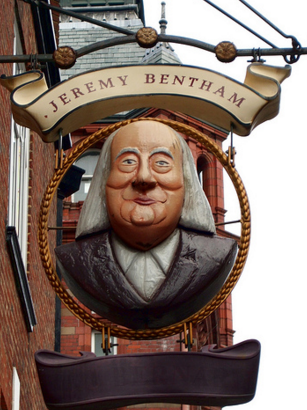
Jeremy Bentham is probably regarded as the most eminent of Utilitarians. Sean O’Casey, whose “JUNO AND THE PAYCOCK” is choc- full of useless Irishmen, has a useless Englishman named named Bentham.
In Ireland, Bentham’s most celebrated disciple was Daniel O’Connell who would have been happy for the Irish language to die. The pedlars of Tripe and Treason put O’Connell on a pedestal.
The declared object of Utilitarianism is “the Greatest Happiness of the Greatest Number.” Despite his heroic efforts, O’Connell’s greatest monument was the Great Starvation and the scattering of millions of Irish in destitution all over the world. Surely the Greatest Unhappiness of the Greatest Number of Irish people in their long suffering history.
He lived in London’s Pentonville and seems never to have met an Indian or Chinese person in his life. Where such information?