
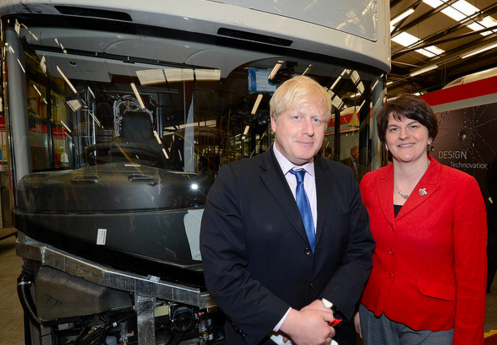
First Minister in waiting, Arlene Foster, has ruled out attendance at events to commemorate the 100th Anniversary of the Easter Rising. As a Unionist, Mrs Foster is entitled to choose whether she attends these commemorative events or not. But, in her future role as First Minster, representing all backgrounds, histories, traditions and cultures within Northern Ireland, this was a golden opportunity for Mrs Foster to show progressive leadership. This was a perfect occasion to make a break from her predecessors, embrace a new era of promoting an inclusive and shared future, engage in an act of commemoration, signalling political maturity and respect for those outside Unionism – commemorating whilst not celebrating – showing respect, reaching out. In 2012 the Assembly urged Sinn Fein Culture Minister Caral Ni Chuilin and then Industry Minister, Arlene Foster to work together to ensure the centenary commemorations were as “inclusive as possible.” Peter Robinson at the time talked about having “an understanding and respect for people’s background and traditions.” Sounds good. But Instead, Mrs Foster has reverted to where political Unionism knows best, to cut themselves off from gestures outside their comfort zones, to fail to reach out, to fail to engage with narratives anathema to their own. What has Mrs Foster to fear? A backlash in the party? Loss of Voters? 2016 Assembly Elections?
In contrast, to name but a few, Martin McGuinness, Nationalist Lord Mayors and even Queen Elizabeth have openly stepped outside their comfort zones:
- Martin McGuinness as DFM met the Prince of Wales, Prince Charles, head of the Parachute regiment, who were responsible for the murders of 11 innocent people in Ballymurphy and 14 innocent civilians on Bloody Sunday;
- He also met and shook hands with the Queen on numerous occasions in acts of reconciliation;
- Nationalist Lord Mayors have attended Remembrance Services to commemorate those who died in World War One and World War Two – wars that many Nationalists felt and feel no connection with;
- In 2012, Nationalists attended an event in Belfast City Hall to commemorate the signing of the Ulster Covenant, the same document that threatened violence and would sit uncomfortably within Nationalism;
- In 2011 the Queen attended the Garden of Remembrance in Dublin and bowed before those who were executed during the Easter Rising, those who fought for the freedom of Ireland and subsequently laid a wreath. This was a very progressive and welcoming gesture.
I have no doubt, the above gestures were uncomfortable and difficult. It must be understood that commemoration is not the same as celebration. It is possible to attend commemorations without necessarily feeling any allegiance towards the events or protagonists or sympathy to their objectives or raison d’etre. In a multi cultural society emerging from decades of division, it takes these acts and gestures to drive forward our society. They instil a progressive mindset, something our society is missing. Continuing to see the past as divided, as “us” and “them”, only Foster’s the same mentality for the future.
The Easter Rising, as has been so often argued, was a defining moment in Irish history. It is important to debate and reflect the legacy of the Easter Rising and the voice of political unionism is integral to this. To simply lambast the event, in line with Jim Allister’s “grubby little rebellion” mindset is a failure on behalf of Unionism. A failure to move forward.
Mrs Foster’s justification for not attending is based on the assertion she “would not be going to commemorate a violent attack on the United Kingdom.” She has further stated the Rising “was an attack on democracy.” Mrs Foster’s comments are so rich with irony and hypocrisy, they fail to take into account that during the third Home Rule crisis, Unionists with their Conservative allies, threatened to subvert legislation introduced by the UK Government and the stability of that UK, threatening Civil War. The undemocratic nature of Ulster Unionist resistance, failing to recognise or accept the majority of the wishes of the people of Ireland undermined constitutionalism and the rule of law. A few points I would like to make here:
- The biggest threat to the United Kingdom during the period 1912-14 came from Unionism and their allies in the Conservative Party. This was before the Easter Rising took place.
- The violent rhetoric and “verbal menace” of Edward Carson and Conservative leader, Andrew Bonar Law, led to the rise of radical nationalism – the “rekindling the Fenian flame” in turn provided the circumstances and atmosphere for the Easter Rising to take place;
- The often inflammatory and contemptuous extra parliamentary speeches of Carson and Bonar Law aimed at the UK Government, often using the word “force”, the text of the Ulster Covenant stating Unionists would oppose Home Rule “by all means necessary”, the Blenheim Demonstration where Bonar Law pre-empted the use of violence against the UK Government created a revolutionary and rancorous atmosphere of the time, against the same UK Mrs Foster alludes too;
- Threats by Carson and other leading Unionists to set up an undemocratic Provisional Government to govern the province of Ulster further undermined the UK and the principle of democracy;
- Carson’s increasing militant rhetoric culminated in the formation of the UVF in 1913, embracing physical force as a political strategy aimed at destabilising the UK Government and threatening them into a “rule by force” mentality;;
- Carson, bringing the gun back into Irish politics, triggered a chain of events that, a few years earlier, could not have been foreseen – resulting in this violent attack against the UK that Mrs Foster alludes too. Would the Easter Rising have taken place if Carson did not bring the gun back into Irish politics?
- The open display of militarism through drilling, parading and marching had a direct impact across Irish Society and on the UK Government; It created a militarised mindset in society thus undermining law and order, the very foundation of the UK;
- The formation of the UVF as the threat to Home Rule and the UK Government resulted in the formation of the Irish Volunteers in November 1913, who were to provide a front for the reviving Irish Republican Brotherhood who heavily infiltrated same. Historians have argued that Carson provided the IRB with the opportunity they had so long waited. So Carson, therefore, is responsible for creating the conditions for this violent attack on the UK;
- The events of the Curragh Mutiny aided and abetted by the British Army’s refusal to act against Ulster Unionism, if instructed, served to leave the UK Government in a very delicate position and in essence made them look powerless in the face of increasingly Ulster Unionist militant rhetoric;
- The illegal landing of 25,000 rifles and millions of rounds of ammunition was a threat to the UK. Why did Unionism need all the weapons and ammunition? Were they to be used against the UK Government?
- As Unionism increased their resistance during this period, radical and revolutionary Nationalism became a reaction to the militancy of Ulster Unionism thus creating the conditions for the Easter Rising.
It would be fair to say that “Unionism gave the kiss of life to Irish revolutionaries”, Carson triggered events that would have appalled him and created the conditions for the Easter Rising to take place. Maybe Mrs Foster should realise that this “violent attack” she alludes to is not in isolation, it was precipitated by Unionism at the time – Unionism must bear the responsibility for their part in creating the atmosphere for what lay ahead. The extra-constitutional and undemocratic tactics of Unionism was responsible for destabilising the UK before the Easter Rising – would Mrs Foster accept this? In a new era of political leadership within Unionism and Northern Ireland, Arlene saying “No”, takes us backwards. Yesterday, Mrs Foster stated, “People do want to see real change.” Yes, people do, but is political Unionism under Arlene Foster capable of real change? This isn’t a good start – nothing to see here, Unionism, carrying on as normal!
did you really expect any change
are they capable of change.
no.
If Arlene Foster had chosen to involve herself, it would have been a progressive gesture in the context of reconciliation and all that, sure, but she won’t be on account of her cultural sensitivities, which I think is fair enough.
Many who will be criticising Arlene Foster will have defended James McClean opting out observing ‘God Save the Queen’ or his eschewing the wearing of a poppy. Indeed, I defended him myself, but it’s important to be consistent and apply the same standards to others as we would apply to ourselves.
Arlene Foster is entitled to her sensitivities and hang-ups, even if we might think of them as irrational or rooted in misunderstanding and even if others have been able to step outside their separate comfort zones. Fundamentally, I don’t think people should be obliged or pressured against their will into doing thing that will cause them discomfort. It certainly doesn’t move an already-delicate situation forward in any way.
Crucially, she’s not stopping anyone else from commemorating or celebrating 1916 if they wish. I’m not sure why some of us are in such desperate need of a thumbs-up from Arlene Foster. If she was suppressing the right of others to commemorate or celebrate, then I think it would be justified to take issue, but, as it is, nationalists and republicans can get on with doing what they want and need to.
Daniel, thank you for your comment. I can see where you are coming from to an extent, but the difficulty I see is, although Arlene has her own political allegiance, she has chosen to accept the position of First Minister – her duty as First Minister is to represent all the people in Northern Ireland regardless of religion, creed, history, belief, culture, identity et al. She’s supposedly an ambassador for this place, a representative of green and orange, someone with a vision, someone with the interests of all at heart. Her refusal to engage with commemoration illustrates her inability to represent a section of the community who find common ground with the ideals and principles of 1916.
If all politicians and leaders within society remained loyal to their own cultural and even political sensitivities, we probably would still be entangled in conflict – reverting to and staying in the past, most certainly does not shape or identify positively with our future. We need positive leadership within Unionism – how many reconciliatory gestures have Unionists made toward Nationalists? Or, is it a one way process?
I believe this would have been a very progressive step. I cite a number of examples above – I’m pretty sure the gestures weren’t easy, I’m assuming there was some discomfort – but why make these gestures? It’s progressive, it’s forward thinking, they are fundamental to our shared heritage and History,
Moving his place forward. Stepping outside of comfort zones is the sign of a bold,
Imaginative leader who wishes to move forward …
Personally, I couldn’t care less if she showed up or not – unionists are like spoilt brats and do what they want anyway.
Thinking beyond my personal position however, going forward, unionists are going to need catholic / nationalist support for the union and lets hope this gesture of snubbery is remembered for what it was.
If that is the new northern Ireland she wants, it still smacks of sectarian shithole to me.
Change is needed all right.