
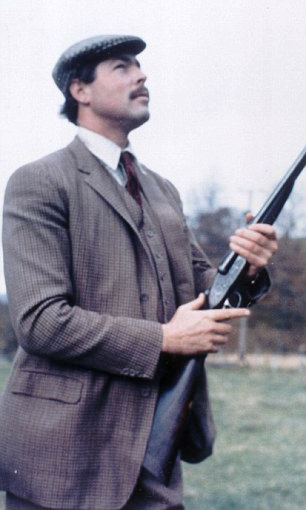
The resuscitation of the Lucan story this week, when the High Court in London granted a death certificate to the family, may perhaps give some pause for thought to the vocal minority around Dublin who question any celebration of the Easter Rising in its centenary year. Honouring men and women of violence is unthinkable to them. And yet, these same people are perfectly ambivalent towards the history of an English aristocracy whose actions caused iniquitous misery for the lives of thousands of Irish people, particularly in the West and in Castlebar, currently represented in the Dáil by the Taoiseach, Enda Kenny. Fundamental to their argument, is the premise that the leaders of the Uprising had no mandate for their actions; Fintan O’Toole recently described them as ‘a minority of a minority’. In the same piece, O’Toole claims that Unionists saw the Rebellion as ‘a stab in the back’; that is a pretty surprising deduction, given that Carson with the support of Randolph Churchill, was busy raising an armed Protestant militia, the Ulster Volunteer Force, to resist Home Rule. This questionable democratic action escapes Fintan’s attention.
Violence in Ireland long preceded the Easter Rising which in the context of rebellions was short lived and in reality little more than a skirmish; the indiscriminate actions of General Sir John Maxwell caused more casualties and physical damage to the City than that of the ‘rebels’. The Lucan dynasty and their cohorts wrought devastating hardship on Irish people for hundreds of years and especially during the Great Famine. Mayo was especially bad; starving and dying people roamed the streets of Castlebar. The Earl of Lucan saw the famine as an obvious indicator for clearing the land of peasants which he set about with vigour. Violent evictions were wholesale; to allow people to remain on unproductive land, he regarded as criminal sentimentality. In Parliament, Lucan argued with satanic semantics that these were processes for recovery of rent and not evictions. Cromwell wrought havoc among the poor in the mid seventeenth century with his confiscation of estates. Violence has many forms but it is always the poor who suffer most. For more than 250 years, the island of Ireland was treated as any other colony; a landed elite oversaw the maximum extraction of resources, often violently enforced, with the minimum of regard for the people actually inhabiting the territory.
Irish land reforms did not significantly improve the lot of many tenant farmers; they simply created a class of peasant farmers who were allowed to compete in a free market which frequently operated in adverse ways to their needs. The planted aristocracy continued to draw rents; many home-owners, whose houses are on land once owned by the recently declared dead Lucan, still pay significant sums to his estate; indeed, the current Taoiseach had to ‘buy out’ for a considerable amount the freehold on his office premises in Castlebar. Successive Irish governments have failed to tackle the issue of smallholders paying ground rent to absentee, English landlords. The violence of poverty and injustice causes profound suffering which is every bit as painful as that briefly experienced in violent confrontation.
Dáil elections are underway; it’s time for a change in whose interests the country is managed and by whom.
Couldn’t agree more John, the whole edifice needs root and branch reform. I was astonished to read an article not so long ago that fishing rights in some rivers and lakes in the 26 counties are still controlled from England!
Any type of ground rent to the British aristocracy or former aristocracy should cease forthwith!
Jude
I know you have no love for Fintan O’Toole, but his description seems factually accurate to me.
A minority of a minority is what they were is it not? And as he points out the logic of the rising can be claimed by any some group of violently inclined men, dissidents here, IS elsewhere, and so on.
If you believe in your cause that gives you the right to kill, is the logic.
Additionally the Unionists did indeed raise a militia but at the time of the outbreak of the war many enlisted. Home Rule was superseded by the larger threat, and they would have been all to aware of the idea of ‘England’s difficulty, Ireland’s opportunity’
That is the context for the description of the rising as a stab in the back, “during Britains hour of need” the phrase you omit.
Why are you directing your comment to me, gio? The sole author of the piece is John Patton – I should have thought that was fairly clear…
Don’t mean to be “splitting hairs” with you Gio but I believe you have been quite deliberately selective in your examples cited in your comment “the logic of the rising can be claimed by any some group of violently inclined men, dissidents here, IS elsewhere, and so on.
If you believe in your cause that gives you the right to kill, is the logic”.
We both know your choices were the type of violently inclined men (and women) which would certainly seem to be unacceptable in the pro-British establishment circles, unlike those other violently inclined men and women like George Washington, William Wallace, WW2 French Resistance and other partisan groups across Europe such as ZOB and ZZW whom the establishment have no difficulty in having an affinity.
Pointis
You are right.I chose those examples as they are generally accepted by most of society (or western society at least)as being wrong in their actions. Other groups such as the ones you mention may be open to debate, but that is not relevant to the point I was making.
If we allow that any group can take up arms if they believe strongly enough,even if they are a minority of a minority then we can hardly complain about them taking that option.
Maybe we can agree at least that O’Toole was factually accurate in saying those behind the rising were a minority of a minority?
A bit tetchy today Jude? Keep your hair on!
An innocent mistake on my part,one made frequently by commenters here, though usually not corrected so sternly!
You know I could never be stern with a charming chap like yourself, gio…Mind you, I’m still mulling over that ‘keep your hair on’ remark…